
Topical finasteride: what it is and how it works
Topical finasteride is a scalp-applied hair loss treatment that lowers DHT locally. Learn how it is used, the risks, and how to access it.
Key facts
- Finasteride + Minoxidil Scalp Solution is $53.50/month (billed $107 every 50 days), charged only after a clinician approves it.
- Answer a few health questions online. A licensed clinician reviews them. If approved, it ships to your door.
- Adults 18 or older. A licensed clinician reviews your health history and decides whether treatment is appropriate for you. Availability depends on the state you live in.
- A $20 clinician review, refunded if you don’t qualify.


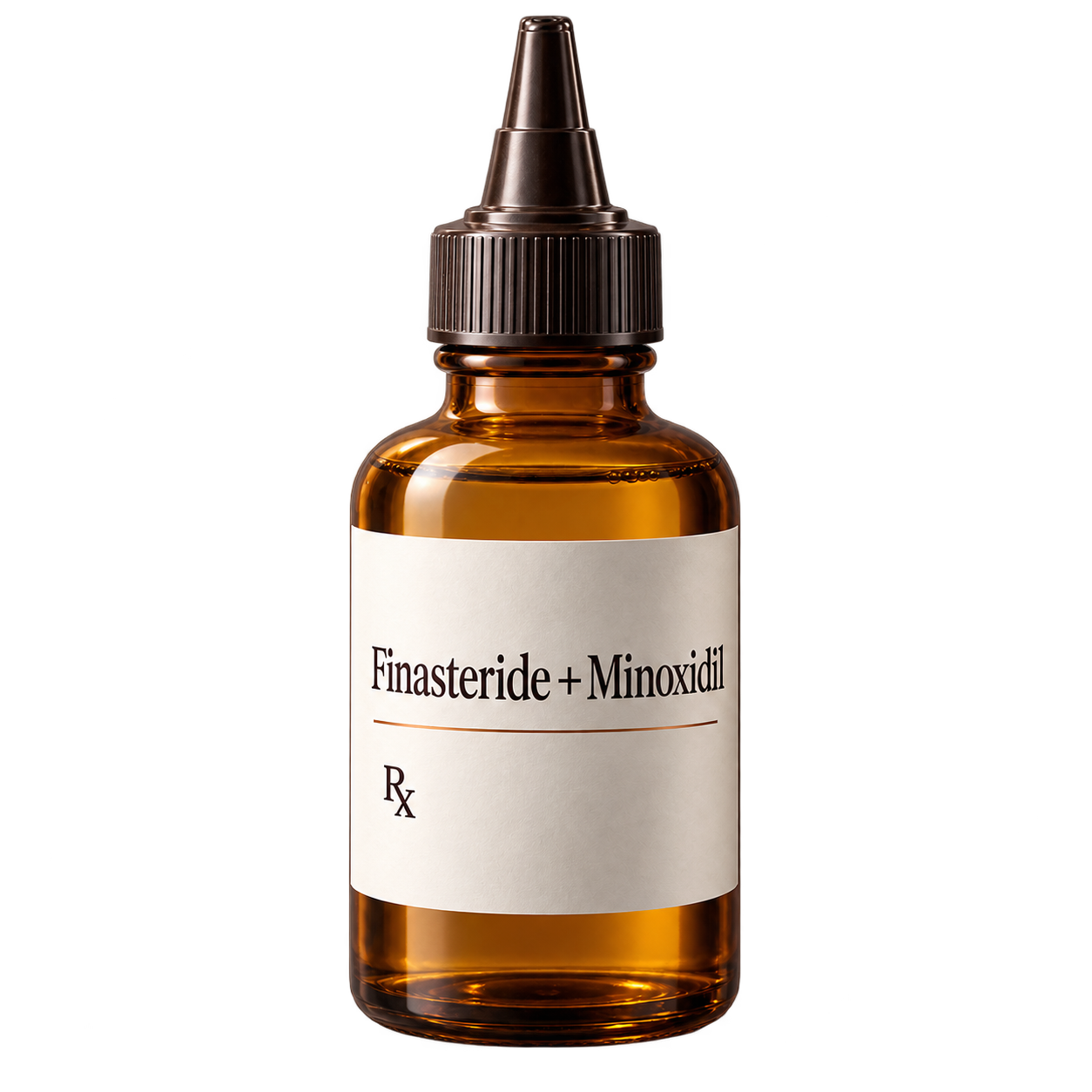
Topical finasteride refers to finasteride applied to the scalp, usually as a solution or foam, to treat pattern hair loss (androgenetic alopecia). It is often used when you want a DHT-lowering approach but prefer a topical route rather than a pill. This page explains what topical finasteride is, what the evidence suggests, and the key safety issues to know before you pursue care.
- Topical finasteride is a scalp-applied treatment aimed at androgenetic hair loss by reducing DHT in the scalp.
- Many topical products are compounded, meaning they are not FDA-approved and are made for an individual prescription.
- Some formulas combine finasteride with topical minoxidil to target hormones and hair growth pathways.
- Finasteride can cause sexual side effects and is unsafe in pregnancy due to fetal risk.
- Cost varies by formulation, pharmacy, and whether a clinician visit and labs are included.
What topical finasteride is
A DHT-lowering medication
Finasteride is a 5-alpha reductase inhibitor, meaning it blocks conversion of testosterone to dihydrotestosterone (DHT). DHT is a key driver of androgenetic alopecia in many people. Oral finasteride is FDA-approved for male pattern hair loss, but topical use is not FDA-approved.
Usually a compounded product
In the US, many topical finasteride products are compounded by a pharmacy for an individual prescription. Compounded medications are not FDA-approved, and their exact concentration and vehicle can vary by prescriber and pharmacy.
Often combined with minoxidil
Some topical formulas include minoxidil along with finasteride. Minoxidil is FDA-approved as a topical treatment for hair loss, and it works through a different pathway than finasteride. Combination products are typically compounded.
Applied to the scalp
Topical finasteride is intended for application to areas of thinning on the scalp. Because it is applied to skin, local irritation can occur, and some systemic absorption is still possible.
How topical finasteride works for hair loss
Targets scalp DHT
Finasteride inhibits type II 5-alpha reductase, lowering DHT. When used topically, the goal is to reduce DHT in scalp tissue where hair follicles are sensitive to it. Studies of topical finasteride suggest it can reduce scalp DHT and may also reduce serum DHT to some degree.
Helps slow miniaturization
In androgenetic alopecia, DHT contributes to follicle miniaturization, where hairs become progressively thinner and shorter. Lowering DHT can help slow this process, which may help preserve hair density over time.
Minoxidil supports growth phase
If your formula includes minoxidil, it can help promote hair growth by prolonging the anagen (growth) phase and increasing follicle size. Using finasteride and minoxidil together is intended to address both hormonal and growth-cycle factors.
Absorption varies by vehicle
How much finasteride reaches the follicle and how much reaches the bloodstream depends on the vehicle (solution, foam), concentration, scalp condition, and application area. This is one reason topical products are not interchangeable without clinician guidance.
- FDA-approved for hair loss
- Oral finasteride is FDA-approved for male pattern hair loss; topical finasteride is not FDA-approved for this use.
- Mechanism
- 5-alpha reductase inhibition lowers DHT, a driver of androgenetic alopecia.
Who topical finasteride may be for
Pattern hair loss
Topical finasteride is generally considered for androgenetic alopecia, which typically causes gradual thinning at the crown or hairline. A clinician can help confirm the pattern and rule out other causes such as thyroid disease, iron deficiency, or inflammatory scalp conditions.
People avoiding a daily pill
Some people prefer a topical route due to convenience, personal preference, or concerns about systemic exposure. Topical use can still lead to some absorption, so it is not risk-free.
Combination approach seekers
If you want one topical product that includes both finasteride and minoxidil, a compounded combination may be an option. Your clinician can help decide whether a combination makes sense based on your history and scalp tolerance.
Those with early to moderate thinning
Treatments that slow follicle miniaturization tend to work best when follicles are still active. A clinician can help set realistic expectations based on how long thinning has been present.
People who can follow precautions
Because finasteride can cause fetal harm, topical products require careful handling and avoidance of exposure during pregnancy. This is especially important if a partner is pregnant or could become pregnant.
Who should not use topical finasteride
Pregnant or trying to conceive
Finasteride is contraindicated in pregnancy because it can cause abnormalities of the external genitalia in a male fetus. People who are pregnant should not use finasteride, and they should avoid handling crushed or broken finasteride tablets. With topical products, discuss exposure risk and handling precautions with your clinician.
Hypersensitivity to ingredients
Do not use finasteride if you have had an allergic reaction to finasteride or to components of the formulation. Compounded topicals may include solvents or fragrances that can also trigger irritation or allergy.
Unexplained sudden hair loss
If hair loss is sudden, patchy, painful, associated with scalp scaling, or accompanied by systemic symptoms, you need an evaluation before starting a hair loss medication. Conditions like alopecia areata, tinea capitis, or scarring alopecias require different treatment.
High-risk medication situations
If you take medications that affect hormones or have complex medical conditions, a clinician should review your full history before you use finasteride. This helps reduce the risk of interactions, misdiagnosis, or delayed care for a different cause of hair loss.
What to expect with topical finasteride
Gradual change, not overnight
Hair growth cycles are slow, so any benefit from finasteride-based therapy is typically gradual. Your clinician may recommend tracking changes with consistent photos and checking in at set intervals rather than judging day to day shedding.
Possible early shedding
Some people notice increased shedding early in treatment with hair loss therapies, including minoxidil. This can be distressing but may reflect hairs cycling; it is not always a sign the treatment is failing. Tell your clinician if shedding is heavy or persists.
Scalp tolerance matters
Topical solutions can cause dryness, itching, redness, or flaking depending on the vehicle. If irritation occurs, your clinician may adjust the formulation or recommend supportive scalp care.
Ongoing use is usually needed
Finasteride works by suppressing DHT, so benefits generally depend on continued use. If treatment is stopped, DHT levels return toward baseline and hair loss may progress again over time.
Follow-up is part of safety
Because finasteride can cause sexual side effects and mood changes in some people, follow-up matters. A clinician can help you weigh benefits and risks and decide whether the plan should be adjusted.
Topical finasteride side effects and warnings
Scalp irritation
Redness, itching, burning, dryness, or flaking can occur with topical products, especially if the vehicle contains alcohol or propylene glycol. If irritation is persistent, a clinician may suggest a different vehicle or supportive scalp care. Seek care promptly for severe rash or swelling.
Unwanted facial or body hair
If your topical product contains minoxidil, hair growth can occur in areas where the medication spreads beyond the scalp. Careful application and hand washing after use can help reduce this risk. Discuss any bothersome hair growth with your clinician.
Sexual side effects
Finasteride can cause decreased libido, erectile dysfunction, and decreased ejaculate volume. These effects are described in FDA labeling for oral finasteride; topical use may still carry risk because systemic absorption can occur. Tell a clinician promptly if you notice sexual side effects.
Mood changes
Depression and, rarely, suicidal thoughts have been reported with finasteride use in postmarketing reports. If you notice new or worsening depression, anxiety, or thoughts of self-harm, seek immediate help and contact a clinician.
Breast changes
Breast tenderness, enlargement, lumps, pain, or nipple discharge have been reported with finasteride. Report these symptoms promptly so a clinician can evaluate for other causes, including rare breast cancer in men.
Pregnancy exposure risk
Finasteride can cause fetal harm. People who are pregnant should not use finasteride, and they should avoid exposure to finasteride-containing products. If there is a possibility of pregnancy exposure in your household, discuss handling and contact precautions with a clinician.
Cost and access for topical finasteride
What drives cost
Cost depends on whether your topical finasteride is compounded, the concentration and vehicle, whether it includes minoxidil or other ingredients, and the dispensing pharmacy. Clinician visits, follow-ups, and shipping can also affect total cost.
Insurance coverage varies
Hair loss treatments are often considered elective, so insurance coverage can be limited. Compounded medications are less likely to be covered than FDA-approved products. If you use an HSA or FSA, eligibility depends on your plan rules.
Why access can differ by state
Telehealth prescribing rules and pharmacy dispensing rules vary by state. Availability of a specific compounded formulation can also depend on pharmacy policies and clinician judgment.
Where to see current prices
If a price block appears on this page, it shows current catalog pricing for the topical finasteride and minoxidil plan linked here. Prices can change, and a clinician still needs to determine whether the treatment is appropriate for you.
How to get topical finasteride safely
- 1
Start with a hair loss assessment
Share your pattern of thinning, timeline, photos if available, and any scalp symptoms with a clinician.
- 2
Review health history and risks
A licensed clinician reviews your history, medications, pregnancy risk, and side effect concerns to decide if topical finasteride fits.
- 3
Consider labs when appropriate
If the cause is unclear or you have risk factors, a clinician may request labs to check for contributors to hair shedding.
- 4
Fill through a licensed pharmacy
If prescribed, the medication is dispensed by a pharmacy with instructions specific to your formulation and follow-up plan.
Frequently Asked Questions
Is topical finasteride FDA-approved for hair loss?
No. In the US, finasteride tablets are FDA-approved for male pattern hair loss, but topical finasteride products are not FDA-approved. Many topical versions are compounded, which also means they are not FDA-approved.
Does topical finasteride have the same sexual side effects as oral finasteride?
Finasteride can cause sexual side effects such as decreased libido and erectile dysfunction in FDA labeling for oral finasteride. Topical use may still carry risk because some systemic absorption can occur. If you notice symptoms, discuss them promptly with a clinician.
Can women use topical finasteride?
Finasteride is contraindicated in pregnancy due to fetal risk, so it is not appropriate for anyone who is pregnant or could become pregnant without strict precautions. For others, a clinician needs to weigh potential benefit, safety, and alternatives. Do not self-treat without medical guidance.
How long does topical finasteride take to work?
Hair growth changes are usually gradual because hair cycles take time. Your clinician may suggest evaluating progress over months rather than weeks and using consistent photos. If you are using a minoxidil combination, early shedding can happen and should be discussed if severe.
How much does topical finasteride cost?
Cost depends on whether the product is compounded, the formulation and pharmacy, and whether clinician visits or labs are included. If a price block appears on this page, it shows current catalog prices for the linked plan. A clinician still decides whether treatment is appropriate.