
Compounded semaglutide dosage chart: what to know
A compounded semaglutide dosage chart depends on your prescription. Here is the FDA labeled semaglutide titration schedule for reference.
Key facts
- Semaglutide + B12 is $157/month (billed $157 every 4 weeks), charged only after a clinician approves it.
- Answer a few health questions online. A licensed clinician reviews them. If approved, it ships to your door.
- Adults 18 or older. A licensed clinician reviews your health history and decides whether treatment is appropriate for you. Availability depends on the state you live in.


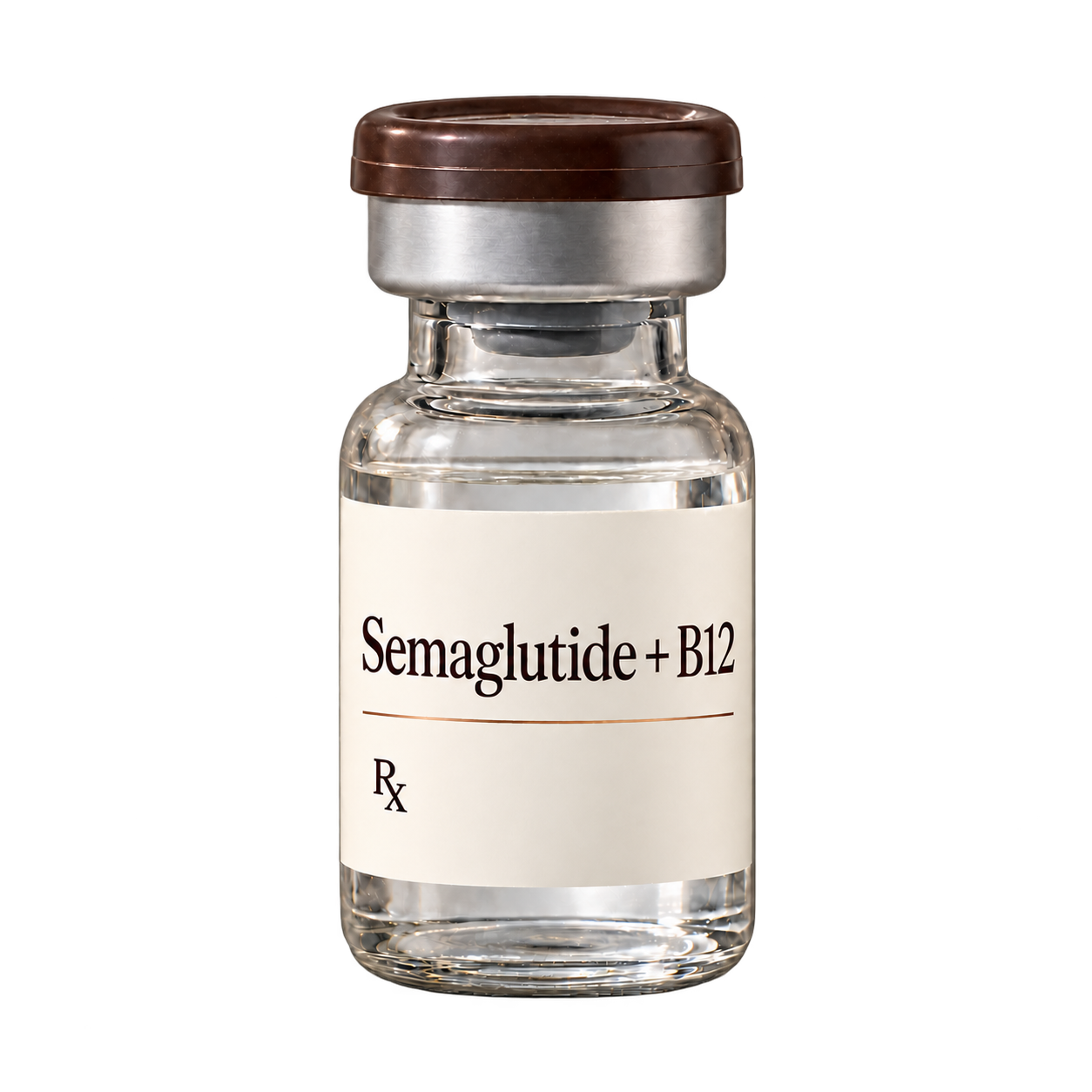
If you searched for a compounded semaglutide dosage chart, you are usually trying to confirm what dose comes next and when. The safest way to think about it is this: compounded products vary, so your dosing schedule must match your specific prescription and clinician plan. Below, Vitals Vault summarizes the FDA labeled semaglutide titration schedules for reference only and explains why you cannot directly convert that label into a compounded vial or pen dose without clinician guidance.
- A compounded semaglutide dosage chart is prescription specific, but the FDA label shows a standard titration schedule.
- For weight management, labeled semaglutide is increased every 4 weeks to a maintenance dose, if tolerated.
- Compounded semaglutide is not FDA-approved and may come in different concentrations and devices.
- If you have severe belly pain, dehydration, or allergic symptoms, seek urgent medical care.
Answer: what a dosage chart can and cannot show
What a chart can show
Semaglutide is typically started at a low dose and increased in steps (titration) to improve tolerability. The FDA label for Wegovy and Ozempic provides specific week-by-week schedules. Those schedules are useful for education and for checking whether a change is happening too fast.
Why compounded is different
Compounded semaglutide is prepared by a licensed pharmacy for an individual prescription and is not FDA-approved. It may be dispensed in different concentrations, containers, and dosing devices than the brand products. Because of that, a chart that lists only milligrams does not tell you how to measure your dose from your specific compounded product.
What to use instead
Use the dosing instructions on your prescription label and the plan your prescribing clinician gave you. If anything on the pharmacy label does not match what you were told, pause and contact the prescribing clinician or dispensing pharmacy to confirm the intended dose and schedule.
Labeled semaglutide dosing tables (for reference)
| Time on treatment | Labeled dose (mg once weekly) |
|---|---|
| Weeks 1 to 4 | 0.25 mg |
| Weeks 5 to 8 | 0.5 mg |
| Weeks 9 to 12 | 1 mg |
| Weeks 13 to 16 | 1.7 mg |
| Week 17 and onward (maintenance) | 2.4 mg (or 1.7 mg if not tolerated) |
| Time on treatment | Labeled dose (mg once weekly) |
|---|---|
| Weeks 1 to 4 | 0.25 mg (for initiation, not effective for glycemic control) |
| Week 5 and onward | 0.5 mg |
| If additional glycemic control needed after at least 4 weeks on 0.5 mg | 1 mg |
| If additional glycemic control needed after at least 4 weeks on 1 mg | 2 mg |
Missed dose (Wegovy)
The Wegovy label gives specific instructions based on how many days have passed since the missed dose and how close you are to the next scheduled dose. Follow your prescriber instructions and the product labeling for the specific semaglutide product you use.
Missed dose (Ozempic)
The Ozempic label instructs that if a dose is missed, it should be administered as soon as possible within a specified window, and otherwise skipped until the next scheduled dose. Follow your prescriber instructions and the labeling for the specific product you use.
Why you should not convert to “units”
Insulin syringes and some compounded dosing devices use “units,” but semaglutide labels dose in milligrams. Converting mg to units depends on the concentration of the liquid you were dispensed, which can differ across compounded prescriptions. Ask your clinician or dispensing pharmacy to confirm the exact measurement for your prescription.
Injection sites and technique
For FDA approved semaglutide pens, the Instructions for Use describe where to inject and how to use the pen, and a clinician or pharmacist should show you how. For compounded semaglutide, your prescribing clinician and dispensing pharmacy provide the injection instructions specific to your product.
When to talk to a clinician urgently
Severe stomach pain
Seek urgent medical care for severe abdominal pain that may radiate to your back, with or without vomiting. This can be a sign of pancreatitis, which is a serious warning for semaglutide products.
Gallbladder symptoms
Contact a clinician promptly for right upper belly pain, fever, yellowing of the skin or eyes, or clay-colored stools. Semaglutide products carry warnings for acute gallbladder disease.
Dehydration or kidney concerns
If vomiting or diarrhea is persistent, you cannot keep fluids down, or you have signs of dehydration, seek care. The label warns about acute kidney injury, sometimes in the setting of severe gastrointestinal reactions.
Allergic reaction
Get emergency help for swelling of the face, lips, tongue, or throat, trouble breathing, or severe rash. Serious hypersensitivity reactions are listed in semaglutide labeling.
Low blood sugar risk
If you use insulin or a sulfonylurea, ask your clinician about hypoglycemia risk and monitoring. Semaglutide labeling notes increased hypoglycemia risk when used with insulin secretagogues or insulin.
Practical tips to avoid dosing mix-ups
Match the label to your plan
Compare your pharmacy label to your clinician plan each refill. Ask if anything differs.
Track the date and dose
Write down each injection date and the exact dose you were instructed to take.
Confirm concentration each refill
Compounded semaglutide concentration can vary. Confirm the concentration and measuring device every time.
Plan for side effects
If nausea or vomiting is limiting, contact your clinician. Dose changes should be clinician-directed.
Bring your questions to visits
Ask what symptoms should prompt a call, and what monitoring is recommended for you.
Frequently Asked Questions
What is a compounded semaglutide dosage chart?
A compounded semaglutide dosage chart is a schedule that matches your specific prescription, including the concentration and measuring device your pharmacy dispensed. Because compounded products vary, the FDA label schedules for Wegovy or Ozempic cannot be directly used to measure a compounded dose.
Is the compounded semaglutide dosage chart the same as Wegovy?
Not necessarily. Wegovy is an FDA-approved product with a fixed labeled titration schedule, while compounded semaglutide is not FDA-approved and may be dispensed in different concentrations. Your clinician and dispensing pharmacy should confirm the exact schedule and measurement for your prescription.
Can I convert semaglutide mg to units for a compounded vial?
You should not convert mg to units without knowing the exact concentration of the compounded product you received. Units are a volume measure on certain syringes, and the mg per mL can differ across compounded prescriptions. Ask your clinician or dispensing pharmacy to confirm the measurement.
What should I do if I missed a semaglutide dose?
FDA-approved semaglutide products include missed-dose instructions in their prescribing information, and the guidance depends on timing relative to your next scheduled dose. For compounded semaglutide, follow your prescriber instructions and confirm with your clinician if you are unsure what to do next.
When should I seek urgent care while using semaglutide?
Seek urgent care for severe abdominal pain (with or without vomiting), signs of a serious allergic reaction, or inability to keep fluids down. Semaglutide labeling warns about pancreatitis, hypersensitivity reactions, and kidney problems that can occur with severe gastrointestinal symptoms.