
How long does minoxidil take to work?
How long does minoxidil take to work? Most people need at least 4 months of consistent use to see regrowth, with fuller results often taking longer.
Key facts
- Finasteride + Minoxidil Scalp Solution is $53.50/month (billed $107 every 50 days), charged only after a clinician approves it.
- Answer a few health questions online. A licensed clinician reviews them. If approved, it ships to your door.
- Adults 18 or older. A licensed clinician reviews your health history and decides whether treatment is appropriate for you. Availability depends on the state you live in.


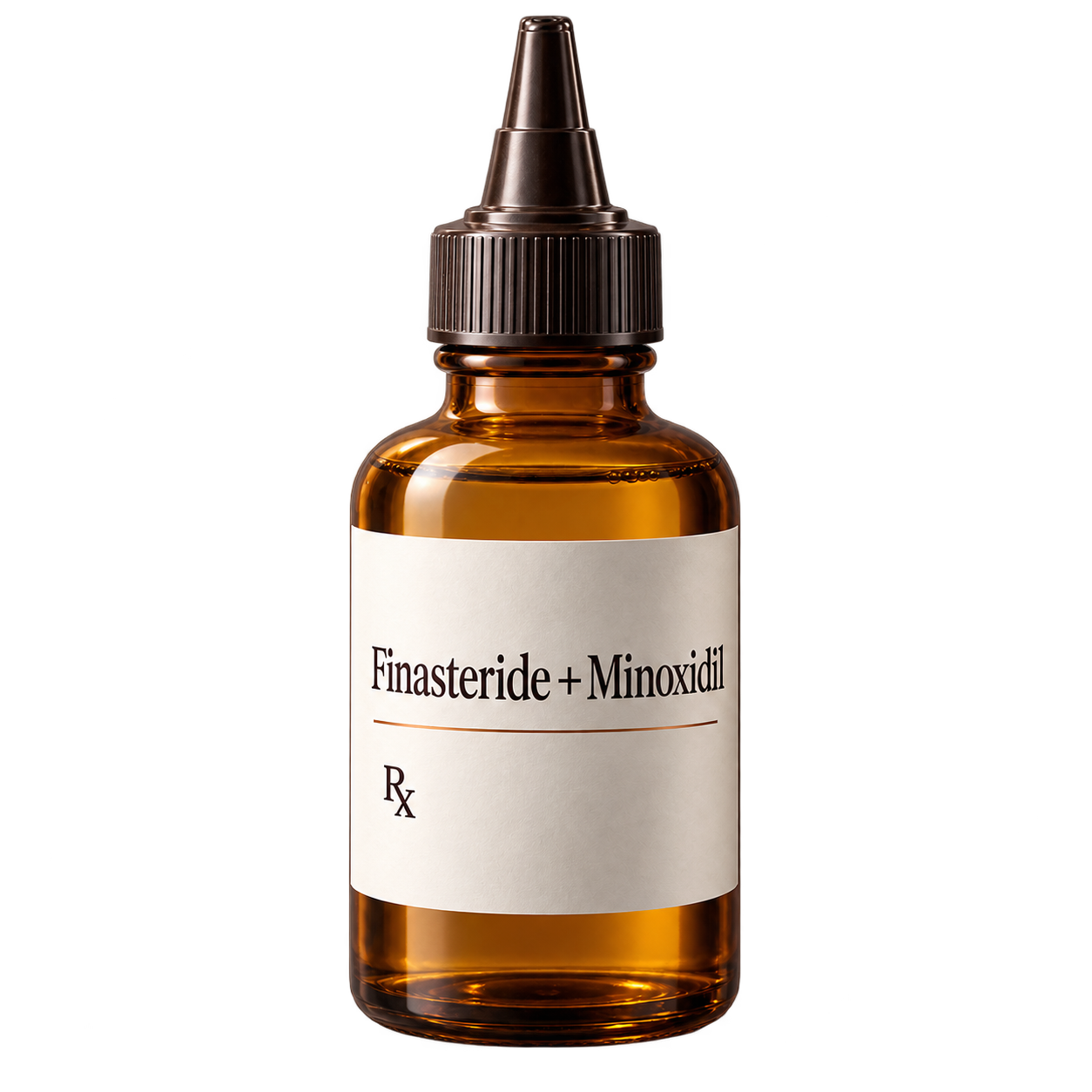
Minoxidil is a hair growth medicine that works slowly because it influences the hair cycle, not overnight hair thickness. For many people, the first meaningful signs of regrowth take months, and the timeline depends on how consistently you use it and what is causing your hair loss. Vitals Vault can help you set realistic expectations and decide what questions to ask a clinician, especially if you are considering combination options like finasteride plus minoxidil.
- Most people need at least 4 months of consistent minoxidil use to see regrowth.
- Early shedding can happen and does not always mean it is failing.
- Results vary by hair loss cause, how long it has been present, and consistency.
- If you stop minoxidil, any benefit typically fades over time.
How long it usually takes
Regrowth: think months
In clinical studies of topical minoxidil for androgenetic alopecia (pattern hair loss), new hair growth is typically assessed over months, not weeks. Product labeling notes that results may be seen as early as 2 months, but for some people it can take at least 4 months. Consistent use is key to fairly judging response.
Early changes can be subtle
Early improvement may look like less shedding, small new hairs, or slightly better coverage in photos rather than a dramatic change. Because hair grows in cycles, it can take time for more hairs to enter and stay in the growth (anagen) phase. Taking periodic photos in the same lighting can help you track change.
Stopping usually reverses gains
Minoxidil does not cure pattern hair loss. Labeling warns that hair regrowth may be lost after stopping use, often within months. If you are thinking about stopping, it is worth discussing alternatives and expectations with a clinician first.
Why minoxidil takes time and what affects your timeline
Hair cycle biology
Hair follicles rotate through growth (anagen), transition (catagen), and rest (telogen). Minoxidil is thought to help shift follicles toward growth and prolong the growth phase, which is why changes are gradual. Even when a follicle responds, visible length and density take time to accumulate.
Temporary shedding can occur
Some people notice increased shedding early on. This can happen when older hairs shed as follicles transition into a new growth cycle. If shedding is severe, patchy, or paired with scalp symptoms, a clinician can help check for other causes.
Cause of hair loss matters
Minoxidil is FDA-approved as an over-the-counter topical treatment for androgenetic alopecia. If your hair loss is from another cause, such as thyroid disease, iron deficiency, medication effects, scarring alopecia, or a sudden shedding condition like telogen effluvium, the timeline and benefit can be very different. Getting the cause right prevents months of frustration.
Consistency and correct use
Labeling emphasizes regular use and warns that using more than directed will not improve results and may increase side effects. Missed days can slow progress because follicles are not getting steady exposure. If you are using a compounded combination product, follow the prescribing clinician and dispensing pharmacy instructions.
Scalp irritation slows adherence
Itching, dryness, or irritation can make it hard to stay consistent. Some people tolerate foam better than solution because some solutions contain propylene glycol, which can irritate the scalp. If irritation persists, a clinician can help you adjust the plan safely rather than quitting abruptly.
Combination therapy changes expectations
For pattern hair loss, clinicians sometimes use minoxidil alongside other treatments that target different mechanisms, such as finasteride. Combination approaches can change what you notice first, but they still require months to judge. A clinician can help you weigh benefits and risks based on your sex, pregnancy potential, and medical history.
| Factor | How it can affect your timeline | What to do next |
|---|---|---|
| Earlier-stage pattern hair loss | More follicles may still be able to thicken and re-enter growth | Start tracking photos and discuss a long-term plan with a clinician |
| Long-standing thinning | Fewer follicles may be salvageable, so change can be slower or smaller | Set realistic goals and ask about additional options |
| Inconsistent use | Delays the point when you can fairly judge response | Build a routine you can maintain for months |
| Wrong diagnosis | Minoxidil may not address the underlying cause | Consider evaluation and labs if shedding is sudden or diffuse |
| Scalp irritation | Can lead to stopping early | Ask about switching formulation or treating irritation |
When to talk to a clinician about your results
No change after 4 months
Over-the-counter topical minoxidil labeling advises stopping and talking with a doctor if you do not see hair regrowth after 4 months. A clinician can confirm the diagnosis, check for treatable contributors, and discuss other options. Bring photos and a timeline of shedding to the visit.
Chest pain or fast heartbeat
Topical minoxidil can be absorbed and, rarely, cause systemic effects. Labeling advises stopping use and getting medical help for chest pain, rapid heartbeat, faintness, dizziness, or sudden unexplained weight gain. These symptoms need prompt evaluation.
Swelling of hands or feet
Labeling lists swelling of the hands or feet as a reason to stop use and see a doctor. Fluid retention can be a sign of a systemic effect. Do not try to manage this on your own.
Scalp reaction that persists
If you develop persistent redness, burning, itching, or rash, talk with a clinician. Irritant or allergic contact dermatitis can mimic worsening hair loss if it leads to inflammation and scratching. A clinician can help you decide whether to switch formulations or stop.
Pregnancy or breastfeeding questions
If you are pregnant, trying to conceive, or breastfeeding, ask a clinician before using minoxidil. For combination products that include finasteride, pregnancy exposure is a specific safety concern. A clinician can help you choose safer alternatives.
Pro tips to judge progress fairly
Commit to a photo routine
Take photos monthly in the same lighting and hairstyle.
Track shedding, not just density
A simple weekly note can reveal trends you miss day to day.
Treat your scalp gently
Irritation can derail consistency. Ask about foam versus solution if needed.
Ask about root causes
If shedding is sudden or diffuse, consider evaluation for other contributors.
Plan for maintenance
Minoxidil benefits usually require ongoing use to maintain.
Frequently Asked Questions
How long does it take for minoxidil to work?
Labeling for over-the-counter topical minoxidil notes that results may be seen as early as 2 months, but it can take at least 4 months for some people. If you do not see regrowth after 4 months, the label advises stopping use and talking with a doctor.
How long does it take minoxidil to work?
Most people need months of consistent use before they can judge whether minoxidil is helping. Early changes may be subtle, and some people notice temporary shedding as hair cycles shift. If you stop using it, any regrowth may be lost over time.
Is shedding normal when starting minoxidil, and how long does it last?
Some people notice increased shedding early on, which can happen as follicles transition into a new growth cycle. The label does not give a precise duration, and shedding should not be severe or patchy. If shedding is dramatic or you have scalp symptoms, talk with a clinician.
What if I do not see results by 4 months?
Over-the-counter topical minoxidil labeling advises stopping and talking with a doctor if there is no hair regrowth after 4 months. A clinician can confirm whether you have pattern hair loss and check for other contributors like iron or thyroid issues. They can also discuss other treatment options.
If I stop minoxidil, will I lose the hair I gained?
Labeling warns that hair regrowth may be lost after stopping use, often within months. That is because minoxidil helps maintain growth while you use it rather than curing the underlying process. If you want to stop, discuss a transition plan with a clinician.