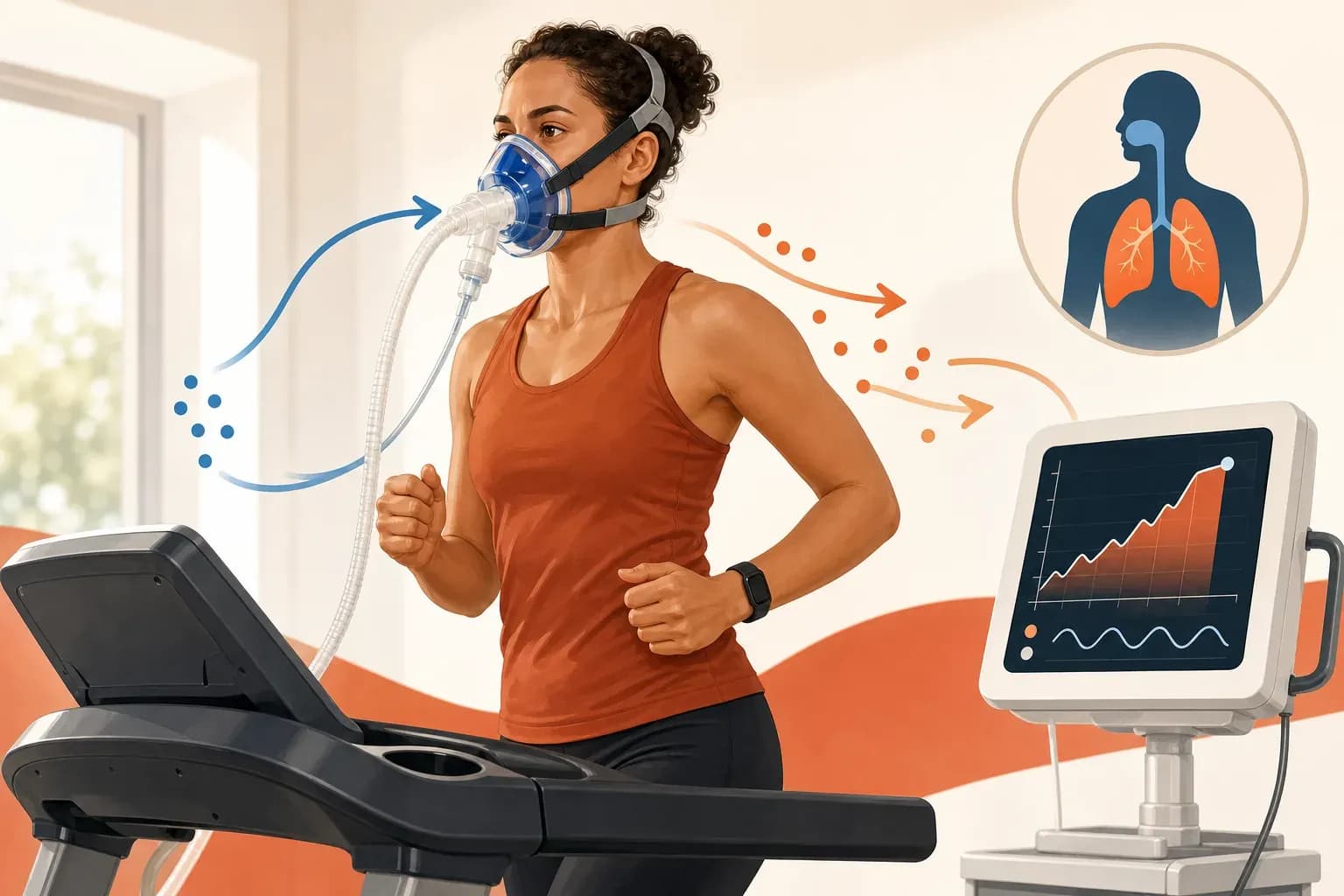
Need a VO2 max test near you? Learn how to locate a testing site, compare protocols and costs, prepare safely, and read your results.
Want to know how much oxygen your body can use at peak effort? A VO2 max test gives you that number and tells you how fit your heart, lungs and muscles really are. Follow these five steps and you’ll be able to book a reliable test close to home.
An analysis of 42 comments and questions from YouTube and Quora about maximal oxygen uptake testing found that 33% mentioned appropriate training intensity.
A VO2 max test can serve different goals. Some people need the data to set training zones for endurance sport. Others use it as a health flag, low scores link to higher heart disease risk. A few clinicians order it to gauge recovery after cardiac surgery.
Write down your primary reason. If you’re an athlete, you’ll likely choose a graded treadmill protocol that pushes you to a plateau. If you’re tracking health, a clinic that also reports ventilatory thresholds and heart‑rate zones adds more value.
Understanding the goal helps you pick the right protocol later. Direct lab measurement with a testing system meets the gold‑standard definition of VO2 max, it records breath‑by‑breath oxygen uptake until you can’t go harder. Sub‑max tests, like the Cooper 12‑minute run, estimate the value but can be off by 5‑15 %.
Key Takeaway: Clarify whether you need a precise clinical measurement or a performance estimate before you start looking for a provider.
Start with a simple Google search for “VO2 max test near me”. Look for facilities that mention VO2 max testing or related exercise testing. Many sports performance labs list the service on their website, but a lot of clinics keep it hidden.
Use a directory that aggregates labs across the U.S. to save time. These sites let you filter by state, city, and whether the lab offers a direct‑access option (no doctor’s order needed).
When you find a candidate, check if they accept self‑pay or insurance, what equipment they use, and whether they provide a written report with ventilatory thresholds. Facilities in Washington state, for example, often spell out their ordering model and weekend availability, which can be a sign of transparency.
Make a short list of three to five sites that meet your basic criteria. Keep the list handy for the next step.
Pro Tip: Bookmark the Metabolic Testing Near Me: 6 U.S. Options guide for related testing options.
Not all VO2 max tests are created equal. Testing sites may use different treadmill protocols, so ask which one they use and whether it suits your fitness level and needs.
Ask each site what validity criteria they follow. A true maximal test should meet at least two of three markers: a plateau in oxygen uptake despite higher workload, a respiratory exchange ratio of ≥ 1.15, or a heart‑rate within ten beats of the age‑predicted max.
Cost varies widely by setting. Fitness‑focused labs and hospital CPETs may have different pricing, and hospital testing may be covered by insurance if ordered for a medical reason. Make sure the price includes the full report and any follow‑up consultation.
Consider oversight, too. Labs that have a board‑certified physician reviewing the data can spot abnormal heart‑rate responses that might need a doctor’s attention. Those that only provide raw numbers may leave you guessing.
Key Takeaway: Choose a site that matches your protocol preference, offers clinician oversight, and shows a transparent price.
Good prep can mean the difference between a true max and an underestimate. Arrive well‑rested, hydrated, and with a light meal 2‑4 hours before the test. Skip caffeine and alcohol the night before, and avoid any intense workout for 24 hours.
Wear comfortable athletic shoes and clothing that won’t restrict movement. The lab will fit you with a snug mask that captures every breath; a proper seal prevents leaks that could skew the reading.
The technician will guide you through a three‑minute warm‑up, then increase the workload each minute. The test continues until you can’t keep up with the workload, which is when you’ve likely hit your max. After you finish, a short cool‑down lets your heart rate settle before the mask comes off.
Some clinics bundle the VO2 max test with a DEXA scan or resting metabolic rate, which can be convenient if you need a broader health picture. Check the Executive Physical Near Me guide for locations that offer such bundles.
Pro Tip: Bring any prior lab results or a list of medications; they help the clinician interpret your VO2 max in context.
Your report will show the absolute VO2 max (L/min) and the relative value (mL·kg⁻¹·min⁻¹). It may also list ventilatory thresholds, heart‑rate zones, and a brief interpretation.
Compare your number to age‑ and sex‑specific reference tables.
If the result is low, consider a structured endurance program that mixes Zone 2 cardio with short, intense intervals. If it’s already high, focus on maintaining consistency and monitoring any drift over time.
VO2 max is one fitness marker. If you also want blood biomarkers such as ApoB, glucose and hs‑CRP in one place, Vitals Vault lets you upload supported lab PDFs and track your results on one timeline. See how Vitals Vault works.
Key Takeaway: Use the report as a baseline, not a verdict. Track changes every 3‑4 months to see if your training is moving the needle.
Most fitness‑focused labs let you book a test without a referral, but clinical CPETs ordered for heart or lung concerns usually require a physician’s note.
The whole visit lasts about 45 minutes: 10‑15 minutes of warm‑up and testing, plus setup, mask calibration, and a short cool‑down.
Insurance may cover a hospital‑based CPET if it’s medically indicated. Fitness labs typically charge out‑of‑pocket fees.
Yes, as long as your condition is stable and you have clearance from a clinician. The lab will monitor your breathing closely.
Re‑testing every 12‑16 weeks gives enough time for training adaptations to show up while keeping the data fresh.
Most labs stop the test at volitional exhaustion. A sub‑max protocol can still provide useful estimates, but the result won’t be a true VO2 max.
Start by clarifying why you need the VO2 max number, then follow the five steps to locate, compare, book, prepare for, and interpret the test. When you want to pair your fitness data with blood biomarkers, Vitals Vault offers lab panels tested at Quest and keeps your results organized for future check‑ins.
Core Essential Wellness Panel
Includes the depth of physician-backed labs plus AI-reviewed storytelling so you can act on your physiology with confidence.
