Why You Can’t Focus in Perimenopause (and What Helps)
Lack of focus in perimenopause often comes from estrogen swings, poor sleep, or thyroid and iron issues. Targeted labs are available—no referral needed.






Lack of focus in perimenopause is usually your brain reacting to hormone swings, sleep disruption, and sometimes a fixable medical issue like low iron or an underactive thyroid. When estrogen and progesterone fluctuate, your attention, working memory, and stress response can feel “glitchy,” especially on days after poor sleep. A few targeted labs can help you tell the difference between hormone-transition brain fog and something you can treat directly. This symptom is frustrating because it can look like “you’re not trying hard enough,” when it is often your nervous system running on a different operating system than it used to. You might notice more task-switching, more rereading, and more time spent trying to get started than actually doing the work. The good news is that there are practical levers you can pull right now, and there are also medical options worth considering if the problem is persistent. If you want help sorting your pattern into a likely cause, PocketMD can walk through your symptoms, and Vitals Vault labs can help confirm (or rule out) common contributors.
Why you can’t focus in perimenopause
Hormone swings scramble attention circuits
In perimenopause, estrogen and progesterone can rise and fall unpredictably, and your brain uses those hormones to tune attention, motivation, and mental speed. When the signal keeps changing, you can feel like you cannot “lock on” to a task even when you care about it. A useful clue is variability: if you have a few sharp days and a few foggy days in the same month, hormone fluctuation is often part of the story.
Sleep gets lighter and more broken
Even if you are in bed for eight hours, perimenopause can reduce deep sleep and increase awakenings, especially if you are getting night sweats or early-morning wake-ups. The next day, your brain has less capacity for working memory, which is the mental scratchpad you use to hold a thought while you act on it. If your focus is worst after 2–3 nights of “almost sleeping,” treating sleep like the main symptom (not an afterthought) usually pays off fast.
Stress hormones stay stuck “on”
When your stress system is revved up, your brain prioritizes scanning for problems over sustained concentration, which can feel like restlessness, irritability, or constant checking. Perimenopause can lower your stress tolerance, so the same workload suddenly feels unmanageable. If you notice a racing mind, jaw tension, or a tight chest along with poor focus, it helps to address the stress response directly rather than forcing more willpower.
Low iron stores drain mental energy
Heavy or irregular bleeding in perimenopause can quietly deplete iron stores, even before you become anemic. Low iron can show up as mental fatigue, poor concentration, and feeling like your brain is moving through mud, especially in the afternoon. If your periods have gotten heavier or closer together, checking ferritin (your iron storage marker) is one of the most practical next steps.
Thyroid slowdown mimics brain fog
An underactive thyroid can make you feel slowed down, forgetful, and mentally foggy, and it can overlap with perimenopause so closely that it gets missed. You might also notice feeling colder than others, constipation, dry skin, or unexplained weight gain, but sometimes the main complaint is focus. A simple TSH test can flag when your thyroid may be contributing, which is worth doing if the fog is persistent rather than cyclical.
What actually helps you focus again
Treat sleep like the first domino
Pick one sleep target for two weeks: a consistent wake time, a cooler bedroom, or reducing alcohol because it fragments sleep later in the night. If you wake at 3–4 a.m., try a low-light routine and avoid checking the clock, since “time math” can train your brain to stay alert. When sleep improves, focus often improves without you changing anything else.
Use a “single-task” work container
Perimenopause brain fog often shows up as task-switching, so your goal is to reduce decisions, not increase effort. Set a 25–40 minute timer, close extra tabs, and write one sentence at the top of your notes that says what “done” looks like for this block. When the timer ends, take a 3–5 minute movement break, because a small physical reset helps your attention reset too.
Stabilize blood sugar for steadier focus
If you feel focused in the morning and foggy after lunch, a blood sugar dip can be part of it, especially when stress and sleep are off. Build lunch around protein and fiber first, and then add carbs, rather than leading with a refined-carb meal that spikes and crashes. A simple experiment is to swap one week of “sandwich and chips” lunches for a protein-forward option and see if your 2–4 p.m. brain improves.
Address iron or B12 if low
If ferritin or vitamin B12 is low, no productivity hack will fully fix the problem until your body has the raw materials it needs. Your clinician can guide dosing and timing, and it is especially important not to self-treat iron long-term without labs because too much iron is also harmful. The payoff can be noticeable: many people report better mental stamina within weeks once deficiencies are corrected.
Consider menopause hormone therapy when appropriate
For some people, menopause hormone therapy (MHT) improves sleep and reduces the “wired but tired” feeling that wrecks concentration, even if it does not feel like a direct focus medication. It is most helpful when your focus problems track with other perimenopause symptoms like hot flashes, night sweats, or new anxiety. If you are curious, ask specifically about whether you are a good candidate based on your age, symptoms, and personal risk factors.
Useful biomarkers to discuss with your clinician
Ferritin
Ferritin is your body's iron storage protein, reflecting total iron stores in the body. In functional medicine, ferritin assessment is crucial for identifying both iron deficiency and iron overload, conditions that can significantly impact energy levels and overall health. Low ferritin is the earliest sign of iron deficiency, often occurring before anemia develops. This can cause fatigue, weakness, restless leg syndrome, and cognitive impairment. Conversely, elevated ferritin may indicate iron overload, inflamma…
Learn moreVitamin B12
Vitamin B12 (cobalamin) is essential for DNA synthesis, red blood cell formation, neurological function, and energy metabolism. In functional medicine, we recognize that B12 deficiency is surprisingly common, especially in older adults, vegetarians, vegans, and those with digestive issues. B12 deficiency can cause irreversible neurological damage if left untreated. The vitamin is crucial for methylation reactions, which affect cardiovascular health, detoxification, and gene expression. Even subclinical deficienc…
Learn moreTSH
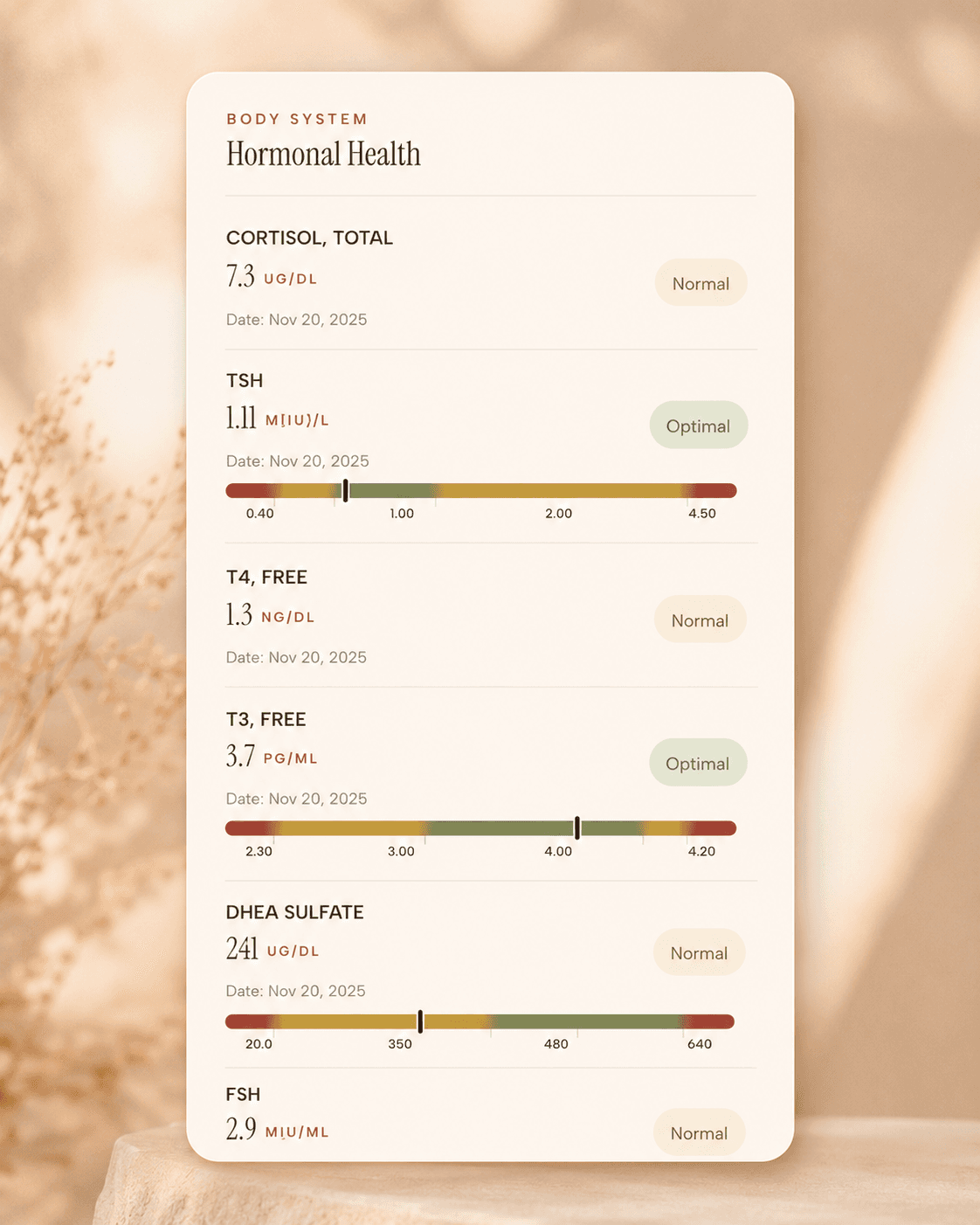
TSH is the master regulator of thyroid function, controlling the production of thyroid hormones T4 and T3. In functional medicine, we use narrower TSH ranges than conventional medicine to identify subclinical thyroid dysfunction early. Even mildly elevated TSH can indicate thyroid insufficiency, leading to fatigue, weight gain, depression, and metabolic dysfunction. TSH levels are influenced by stress, nutrient deficiencies, autoimmune conditions, and environmental toxins. Optimal TSH supports energy, metabolism…
Learn moreLab testing
Get TSH, ferritin, and vitamin B12 checked at Quest
starting from $99 panel with 100+ tests, one visit
No referral needed
About 1 week
Schedule online — results typically within a week
Clear next steps
Guidance included, with follow-up care available
HSA / FSA
Eligible for pre-tax health spending accounts
Pro Tips
Try a two-week “focus map”: each day, rate focus from 1–10 at 10 a.m., 2 p.m., and 8 p.m., and note sleep quality and where you are in your cycle. Patterns show up quickly, and they are more useful than trying to remember how you felt last Tuesday.
If you work from home, create a start ritual that takes under two minutes, such as making tea and opening one document only. Your brain learns that this sequence means “we are doing the thing,” which reduces the painful ramp-up time.
When you feel mentally stuck, do a 60-second physical reset before you change tasks: stand up, look out a window, and take 6 slow breaths with a longer exhale. It sounds small, but it often turns down the stress signal that blocks concentration.
If afternoons are your danger zone, schedule your most demanding work for your personal “best two hours,” even if it is earlier than you prefer. Protect that window like a meeting, because perimenopause often makes timing more important than total hours worked.
If you suspect heavy bleeding is part of this, track how often you change protection and whether you pass clots, then bring that data to your clinician. It makes it much easier to justify ferritin testing and to discuss treatments that reduce blood loss.
Frequently Asked Questions
Can perimenopause cause ADHD-like symptoms?
Yes. Estrogen swings can affect dopamine signaling, which is part of how your brain starts tasks, filters distractions, and holds information in working memory. That can feel ADHD-adjacent even if you never had attention issues before. If symptoms are new in your 40s and fluctuate with sleep or cycle changes, perimenopause is a strong suspect, and checking TSH and ferritin can rule out common mimics.
How do I know if my brain fog is perimenopause or thyroid?
Perimenopause-related fog often comes in waves and travels with symptoms like night sweats, cycle changes, or new anxiety, while thyroid-related fog tends to be steadier and comes with slowed-down body symptoms. A TSH blood test is the quickest way to screen for thyroid contribution. If TSH is above about 2.5–4.0 mIU/L and you feel clearly “off,” ask your clinician how to interpret it in your context.
What ferritin level is too low for concentration?
Many people start noticing fatigue and poor focus when ferritin drops below about 30 ng/mL, even if hemoglobin is still normal. If you have heavy periods, aiming for at least 50 ng/mL is a common symptom-focused target discussed in practice. The actionable step is to test ferritin first, and then treat based on results rather than guessing.
Does hormone therapy help with focus in perimenopause?
It can, but often indirectly. When hormone therapy reduces night sweats and improves sleep, your attention and mental stamina usually improve too, even if it does not feel like a stimulant. If your focus problems track with vasomotor symptoms (hot flashes or night sweats), it is worth a focused conversation about whether you are a candidate.
When should I worry that lack of focus is something serious?
If you have sudden confusion, new one-sided weakness, trouble speaking, severe headache, or a dramatic change in personality, treat that as urgent and seek immediate care. More commonly, you should book a timely visit if your focus decline is steadily worsening over months, you are making unsafe mistakes at work or while driving, or you also have significant depression or anxiety. Bring a short symptom timeline and consider screening labs like TSH, ferritin, and vitamin B12 to speed up answers.
What the research says about cognition in the menopause transition
The menopause transition is linked to changes in memory and attention, especially when sleep and mood symptoms are present (STRAW+10 staging paper).
The North American Menopause Society (NAMS) position statement summarizes evidence for hormone therapy benefits and risks, including effects on sleep and quality of life.
Randomized trials in the KEEPS program evaluated hormone therapy started near menopause and included cognitive outcomes over time.