Why You Can’t Focus During Menopause (And What Helps)
Lack of focus during menopause often comes from estrogen shifts, poor sleep, or thyroid changes. Targeted labs available, no referral needed.






Lack of focus during menopause is usually your brain reacting to hormone shifts, especially changing estrogen, which can affect attention circuits and memory. It also commonly shows up because your sleep gets lighter or more fragmented, and because thyroid or iron issues quietly pile on and make your brain feel “slower.” A few targeted blood tests can help sort out which of these is driving your symptoms so you’re not guessing. If you feel like you’re suddenly bad at your job, can’t finish a thought, or keep task-switching without meaning to, you’re not imagining it. The menopause transition can change how your brain handles stress, sleep, and multitasking, which is why focus problems often come with brain fog, irritability, or a shorter fuse. The good news is that this symptom is very workable once you identify your main bottleneck. PocketMD can help you map your pattern and decide what to try first, and Vitals Vault labs can help you check for common, fixable contributors.
Why you can’t focus during menopause
Estrogen shifts disrupt attention circuits
When estrogen rises and falls in perimenopause, your brain’s “signal strength” for attention and working memory can change day to day, because estrogen interacts with dopamine and acetylcholine systems that help you stay on task. That can feel like you are reading the same paragraph three times or losing your train of thought mid-sentence. A useful clue is variability: if your focus is noticeably better on some weeks than others, hormone fluctuation is often part of the story.
Sleep gets lighter and more fragmented
Menopause doesn’t just reduce total sleep time; it often breaks sleep into chunks, especially if you wake with heat, anxiety, or a racing mind. Even if you are “in bed” for eight hours, your brain may not get enough deep sleep to consolidate memory and reset attention. If your worst focus days follow nights with 2–3 awakenings, treating sleep like the primary problem (not a side issue) usually pays off fastest.
Stress hormones stay switched on
During this transition, your stress response can become more reactive, which means you can run on adrenaline and still feel mentally sluggish. High stress hormones can narrow your attention so you can only handle one thing at a time, and everything else feels overwhelming. If you notice a tight chest, jaw clenching, or a “wired but tired” feeling alongside poor focus, calming your nervous system is not optional—it is part of the treatment.
Thyroid slowdown mimics brain fog
An underactive thyroid can show up as forgetfulness, slower word-finding, and low motivation, and it is easy to blame on menopause because the timing overlaps. The thyroid helps set your metabolic “speed,” including in the brain, so when it slows, thinking can feel like wading through mud. If you also have constipation, dry skin, feeling cold, or unexplained weight gain, it is worth checking a thyroid-stimulating hormone test (TSH).
Low iron or B12 reduces clarity
You do not need to be severely anemic to feel mentally flat; low iron stores (ferritin) or low vitamin B12 can reduce oxygen delivery and nerve function in ways that show up as concentration problems. This can be especially relevant if you had heavy periods earlier in perimenopause, follow a low-meat diet, or take acid-suppressing medication long term. If your focus issues come with restless legs, hair shedding, or tingling in your hands or feet, labs can quickly tell you if this is a fixable contributor.
What actually helps you focus (without feeling like you’re “failing”)
Treat sleep like the foundation
Pick one sleep lever and work it for two weeks, because scattered changes rarely move the needle. A strong starting point is a consistent wake time plus a 60-minute “dim-down” routine that reduces bright light and work tasks, since your brain needs a clear off-ramp. If hot flashes or night sweats are waking you, addressing them directly (cool bedroom, breathable layers, and discussing hormone therapy or non-hormonal options with a clinician) often improves focus more than any productivity hack.
Use “single-task” scaffolding at work
When your attention is fragile, multitasking is not a skill—it is a symptom amplifier. Try a 25-minute focus sprint where you close email and chat, put your phone in another room, and write down the one outcome you will finish before you start. If you keep switching tasks anyway, set a timer to “switch on purpose” every 30 minutes so your brain stops doing it impulsively.
Stabilize blood sugar for steadier attention
Menopause can make you more sensitive to blood sugar swings, and the crash after a high-sugar breakfast often feels like fog, irritability, and zero motivation by late morning. Aim for a protein-forward first meal and add fiber, because that slows the rise and fall that yanks your attention around. A simple experiment is to compare two mornings: one with 25–35 grams of protein at breakfast versus one with mostly carbs, and notice your 11 a.m. focus.
Talk about hormone therapy if appropriate
For some people, menopausal hormone therapy can improve sleep and reduce hot flashes, and that indirect effect can meaningfully improve concentration. It is not a universal fix, and it depends on your age, time since menopause, and personal risk factors, but it is worth a real conversation if your symptoms are affecting your work or safety. If you want that conversation to be efficient, bring a short log of sleep quality, hot flashes, mood, and focus for 10–14 days.
Correct deficiencies with a plan
If ferritin or B12 is low, you will not think your way out of it with willpower, because your brain is missing raw materials. The fix is usually straightforward, but the details matter: iron dosing and timing affect absorption, and B12 replacement depends on whether the issue is diet, absorption, or medication-related. Use your lab results to guide a targeted plan, and recheck in about 8–12 weeks to make sure you are actually replenishing stores.
Useful biomarkers to discuss with your clinician
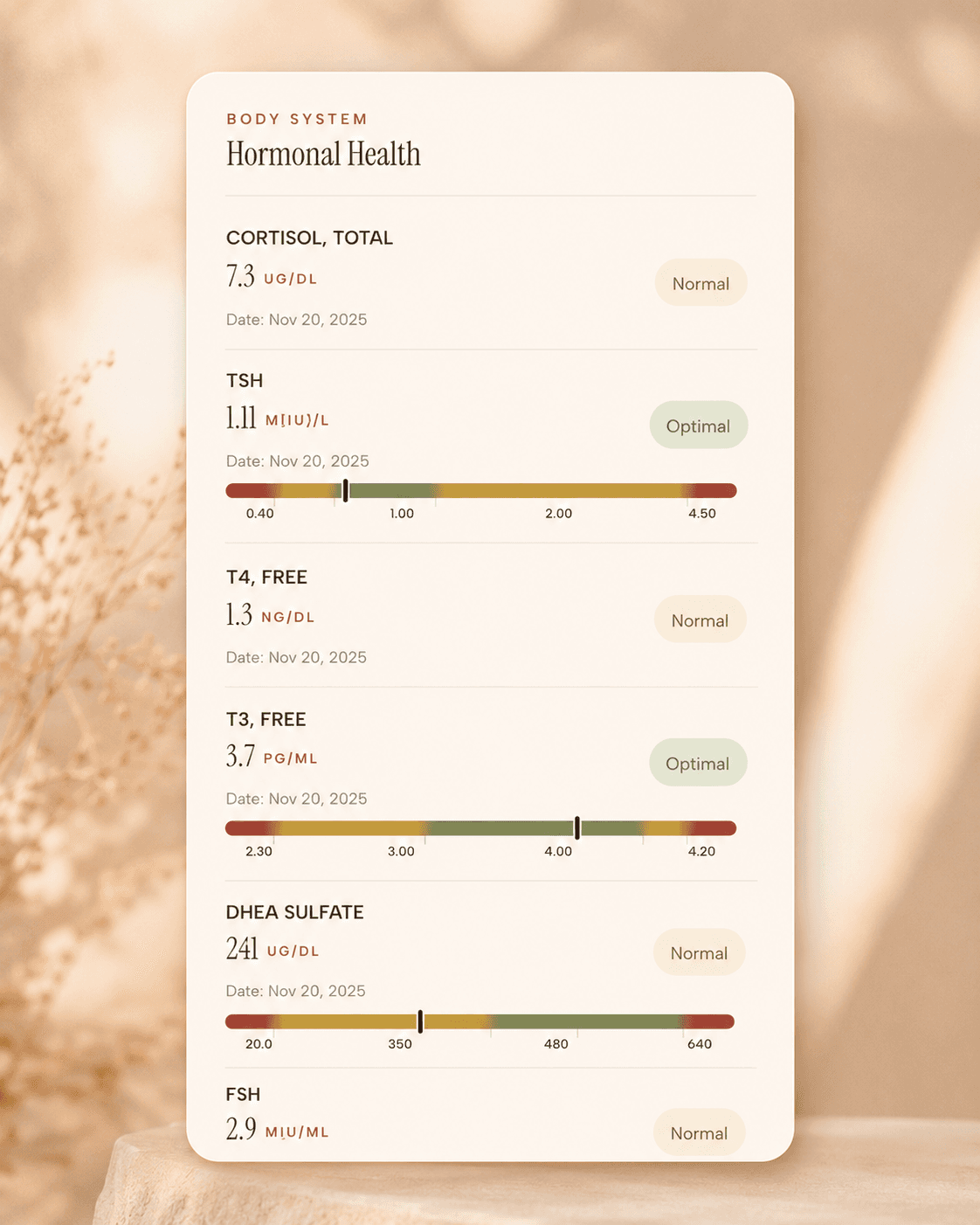
TSH
TSH is the master regulator of thyroid function, controlling the production of thyroid hormones T4 and T3. In functional medicine, we use narrower TSH ranges than conventional medicine to identify subclinical thyroid dysfunction early. Even mildly elevated TSH can indicate thyroid insufficiency, leading to fatigue, weight gain, depression, and metabolic dysfunction. TSH levels are influenced by stress, nutrient deficiencies, autoimmune conditions, and environmental toxins. Optimal TSH supports energy, metabolism…
Learn moreEstradiol
Estradiol in men is produced from testosterone via aromatase enzyme. In functional medicine, we recognize that men need optimal estradiol levels for bone health, cognitive function, and cardiovascular protection. However, excessive estradiol can suppress testosterone production and cause feminizing effects. The testosterone-to-estradiol ratio is crucial for male health, with optimal balance supporting vitality while preventing estrogen dominance. Balanced estradiol levels in men support bone health and cognitive…
Learn moreCortisol, Total
Cortisol is the primary stress hormone that regulates metabolism, immune function, and blood pressure. In functional medicine, cortisol assessment is crucial for understanding stress response and its impact on overall health. Chronic elevation suppresses testosterone production and immune function, while low cortisol indicates adrenal insufficiency. Optimal cortisol rhythm supports energy, mood stability, and hormone balance. Cortisol orchestrates the body's stress response and daily energy rhythms. Balanced cor…
Learn moreLab testing
Get TSH, ferritin, and vitamin B12 checked at Quest
starting from $99 panel with 100+ tests, one visit
No referral needed
About 1 week
Schedule online — results typically within a week
Clear next steps
Guidance included, with follow-up care available
HSA / FSA
Eligible for pre-tax health spending accounts
Pro Tips
Run a 14-day “focus log” that takes 60 seconds: rate focus from 1–10 at 10 a.m. and 3 p.m., then note last night’s awakenings and whether you had a protein-forward breakfast. Patterns show up faster than you think.
If you work remotely, try a “first 10 minutes offline” rule at the start of the day: write the one deliverable that would make today a win before you open email. This prevents other people’s priorities from hijacking your attention.
When you feel the urge to task-switch, do a 30-second brain reset instead of pushing harder: stand up, look out a window, and take six slow breaths with a longer exhale. It sounds small, but it can drop the stress response enough to get you back into the task.
If you suspect iron is part of your story, do not start supplements blindly; instead, check ferritin and then recheck after 8–12 weeks of a plan. Too much iron is not harmless, and the goal is to replenish stores, not guess.
Use “external memory” on purpose: keep one running note for passwords, names, and to-dos, and stop trying to hold everything in your head. Offloading reduces the mental noise that makes menopause focus problems feel worse.
Frequently Asked Questions
Is it normal to have trouble concentrating during menopause?
Yes. Shifting estrogen can affect attention and working memory, and sleep disruption from hot flashes or anxiety can make it feel dramatically worse. If it is new for you or affecting work and safety, it is worth checking for common add-ons like thyroid issues (TSH) and low iron stores (ferritin). Start by tracking sleep and focus for two weeks so you can describe the pattern clearly.
How do I know if it’s menopause brain fog or ADHD?
If you had lifelong symptoms that started in childhood, ADHD is more likely, although menopause can amplify it. If the problem is new or clearly worsened during perimenopause, hormone shifts and sleep fragmentation are often the main drivers. A practical next step is to document when symptoms began, how variable they are week to week, and whether they track with sleep or hot flashes, then discuss that timeline with a clinician.
What blood tests should I ask for when I can’t focus?
For menopause-related focus issues, a targeted trio that often pays off is TSH for thyroid function, ferritin for iron stores, and vitamin B12 for nerve and brain signaling. Abnormal results can point to fixable causes that mimic “brain fog,” especially if you also have fatigue, hair shedding, constipation, or tingling. If you get tested, plan a recheck in about 8–12 weeks after treatment to confirm the numbers are moving.
Can hormone therapy help with focus during menopause?
It can, especially when improved sleep and fewer hot flashes lead to better daytime attention. It is not guaranteed, and the decision depends on your age, time since menopause, symptom severity, and personal risk factors. If you are considering it, bring a 10–14 day log of sleep quality, hot flashes, mood, and focus so the discussion is specific rather than vague.
When should I worry that poor focus is something serious?
Get urgent help if confusion comes on suddenly, you have new weakness on one side, trouble speaking, severe headache, chest pain, or you feel unsafe driving because you cannot stay alert. For non-urgent but important evaluation, seek care if focus problems are steadily worsening over months, you are getting lost in familiar places, or others notice major memory changes. If it is “just” affecting work performance, that still counts—use labs and a symptom log to speed up getting the right help.
What research says about menopause and cognition
NAMS 2023 position statement on nonhormone therapy for vasomotor symptoms (sleep and hot flashes affect cognition)
NAMS 2022 position statement on hormone therapy (benefits, risks, and symptom relief that can improve sleep and daytime function)
STRIDE trial: aerobic exercise improved cognition in sedentary older adults (supports exercise as a cognitive tool, including in midlife)