01
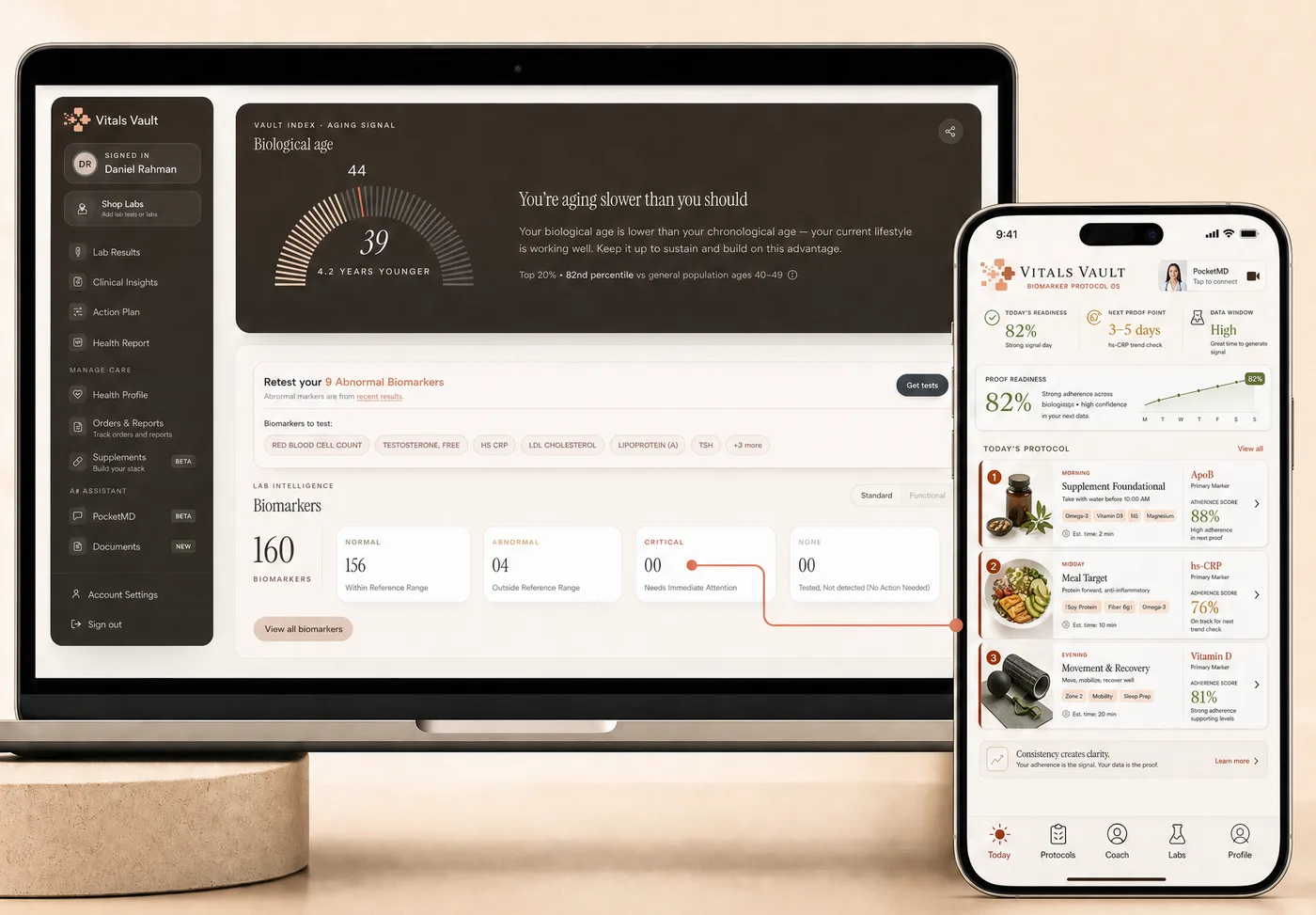
Biological age
Find out if your body is aging faster or slower than your actual age — and see how you rank against the general population.
39
Biological age
44
Actual age
4.2
Years younger
Advanced Lipid Panel
Results in about 10–13 days
Advanced Lipid Panel Cardio IQ (advanced cholesterol testing): what it measures and how to read your results. It measures cholesterol particles and related risk markers beyond a standard lipid panel, with convenient ordering and Quest-based testing through Vitals Vault.
A standard cholesterol test tells you how much cholesterol is riding in your blood. An Advanced Lipid Panel Cardio IQ goes a step further by looking at the number and type of lipoprotein particles that carry cholesterol and triglycerides. That extra detail can matter because two people can have the same LDL-C (“bad cholesterol”) but very different LDL particle counts, particle sizes, and inherited risk markers like lipoprotein(a). Those differences can change how you and your clinician think about prevention and follow-up. This test does not diagnose heart disease by itself. It gives you a clearer picture of lipid-related risk so you can pair it with your personal history, blood pressure, glucose/insulin markers, and (when appropriate) imaging.
What to expect before and at your draw.
Sample Type
Blood
Collection Method
In person at a Quest Diagnostics location
Age
18+
This order includes the lab markers used for Advanced Lipid Panel.
Apolipoprotein B
Included in this Quest Diagnostics order and reported in your Vitals Vault account.
Chol/Hdlc Ratio
Included in this Quest Diagnostics order and reported in your Vitals Vault account.
Cholesterol, Total
Included in this Quest Diagnostics order and reported in your Vitals Vault account.
Hdl Cholesterol
Included in this Quest Diagnostics order and reported in your Vitals Vault account.
Order Advanced Lipid Panel online.
Visit a Quest Diagnostics location near you for your blood draw. Appointments can be scheduled after checkout.
View easy-to-read results in your Vitals Vault account, with trends and a personalized action plan.
Included with every package
Function Health shows you numbers. Vitals Vault connects them — ratios, patterns, and a personalized action plan grounded in functional medicine.
Find out if your body is aging faster or slower than your actual age — and see how you rank against the general population.
39
Biological age
44
Actual age
4.2
Years younger
Turn lab data into what to do next—clear guidance on follow-ups, lifestyle context, and add-on testing when you need to go deeper. Make the healthy choice the obvious one.
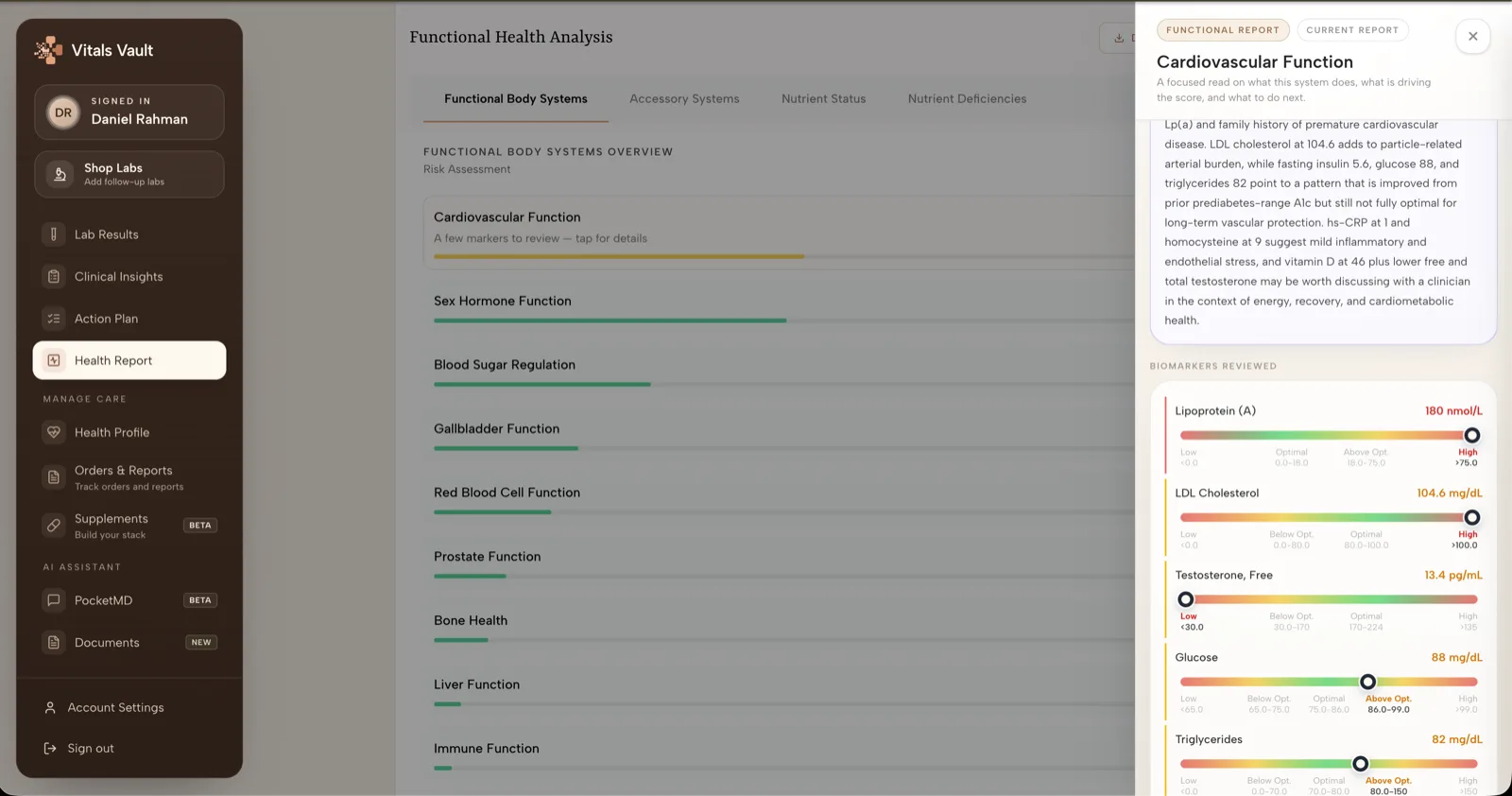
A personalized, plain-language walkthrough of your abnormal markers—reference ranges, pattern context, and what to watch next, grounded in your actual labs.
Personalized Insights
Clear Explanations
Actionable guidance
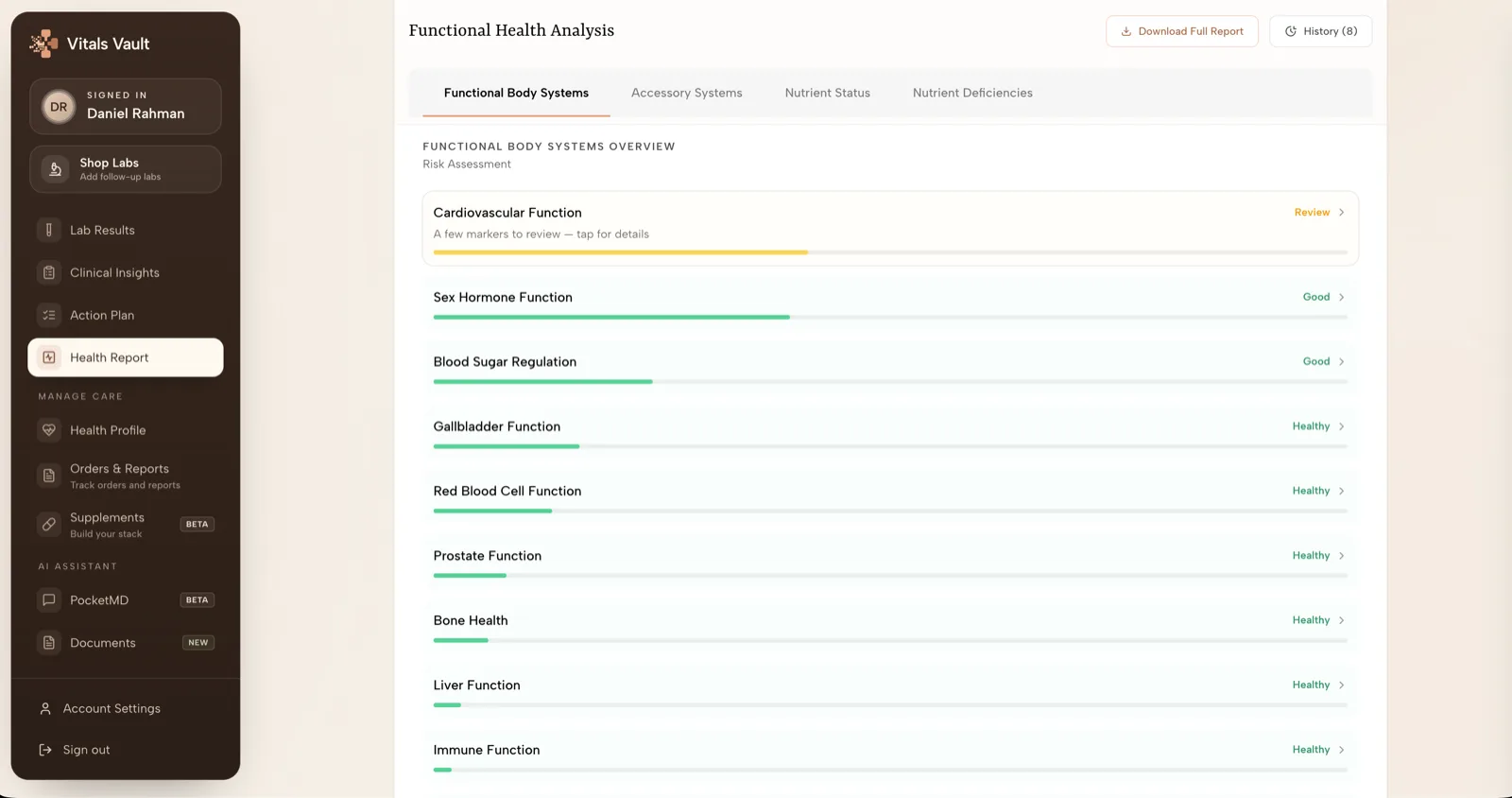
Explore your body systems with clear risk context — refresh your report, download the full PDF, and monitor hormones, heart, bone, and more in one place.
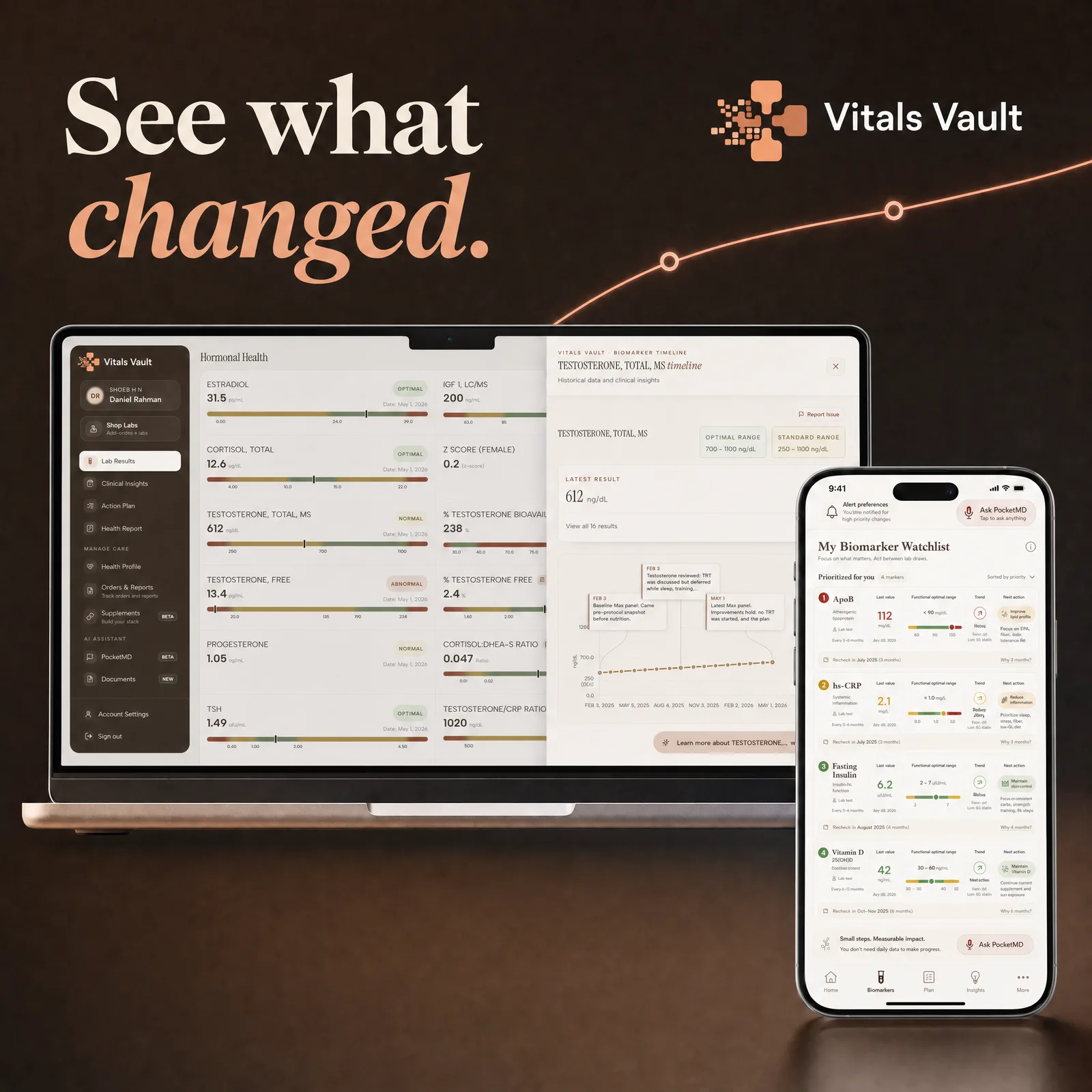
Explore hundreds of tests and panels, filter by concern, and manage your cart—member-exclusive pricing with quick checks and full-body options in one flow.
Wide test selection
300+ tests & panels available
Smart filtering
Find tests by symptoms or goals
Seamless ordering
Add to cart and manage easily
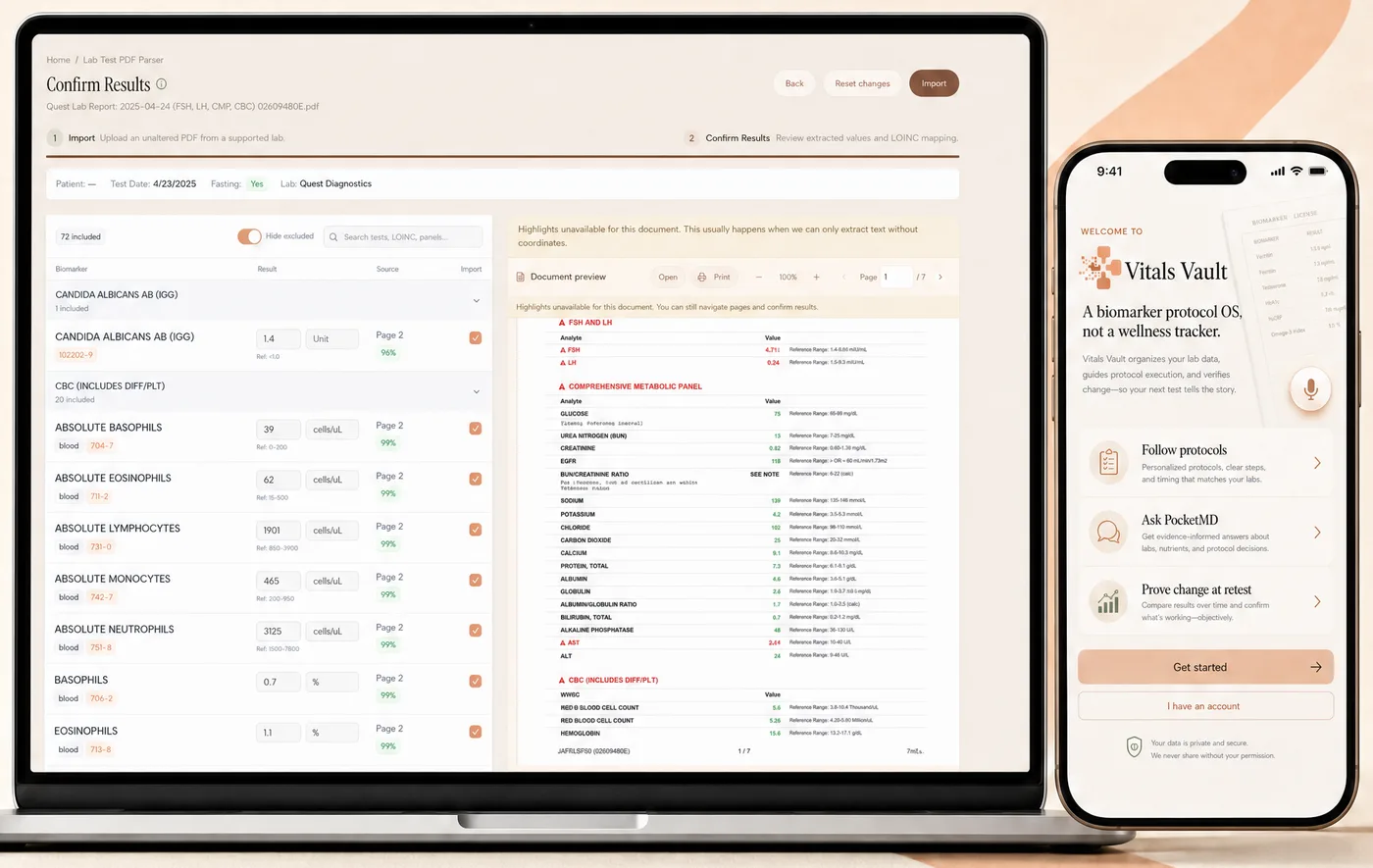
Upload past lab reports, search your documents, and keep appointments and results organized—our AI can extract biomarkers from PDFs so everything lives in one dashboard.
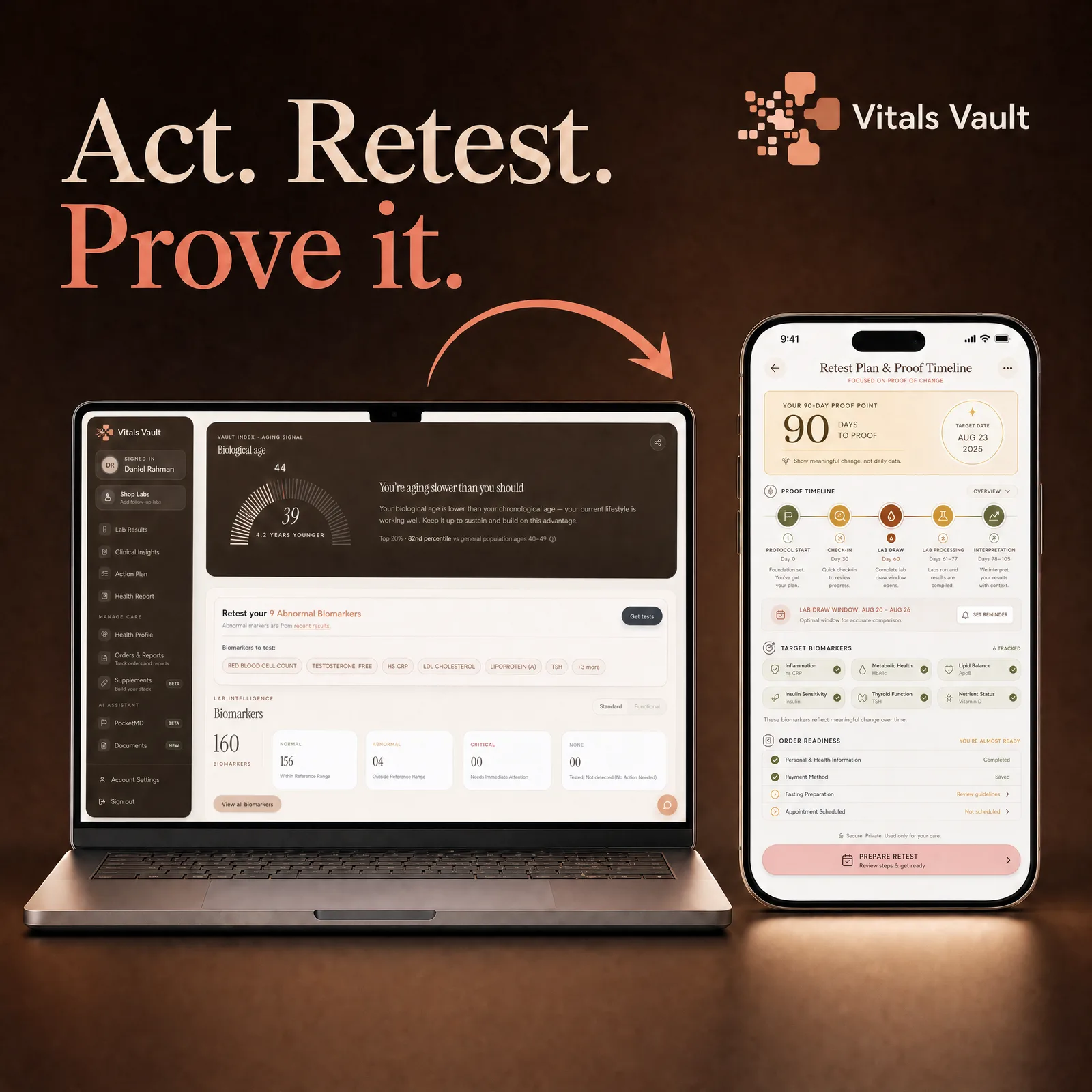
Browse longevity, nutrition, supplement, and movement protocols—structured plans you can follow with clear habits, labs, and targets tied to your profile.
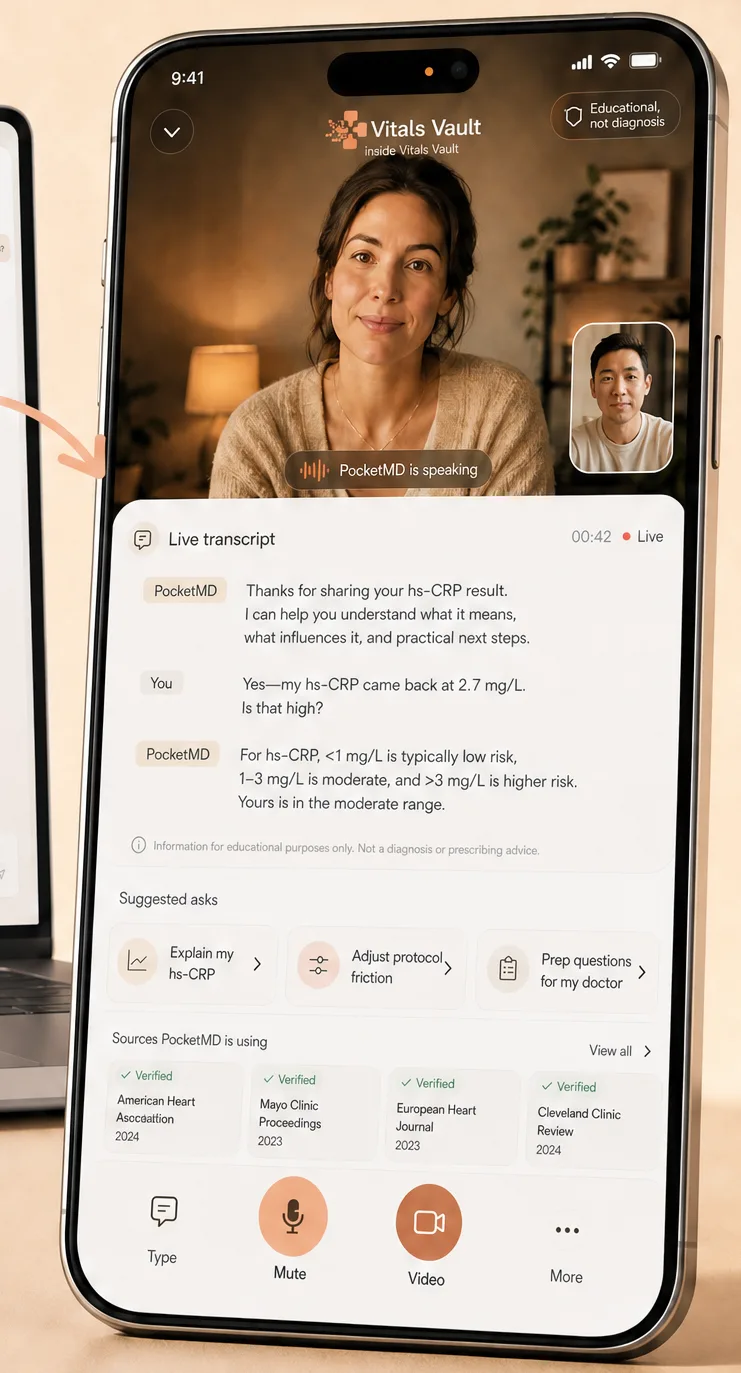
Ask for protocols, nutrition plans, supplement stacks, and education—context-aware suggestions powered by your labs and goals (beta experience).
Order online
Add Advanced Lipid Panel to your cart and check out. No doctor referral is required.
Visit a Quest lab
Provide your blood sample at a Quest Diagnostics location. Appointments can be scheduled after checkout.
Review in Vitals Vault
Results in about 10–13 days. They stay in your Vitals Vault account for trends and follow-up.
No special preparation is usually needed unless noted at checkout.
This order includes the lab markers used for Advanced Lipid Panel and reported in your Vitals Vault account.
Results
Results in about 10–13 days
HSA/FSA
Accepted
Who takes it
Must be taken by the purchaser
Preparation
No special preparation needed unless noted at checkout.
Hdl Large
Included in this Quest Diagnostics order and reported in your Vitals Vault account.
Ldl-Cholesterol
Included in this Quest Diagnostics order and reported in your Vitals Vault account.
Ldl Medium
Included in this Quest Diagnostics order and reported in your Vitals Vault account.
Ldl Particle Number
Included in this Quest Diagnostics order and reported in your Vitals Vault account.
Ldl Pattern
Included in this Quest Diagnostics order and reported in your Vitals Vault account.
Ldl Peak Size
Included in this Quest Diagnostics order and reported in your Vitals Vault account.
Ldl Small
Included in this Quest Diagnostics order and reported in your Vitals Vault account.
Lipoprotein (A)
Included in this Quest Diagnostics order and reported in your Vitals Vault account.
It measures cholesterol particles and related risk markers beyond a standard lipid panel, with convenient ordering and Quest-based testing through Vitals Vault.





A standard cholesterol test tells you how much cholesterol is riding in your blood. An Advanced Lipid Panel Cardio IQ goes a step further by looking at the number and type of lipoprotein particles that carry cholesterol and triglycerides.
That extra detail can matter because two people can have the same LDL-C (“bad cholesterol”) but very different LDL particle counts, particle sizes, and inherited risk markers like lipoprotein(a). Those differences can change how you and your clinician think about prevention and follow-up.
This test does not diagnose heart disease by itself. It gives you a clearer picture of lipid-related risk so you can pair it with your personal history, blood pressure, glucose/insulin markers, and (when appropriate) imaging.
You might consider an advanced lipid panel if your standard lipid panel does not match your real-world risk. For example, you may have “normal” LDL-C but a strong family history of early heart disease, metabolic syndrome, or a prior abnormal coronary calcium score.
It can also be useful when your triglycerides are elevated, your HDL-C is low, or you have insulin resistance, because these patterns often come with a higher number of smaller, denser LDL particles even when LDL-C looks acceptable.
If you are already working on cholesterol lowering—through lifestyle changes or medication—advanced markers like ApoB or LDL particle number can help you and your clinician judge whether the therapy is reducing the particles most linked to plaque formation.
If you are pregnant, acutely ill, or recently had major weight loss, your lipids can shift temporarily. In those cases, it may make sense to time testing with your clinician so the result reflects your usual baseline.
This panel is performed in a CLIA-certified laboratory; results should be interpreted with your clinician and are not a standalone diagnosis of cardiovascular disease.
from $119.99 at Quest Diagnostics
Results in days
Clear next steps
HSA / FSA
Vitals Vault lets you order an Advanced Lipid Panel Cardio IQ without needing a separate referral visit, and you can choose a convenient local draw location.
Once your results are in, PocketMD can help you translate the report into plain language: what each marker measures, which results deserve follow-up, and what companion labs are commonly used to confirm patterns (such as A1c, fasting insulin, or hs-CRP).
If you are tracking progress, you can re-order the same panel to compare trends over time, which is often more useful than reacting to a single number. Your clinician can then use those trends alongside your overall risk profile to guide next steps.
An Advanced Lipid Panel Cardio IQ is a blood test that expands on the standard lipid panel. Instead of focusing only on cholesterol concentration (like LDL-C and HDL-C), it measures additional markers that reflect how many cholesterol-carrying particles you have and what kind they are.
Cholesterol travels through your bloodstream inside lipoproteins. The particles most associated with plaque formation are “atherogenic” particles, which include LDL and other ApoB-containing particles. In many people, the number of these particles (often reflected by ApoB or LDL particle number) tracks cardiovascular risk more closely than LDL-C alone.
The panel may also include lipoprotein(a), an inherited LDL-like particle that can raise risk even when other lipid numbers are favorable. Because Lp(a) is largely genetic, it is often checked at least once in adulthood, and then rechecked selectively based on clinical context.
You can think of this test as answering two questions at the same time: how much cholesterol is being carried, and how many “vehicles” are carrying it.
A standard lipid panel reports total cholesterol, LDL-C, HDL-C, and triglycerides (sometimes with calculated non-HDL-C). An advanced panel adds particle-based metrics (like LDL-P), apolipoproteins (like ApoB and sometimes ApoA1), and inherited markers (like Lp(a)). These additions can be especially helpful when triglycerides are high, when LDL-C is borderline, or when you are deciding how aggressive prevention should be.
LDL-C is the amount of cholesterol inside LDL particles, not the number of particles. If each particle carries less cholesterol (a common pattern with insulin resistance), you can have a normal LDL-C but a high particle count. More particles means more opportunities for particles to enter the artery wall and contribute to plaque over time.
In this context, “low” usually means lower levels of atherogenic particle markers, such as a lower ApoB and/or a lower LDL particle number, along with favorable triglycerides and non-HDL-C. This pattern generally suggests fewer cholesterol-carrying particles that can contribute to plaque formation. If your Lp(a) is low and your inflammatory markers (if checked) are also favorable, your lipid-related risk picture is often simpler. Even with good numbers, your clinician may still consider family history, blood pressure, smoking status, and diabetes risk.
Optimal results typically show alignment between LDL-C and particle-based markers, meaning the cholesterol concentration and particle burden tell the same story. Triglycerides are usually in a healthy range, HDL-C is not suppressed, and LDL size/pattern does not strongly suggest small, dense LDL predominance. Many clinicians also look for ApoB and non-HDL-C to be consistent with your overall risk category rather than chasing a single universal target. If you are on therapy, “optimal” can also mean your numbers are improving in the right direction and staying stable on repeat testing.
Higher ApoB and/or higher LDL particle number generally indicate a higher burden of atherogenic particles. If your LDL-C is only mildly elevated but ApoB or LDL-P is high, that discordance can signal hidden risk, often seen with insulin resistance or higher triglycerides. A high Lp(a) suggests inherited risk that may warrant earlier or more intensive prevention discussions, especially if you also have a family history of early cardiovascular events. Your clinician may pair these results with other data—such as A1c, blood pressure, hs-CRP, or imaging—to decide what to do next.
Recent illness, major stress, pregnancy, and rapid weight loss can temporarily shift cholesterol and triglycerides, which can affect particle measurements. Diet changes, alcohol intake, and exercise patterns can move triglycerides and HDL-C within weeks, while LDL-related markers may take longer to stabilize. Medications (including statins, ezetimibe, PCSK9 inhibitors, hormone therapy, and some acne or HIV medications) can significantly change LDL-C, ApoB, and particle counts. Genetics strongly influence Lp(a), so lifestyle changes may have limited impact on that specific marker even when other lipids improve.
Many clinicians prefer a fasting sample (often 9–12 hours) because triglycerides can rise after eating and can influence calculated values and particle patterns. Some components may still be interpretable non-fasting, but if you are comparing results over time, use the same fasting status each time. Follow the collection instructions on your order or your clinician’s guidance.
LDL-C is the amount of cholesterol inside LDL particles, while LDL-P estimates how many LDL particles are circulating. You can have normal LDL-C but high LDL-P if each particle carries less cholesterol, which is common with insulin resistance and higher triglycerides. LDL-P (and ApoB) can better reflect the number of atherogenic particles that may contribute to plaque.
ApoB is a protein found on atherogenic particles (including LDL), so it acts like a particle count. In many people, ApoB tracks cardiovascular risk well, especially when LDL-C and triglycerides are discordant. It is not “more important” in every situation, but it can be a clearer target when you are trying to reduce particle burden.
A high Lp(a) usually reflects inherited risk, and levels are relatively stable across your life. Lifestyle changes that improve LDL-C and triglycerides may not significantly lower Lp(a), but they can still reduce overall risk. Your clinician may focus on lowering ApoB/LDL-related markers more aggressively and may consider additional risk assessment based on your history.
A common approach is to retest about 8–12 weeks after a meaningful change, such as starting or adjusting lipid-lowering medication or making sustained diet and exercise changes. If you are stable and monitoring long-term risk, your clinician may repeat it less often (for example, annually). The best interval depends on your baseline risk and whether you are actively changing treatment.
No. This panel estimates lipid-related risk and helps guide prevention, but it does not diagnose plaque or blockages. If your results suggest higher risk, your clinician may consider imaging or other tests (such as coronary artery calcium scoring) to assess plaque burden directly.
This is called lipid “discordance.” It can happen when LDL particles are smaller and carry less cholesterol, so LDL-C looks acceptable while ApoB (particle count) is higher. Triglycerides, insulin resistance, and genetics can contribute, which is why pairing this panel with glucose/insulin markers and your clinical history is often helpful.
Purchase online through Vitals Vault. A licensed clinician reviews and approves your order, then you receive a digital requisition for a Quest Diagnostics blood draw.
Samples are collected in person at Quest Diagnostics locations nationwide. After checkout you can schedule your visit at a convenient site.
Most results in 3–5 business days. You can view them securely in your Vitals Vault account.
No separate referral appointment is required. Clinician review is included in the online order flow.
Yes. Eligible HSA/FSA cards can be used at checkout for qualifying lab orders.
Results are available in your secure Vitals Vault account. You control who you share them with, subject to applicable law.
Blood glucose shows the amount of sugar in your blood at a single moment. A1c (hemoglobin A1c) estimates your average blood sugar over roughly the past 8–12 weeks. Comparing them helps explain whether your long-term average lines up with your fasting glucose on draw day.
It helps you understand how this marker fits into your broader metabolic picture, with results tracked in your Vitals Vault account.
Elevated values can signal higher metabolic risk. Many people start with nutrition, activity, sleep, and weight management, then retest and review results with a clinician. This test is educational and does not replace medical advice or diagnosis.
Your sample is processed at CLIA-certified Quest Diagnostics laboratories. Results should still be interpreted with a qualified clinician alongside your history, symptoms, and other labs.
Consumer-initiated testing through Vitals Vault is limited to adults 18+ so ordering and interpretation stay aligned with clinical best practices for this channel.