Brain Fog During Menopause: Causes, Relief, and Lab Tests
Brain fog during menopause often comes from estrogen shifts, poor sleep, or thyroid and iron issues. Targeted blood tests available—no referral needed.






Brain fog during menopause is usually your brain reacting to shifting estrogen, disrupted sleep from night sweats or insomnia, and sometimes a fixable medical issue like low iron or an underactive thyroid. It can feel like your thoughts are moving through molasses, even when you are trying hard. A few targeted blood tests can help sort out whether this is “just the transition” or something you can treat directly. This symptom is common, but it is also personal. Some people mainly notice word-finding problems and forgetfulness, while others feel mentally exhausted by noon or cannot focus long enough to finish a task. The tricky part is that menopause changes your hormones, your sleep, and your stress response at the same time, so the fog can have more than one driver. In the sections below, you will get a clear map of the most common causes, what tends to help, and which labs are worth checking. If you want help matching your exact pattern to the most likely cause, PocketMD can talk it through with you, and Vitals Vault labs can help you confirm what is going on.
Why Brain Fog Hits During Menopause
Estrogen shifts change brain signaling
As estrogen rises and falls in perimenopause and then drops after menopause, your brain has to recalibrate how it uses key messengers like acetylcholine and serotonin. That can show up as slower recall, more “tip-of-the-tongue” moments, and feeling less mentally sharp than you expect. The takeaway is that timing matters: if your fog tracks with cycle changes, hot flashes, or mood swings, hormones are likely part of the story.
Sleep disruption steals your attention
Your brain does a lot of memory filing and emotional reset during deep sleep, but night sweats, early waking, and insomnia can chop that sleep into fragments. The next day you may feel distractible, irritable, and unable to hold multiple steps in your head. If your fog is worst after a bad night, treating sleep like the main symptom (not an afterthought) often gives the fastest improvement.
Thyroid slowdown mimics menopause fog
An underactive thyroid can creep in around midlife, and the symptoms overlap with menopause so closely that it is easy to miss. When thyroid hormone is low, your brain and body run “low power,” which can feel like slowed thinking, low motivation, and heavy fatigue. A simple thyroid test can separate “menopause brain” from a thyroid problem that has a specific treatment.
Low iron stores reduce brain energy
You can have low iron stores even if your hemoglobin looks normal, especially if your periods were heavy earlier in the transition. Iron helps deliver oxygen and supports brain energy metabolism, so low stores can feel like mental exhaustion, poor concentration, and getting overwhelmed by tasks you used to handle easily. Checking ferritin (your iron storage marker) is particularly useful if you also notice hair shedding, restless legs at night, or shortness of breath with exertion.
B12 absorption drops with age
Vitamin B12 supports nerve function and the insulation around nerves, and absorption can decline with age or with long-term acid-suppressing medications. When B12 is low, brain fog can come with tingling in hands or feet, balance issues, or a “spaced out” feeling that does not match your effort. If you are vegetarian, take metformin, or have stomach issues, B12 testing is a smart, targeted step.
What Actually Helps Menopause Brain Fog
Treat sleep like the root problem
If you are waking at 2–4 a.m. or sweating through the night, your brain is not getting the recovery it needs to think clearly. Start by protecting a consistent wake time, and keep the bedroom cool and dark so your body can stay asleep when a hot flash hits. If insomnia is persistent for more than a few weeks, ask about cognitive behavioral therapy for insomnia (CBT-I), because it is one of the most effective non-drug options for midlife sleep.
Use strength training for sharper focus
Resistance training pushes blood flow, insulin sensitivity, and growth factors that support brain function, and it tends to help mood at the same time. You do not need a perfect program: two to three sessions per week with progressive effort is enough to notice changes in energy and mental stamina. If you are new to lifting, start with bodyweight squats, rows, and push movements and add load slowly so it feels sustainable.
Try a “single-task” work reset
Menopause fog often feels worse in environments that demand constant switching, because your working memory is already stretched. For one week, experiment with 25-minute focus blocks where you do one task only, and keep a notepad next to you to park distracting thoughts instead of chasing them. This is not about willpower; it is about reducing cognitive load so your brain can do deeper work again.
Correct iron or B12 deficits directly
If ferritin or B12 is low, lifestyle tweaks alone usually will not fix the fog, because your brain is missing building blocks. Iron repletion is often guided by ferritin trends over 8–12 weeks, while B12 can improve faster with high-dose oral B12 or injections depending on the cause. The practical move is to test first, then supplement with a plan and a recheck date so you know it is working.
Consider menopause hormone therapy when appropriate
For some people, treating the menopause transition itself helps cognition indirectly by improving sleep, hot flashes, and mood. Menopause hormone therapy is not a DIY project, but a clinician can help you weigh benefits and risks based on your age, time since menopause, and personal history. If your fog is paired with frequent hot flashes and night waking, this conversation is worth having because better sleep often equals a clearer brain.
Useful biomarkers to discuss with your clinician
Ferritin
Ferritin is your body's iron storage protein, reflecting total iron stores in the body. In functional medicine, ferritin assessment is crucial for identifying both iron deficiency and iron overload, conditions that can significantly impact energy levels and overall health. Low ferritin is the earliest sign of iron deficiency, often occurring before anemia develops. This can cause fatigue, weakness, restless leg syndrome, and cognitive impairment. Conversely, elevated ferritin may indicate iron overload, inflamma…
Learn moreVitamin B12
Vitamin B12 (cobalamin) is essential for DNA synthesis, red blood cell formation, neurological function, and energy metabolism. In functional medicine, we recognize that B12 deficiency is surprisingly common, especially in older adults, vegetarians, vegans, and those with digestive issues. B12 deficiency can cause irreversible neurological damage if left untreated. The vitamin is crucial for methylation reactions, which affect cardiovascular health, detoxification, and gene expression. Even subclinical deficienc…
Learn moreTSH
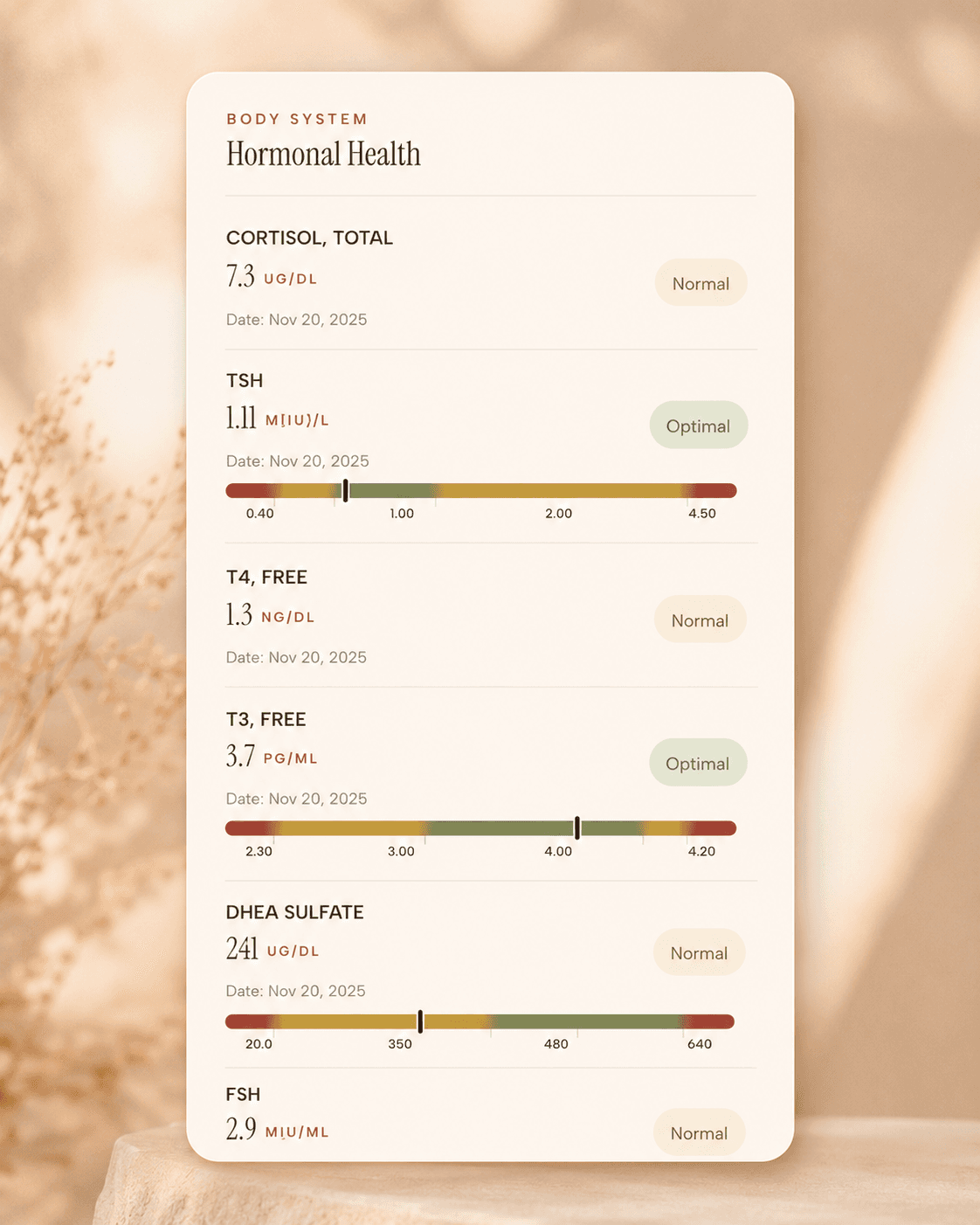
TSH is the master regulator of thyroid function, controlling the production of thyroid hormones T4 and T3. In functional medicine, we use narrower TSH ranges than conventional medicine to identify subclinical thyroid dysfunction early. Even mildly elevated TSH can indicate thyroid insufficiency, leading to fatigue, weight gain, depression, and metabolic dysfunction. TSH levels are influenced by stress, nutrient deficiencies, autoimmune conditions, and environmental toxins. Optimal TSH supports energy, metabolism…
Learn moreLab testing
Check thyroid, iron stores, and B12 at Quest
starting from $99 panel with 100+ tests, one visit
No referral needed
About 1 week
Schedule online — results typically within a week
Clear next steps
Guidance included, with follow-up care available
HSA / FSA
Eligible for pre-tax health spending accounts
Pro Tips
Do a 14-day “fog log” where you rate clarity from 1–10 at the same two times each day (for example, 10 a.m. and 3 p.m.) and write one sentence about the night before. Patterns like “bad after night sweats” or “worse after wine” usually jump out quickly.
If you wake up at night, keep lights low and avoid checking the time, because clock-watching trains your brain to become alert at the exact moment you need to drift back off. A dim red night light and a simple breathing pattern can keep you in “sleep mode.”
When you cannot find a word, pause and describe the idea instead of forcing the missing word. That tiny strategy reduces anxiety, and anxiety itself can worsen retrieval problems in the moment.
Try a protein-forward breakfast for one week, because a blood sugar dip mid-morning can feel exactly like brain fog. You are looking for steadier focus, not perfection, so compare your 10 a.m. rating before and after the experiment.
If you start iron or B12, set a calendar reminder for a repeat lab in about 8–12 weeks. Brain fog improves when your levels actually rise, so tracking prevents months of guessing.
Frequently Asked Questions
Is brain fog a normal symptom of menopause?
Yes, many people notice forgetfulness, slower recall, or trouble concentrating during the menopause transition because estrogen shifts and sleep disruption affect how your brain processes information. “Normal” does not mean you have to tolerate it, though, because treatable issues like low ferritin, low B12, or thyroid problems can make it much worse. If your fog is new, persistent, or affecting work, it is worth checking targeted labs and addressing sleep.
How long does menopause brain fog last?
For many people it is most noticeable in perimenopause and the early postmenopause years, especially when hot flashes and insomnia are active. It often improves as symptoms stabilize, but the timeline varies because sleep, stress, and medical factors like iron stores can keep it going. If you are still struggling after a few months of good sleep habits, get labs such as TSH, ferritin, and vitamin B12 to look for fixable drivers.
Can low estrogen cause memory problems and brain fog?
Low or fluctuating estrogen can contribute because it influences brain chemicals involved in attention, mood, and memory, and it also affects sleep quality. The fog is often indirect: you sleep worse, feel more anxious, and your brain has fewer “recovery hours,” so memory feels unreliable. If your fog tracks with hot flashes or night sweats, talk with a clinician about symptom control options, including menopause hormone therapy when appropriate.
What labs should I ask for with brain fog during menopause?
A practical starting trio is TSH for thyroid function, ferritin for iron stores, and vitamin B12 for nerve and cognitive support. If TSH is abnormal, free T4 is usually the next step, and if B12 is borderline, methylmalonic acid can clarify whether you are truly deficient. Bring your symptoms and any heavy bleeding history or diet pattern to the visit so the results are interpreted in context.
When should I worry that brain fog is something serious?
Get urgent care if confusion comes on suddenly, you have new one-sided weakness, trouble speaking, severe headache, fainting, or chest pain, because those are not typical menopause symptoms. You should also book a prompt medical visit if your fog is rapidly worsening, you are getting lost in familiar places, or family members notice major changes. In the meantime, write down a few concrete examples of what is happening, because specific stories help clinicians triage faster.
Research on Menopause and Cognition
North American Menopause Society (NAMS) 2023 position statement on hormone therapy (benefits, risks, and timing)
Kronos Early Estrogen Prevention Study (KEEPS): cognitive outcomes with early postmenopausal hormone therapy
Women’s Health Initiative Memory Study (WHIMS): hormone therapy and dementia risk in older postmenopausal women