Skin quality after laser
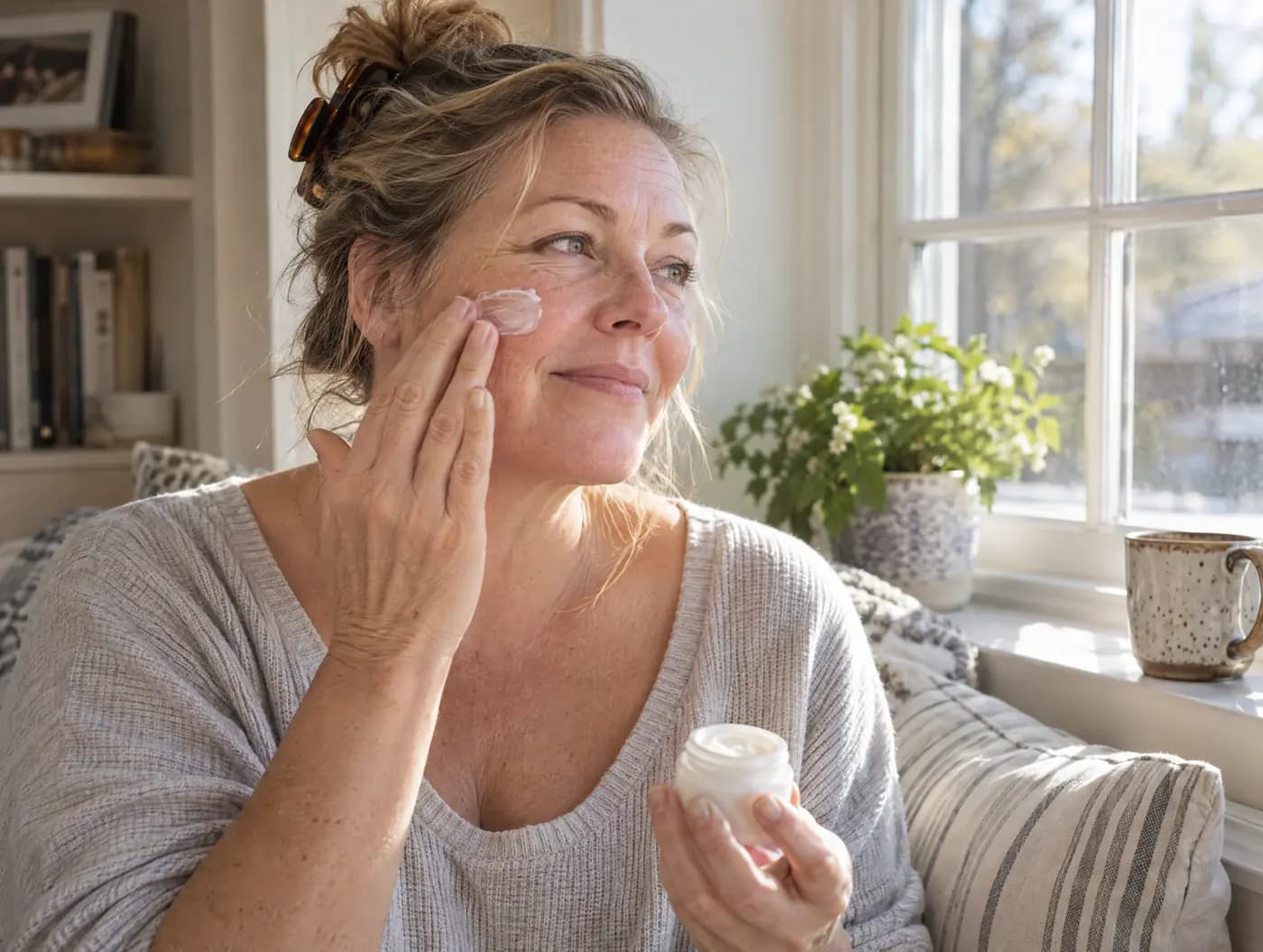
In a small trial (13 completers), GHK-Cu did not change wrinkles or skin quality on objective checks. People using it rated their skin higher.4
Copper tripeptide-1, glycyl-L-histidyl-L-lysine copper
Your blood carries a tiny copper-bound peptide that tells damaged tissue to rebuild, and levels fall as you age. Five decades of research explain the skin care buzz, and show where the human evidence runs thin.
Free to join · One email when peptide care opens · Most lab results in 3–5 business days
GHK-Cu is a three-amino-acid peptide (glycine, histidine, lysine) bound to copper. Your blood carries GHK naturally, levels reportedly fall with age, and it binds copper to form GHK-Cu. In lab work it signals skin cells to build and remodel collagen and draws repair cells to a wound. It is studied for skin repair, wound healing and hair, mostly in lab and animal work plus a few small human trials.

Medically reviewed by Robert Lufkin, MD (opens in a new tab)
Chief Medical Officer, Vitals Vault · Updated · 14 sources
It is a repair signal that tells skin cells to rebuild the scaffold under the skin.
In lab and rat studies it raised collagen and the gel between fibers, and helped clear old material too.781
It draws repair cells to an injury and encourages new blood vessels and nerve fibers.63
In lab cells from COPD lungs it restored repair. Its main research group says it changes thousands of genes.1321
The evidence is early. The human trials are few, small and topical, with mixed results. None tests the injectable form.
In a small trial (13 completers), GHK-Cu did not change wrinkles or skin quality on objective checks. People using it rated their skin higher.4


GHK restored the ability of fibroblasts from COPD lungs to contract and remodel collagen. It has not been tested as a lung treatment in people.13
Raised collagen in skin cells in a dish without adding cells. Lung cells from COPD patients regained repair behavior.713
Shows a mechanism
Sped wound healing in rats, mice, pigs and dogs. Rat wounds with poor blood supply shrank 64.5% by day 13, vs 45.6% for the gel base.19
Shows an effect in a body
A diabetic foot ulcer trial found faster closure with a GHK-Cu gel. A leg ulcer trial and a 13-person skin trial found no benefit.10114
Shows it works in people
The human record is small and split. A multicenter trial in diabetic foot ulcers found faster, more complete closure with a GHK-Cu gel. A trial in venous leg ulcers found a copper tripeptide cream no better than placebo, and a cosmetic trial after laser resurfacing found no objective benefit. Many of the reviews come from one research group, led by Loren Pickart.101141
The full guide to GHK-Cu
In 1973, a researcher named Loren Pickart reported something odd in Nature New Biology. A tiny peptide in human serum, just three amino acids long, prolonged the survival of normal liver cells. The same factor also pushed liver cancer cells to grow. That double edge, a signal that keeps cells working, has followed the molecule ever since.
The peptide was GHK: glycine, histidine and lysine. Its defining trick is copper. GHK grabs copper ions with an affinity close to that of the copper-carrying site on albumin, the main protein in blood, and the pair forms the complex GHK-Cu. Copper is a working part of several enzymes that build and cross-link connective tissue, so a small molecule that carries it around was always going to be interesting to anyone who studies repair.
GHK turns up in plasma, saliva and urine, and its levels fall with age. That one fact launched a long research program and, eventually, a shelf of skin care products. Several of the reviews cited here were written by Pickart and his collaborators. Their output is large and their claims are broad, so the useful job for a reader is to separate what independent groups confirmed from what remains one lab’s hypothesis.561
In 1988, Maquart and colleagues, working with Pickart, reported direct evidence of what the peptide does. They added GHK-Cu to cultures of fibroblasts, the cells that make collagen. Collagen production rose at vanishingly small concentrations, and it did so without any change in the number of cells. The peptide was changing what the cells did, rather than simply making more of them.
Five years later Maquart’s team took it into living tissue. They implanted small mesh chambers under the skin of rats, a standard model of a healing wound, and injected GHK-Cu or saline into them. The chambers that got GHK-Cu filled with more collagen, more glycosaminoglycans (the water-holding gel between fibers) and more total protein, in proportion to the amount given. Collagen rose twice as much as other proteins, and a look-alike control tripeptide did nothing.
Reviews add a longer list: GHK-Cu draws macrophages, mast cells and capillary cells to an injury, encourages new blood vessels and nerve fibers, and raises decorin, a small protein that keeps collagen fibers neatly spaced. One detail is easy to miss and matters most. GHK stimulates both the synthesis and the breakdown of collagen, and it adjusts both the enzymes that dissolve old matrix and their inhibitors. That is the profile of a remodeling signal. Good repair means clearing scar and laying down organized tissue, and GHK appears to work on both sides of that ledger.7861
The animal wound studies cited here report benefits across several models. Reviews describe faster healing of skin, hair follicles, gut lining and bone, and whole-body healing effects in rats, mice and pigs. A 2003 University of Florida study gives a clear picture. Researchers cut small wounds into a strip of rat skin with deliberately poor blood supply, the kind of setting where real chronic wounds stall.
By day 13, wounds treated with a GHK-Cu gel had shrunk by 64.5%, compared with 45.6% for the gel base alone and 28.2% for untreated wounds. The treated wounds also held lower levels of TNF-alpha, a key inflammatory signal, and of two matrix-dissolving enzymes, MMP-2 and MMP-9, that are often overactive in wounds that refuse to close.
People have been tested too, and the results split. In a 1994 multicenter, randomized, evaluator-blinded trial in diabetic foot ulcers, a GHK-Cu gel on top of careful standard care produced a median closure of 98.5% of plantar ulcer area, against 60.8% with the inactive gel. Larger plantar ulcers benefited most: a median 89.2% closure against a slight worsening with vehicle. Among plantar ulcers treated right after the wound was cleaned, infections ran 7% with GHK-Cu against 34% with vehicle.
Two years earlier, a randomized trial completed by 86 evaluable people with venous leg ulcers had compared a copper tripeptide cream with silver sulfadiazine and with placebo. The silver cream shrank ulcers; the copper tripeptide cream did no better than placebo. Different wounds, different formulations, opposite results. The fair summary of the studies cited here: one encouraging GHK-Cu trial in diabetic plantar ulcers, one venous ulcer trial in which a copper tripeptide cream (its exact sequence not given in the abstract) did nothing, and nothing large or modern to settle the question.191011
Most people meet GHK-Cu in a serum bottle. Reviews from Pickart’s group report that in cosmetic products it tightens loose skin, improves elasticity, density and firmness, softens fine lines and wrinkles, reduces photodamage and uneven pigment, and increases the growth of keratinocytes, the cells of the outer skin. A 2008 review describes controlled studies on aged skin with these results.
A randomized study with blinded outcome assessment is more sobering. In a 2006 randomized trial, people who had laser resurfacing around the mouth used aftercare products with or without GHK-Cu. Blinded evaluators and computer analysis found no difference in how fast redness faded, and no difference in wrinkles or overall skin quality at 12 weeks. Both groups improved a lot, as people do after laser treatment.
What did differ was satisfaction. The GHK-Cu group rated their overall skin quality as more improved on a validated questionnaire. Only 13 people completed the study, so it neither proves nor disproves a cosmetic effect. It does show that how skin feels to its owner and how it measures under a camera can diverge, which is worth remembering when reading testimonials.164
Hair claims for copper peptides are everywhere, so it helps to know what sits underneath them. Reviews list hair follicle healing, larger follicle size and better hair transplant success among GHK-Cu’s effects. Those statements come largely from the same research group.
The study most often quoted as independent evidence was published in 2007 by a team in Seoul. It tested AHK-Cu, a close cousin in which alanine replaces glycine. AHK-Cu lengthened human hair follicles kept alive in a dish and boosted the growth of dermal papilla cells, the specialized cells at the base of the follicle that drive hair growth, and shifted their markers of programmed cell death in a protective direction.
That is useful biology, and it suggests the copper-peptide family can act on follicles. It is still a different molecule, in follicles outside a body. None of the sources cited here includes a controlled human trial of GHK-Cu alone for hair loss, so anyone choosing it for hair is making a bet on mechanism, not on measured outcomes.6112
The boldest claim about GHK is that it can raise or lower the activity of at least 4,000 human genes, nudging cells toward a more youthful pattern. That figure comes from Pickart’s reviews, which mined public gene-expression databases. Changing gene activity in cultured cells is a long way from changing health, and big numbers in these databases are easy to generate.
The more convincing gene evidence came from a separate research team studying COPD. In 2012, researchers at Boston University, the University of British Columbia and the University of Groningen profiled 64 tissue samples, eight regions from each of eight lungs removed from smokers with COPD. They found 127 genes whose activity tracked how badly each region was destroyed by emphysema. Repair genes, including the TGF-beta pathway, faded as damage grew.
They then searched the Connectivity Map, a library of how thousands of compounds shift gene activity, for anything that pushed the emphysema pattern the other way. GHK came up. In the lab, it switched on repair-pattern genes in human fibroblasts, organized the cells’ internal skeleton, and restored the ability of fibroblasts from COPD lungs to contract and remodel collagen. A computer search for lung repair landed on the same repair theme Pickart had described for skin.
None of this has been tested as a lung treatment in people. But it is independent support for the idea that GHK is a genuine tissue-remodeling signal, and it came from an unexpected direction.2113
On the skin, GHK-Cu is widely used in cosmetic products. In the diabetic ulcer trial, infections were actually less common with the GHK-Cu gel than with vehicle. That record covers topical use only.
Injection is a different matter. FDA’s compounding safety page lists GHK-Cu for injectable routes among substances that may present significant safety risks. It points to immunogenicity, an immune reaction that can happen when peptides clump together or carry manufacturing impurities, and to limited human safety data. The human trials cited here all used topical products, so they say nothing about the efficacy or long-term safety of injections.
The cancer question deserves a straight answer. The very first paper on GHK reported that it stimulated growth in liver cancer cells in culture. Later reviews from Pickart’s group describe the reverse in other cancer cells, with genes that suppress cancer growth switched on. Mixed lab signals and no long-term human data mean anyone with a cancer history should talk with a clinician first.
Because GHK-Cu delivers copper, people with disorders of copper handling, such as Wilson disease, should avoid it unless a specialist says otherwise. Pregnancy, breastfeeding and known copper allergy belong on the same ask-first list.101452
Skin is a readout of whole-body chemistry, so the useful labs are the ones that track what ages collagen. HbA1c, your average blood sugar over about three months, matters because glucose sticks to collagen fibers and cross-links them, a process called glycation, which stiffens skin. No study here tests how blood sugar changes a person’s response to GHK-Cu, but it is useful context for skin either way.
hs-CRP, high-sensitivity C-reactive protein, measures low-grade inflammation anywhere in the body. It is nonspecific and no study validates it for choosing or tracking GHK-Cu, but it is general baseline context a clinician can read alongside your history. Zinc is worth knowing as general context because zinc and copper compete for absorption in the gut; no study here shows that topical or injected GHK-Cu lowers zinc.
No lab monitoring protocol for injected GHK-Cu exists in these studies, and normal liver enzymes would not prove an injection safe; a clinician may still want a general baseline such as ALT. At Vitals Vault, peptide care starts with a blood panel at Quest Diagnostics, a licensed clinician reviews the results and your history, and the same markers are retested afterward.3
GHK-Cu is sold legally as a cosmetic ingredient in creams and serums. It is not an FDA-approved drug for any condition, so no regulator has reviewed evidence that it works for any medical use.
For injections, FDA’s April 2026 compounding safety page lists GHK-Cu among bulk substances that may present significant safety risks, citing immunogenicity and limited human data. That places injectable GHK-Cu in a more cautious category than the topical products most people use.141
GHK-Cu is a real repair signal with a genuinely clever biology: a copper courier that fades with age and whose sequence is built into collagen itself. In the cell and animal studies cited here it helps tissue rebuild. In people, the evidence is a handful of small topical trials that point in different directions, and none of them tested the injectable form.
If your goal is better skin, the most useful question is not which copper peptide to buy. It is what is breaking your collagen down faster than you rebuild it: sun, blood sugar, inflammation or simply a thin diet. Answer that first with a clinician, using a blood panel as general context, and you will know which levers to pull before reaching for a repair signal.1410
In the human studies, change was measured over weeks to months. The laser resurfacing trial judged wrinkles and skin quality at 12 weeks, and the diabetic ulcer trial tracked closure over the course of standard wound care, with the gel working best when started right after the wound was cleaned.
A responsible start looks like a health history, a baseline blood panel and a clinician’s view on whether a topical or prescribed form makes sense at all. Since collagen turns over slowly, sun protection, blood sugar and protein intake will shape what you see over the same months.410
Pickart and Thaler, 19735
Laboratory study · Human serum and cultured liver cells
A serum tripeptide prolonged survival of normal liver cells and stimulated growth of liver cancer cells
Limits: Cells in a dish
Maquart et al., 1988 and 199378
Cell study, then rat wound chambers · Human fibroblasts; rats
More collagen without more cells; more collagen and matrix in wounds, with a control peptide inactive
Limits: Lab and animal work
Bishop et al., 199211
Randomized, evaluator-blinded trial · 86 evaluable people with venous leg ulcers
Copper tripeptide cream no better than placebo; silver sulfadiazine better
Limits: One formulation in one wound type
Mulder et al., 199410
Multicenter randomized, placebo-controlled trial · People with diabetic foot ulcers
Plantar ulcers: median closure 98.5% vs 60.8%; infections 7% vs 34% when started right after debridement
Limits: Abstract gives no sample size; no large replication among the sources here
Miller et al., 20064
Randomized trial · 13 completers after laser resurfacing
No objective difference in redness, wrinkles or skin quality; higher patient satisfaction
Limits: Very small
Campbell et al., 201213
Gene expression study plus cell experiments · 64 lung samples from 8 people with COPD
GHK reversed an emphysema gene pattern and restored fibroblast remodeling
Limits: Lab only; no treatment trial
Not in people. The well-known follicle study tested a related peptide, AHK-Cu, on human follicles in a dish. Reviews describe follicle effects, but the sources cited here include no controlled human trial of GHK-Cu alone for hair loss.126
The 4,000-gene figure comes from database analyses by the peptide’s main research group. Shifting gene activity in cells is not the same as a measured health outcome, and no human study cited here shows reversal of biological ageing or longer life.12
The animal studies cited here are positive, and one diabetic ulcer trial was too. A randomized trial in 86 people with venous leg ulcers found a copper tripeptide cream no better than placebo.91011
The human trials cited here all used topical products, none injections. FDA flags injectable GHK-Cu for immune reaction risk and limited safety data, so the injectable form has more unknowns, not more evidence.14
There is no FDA-approved GHK-Cu dose for any use. The human trials were on the skin: a gel applied daily to diabetic foot ulcers, and a cream on leg ulcers that did no better than placebo. There is no published human dose for injections, and online charts come from cosmetic formulations and animal work. A prescribing clinician decides whether to use it at all.1011
No GHK-Cu dose is approved, and no human study has published an injected dose. The human doses on record are topical: a gel applied daily to diabetic foot ulcers, and a cream on venous leg ulcers that did no better than placebo. A prescribing clinician decides whether to use it at all.
Already have a prescribed dose? The peptide dosage calculator turns it into the units to draw on an insulin syringe.
Human trial · Gel applied to the ulcer
Metered dose (strength not stated in the trial abstract)
Daily, starting right after wound debridement10
Adults with diabetic foot ulcers; faster closure than the plain gel.
Human trial · Cream applied to the ulcer
0.4% copper tripeptide cream
Schedule not stated in the trial abstract11
Adults with venous leg ulcers; no better than placebo.
A clinician makes the call. These are the questions they will ask first.
Vitals Vault peptide care starts with a blood panel and a licensed clinician, and ends with a retest.
Get early access to peptide careSkin looks the way it does because fibroblasts keep rebuilding collagen and elastin. With age, those cells get fewer instructions and more damage. Sun, glycation from high blood sugar and chronic inflammation all slow rebuilding while speeding breakdown.
A repair signal can only help if the cells have what they need to act on it. That is why the first moves protect and feed the skin, and you can measure some of them.13
A blood test before you start and a retest after shows what actually changed for you. It is how Vitals Vault approaches every treatment.
No. GHK-Cu is not FDA-approved as a drug. FDA’s compounding safety page lists GHK-Cu for injectable routes among bulk substances that may present significant safety risks, citing a risk of immunogenicity from aggregation and peptide-related impurities and limited human safety data. Topical GHK-Cu is sold in cosmetic products.141
1973
Pickart and Thaler describe a tripeptide in human serum that prolongs the survival of liver cells.5
1988
GHK-Cu shown to stimulate collagen synthesis by fibroblasts; the GHK sequence is found inside type I collagen.7
1992
Randomized venous ulcer trial: a copper tripeptide cream performs no better than placebo.11
1994
Randomized diabetic foot ulcer trial: GHK-Cu gel improves closure of plantar ulcers and lowers infections when started right after debridement.10
2012
Boston University-led lung study identifies GHK as reversing an emphysema gene signature.13
2015
Review of GHK in skin regeneration covers collagen, wound healing and cosmetic use.1
April 2026
FDA’s compounding safety page lists GHK-Cu for injectable routes as a bulk substance that may present significant safety risks.14

GHK-Cu is studied for skin repair, collagen production, wound healing and hair. It appears mostly in cosmetic creams and serums, and some clinics offer it as an injection. It is not FDA-approved to treat any condition.
In lab and animal work it raised collagen, sped wound healing and calmed inflammatory signals. In people, one diabetic ulcer trial was positive, while a venous ulcer trial and a small post-laser skin trial found no objective benefit over standard care.
It carries copper and signals skin cells to make and remodel collagen and other matrix proteins, draws repair cells to an injury and lowers inflammatory signals. Its sequence also sits inside collagen itself, so damaged tissue may release it as a built-in repair cue.
Topical products are widely used in cosmetics. FDA says injectable GHK-Cu may cause immune reactions from aggregation and impurities and that human safety data are limited. The human trials cited here were topical, so long-term safety of injections is unknown.
There is no FDA-approved dose and no published human dose for injections. Wound trials applied a gel or cream to the skin, and cosmetic products carry their own directions. Any injectable use should be directed by a prescribing clinician.
Reviews list hair follicle growth among GHK’s effects, and a related copper peptide, AHK-Cu, lengthened human follicles in a dish. The sources here include no controlled human trial of GHK-Cu alone for hair, so it remains unproven.
GHK-Cu is a three-amino-acid copper complex found in human blood, studied mainly for skin and wound repair and used mostly on the skin. BPC-157 is a 15-amino-acid peptide from a stomach protein, studied mainly for tendon, muscle and gut repair.
No. It is not approved as a drug. FDA lists injectable GHK-Cu among compounding substances that may present significant safety risks. Topical GHK-Cu is sold in cosmetic products.
FDA says there are limited human data on safety and a risk of immune reactions from aggregation and impurities. Because of that, injections are best discussed with a clinician and not bought from unregulated sellers.
Vitals Vault is opening clinician-led peptide care that starts with a blood test. Join the peptides waitlist to hear first. A licensed clinician reviews your history and labs and decides whether GHK-Cu is right for you.

Vitals Vault is opening peptide care that starts with your blood work, is prescribed by licensed US clinicians and ends with a retest. Join the waitlist to hear first.