01
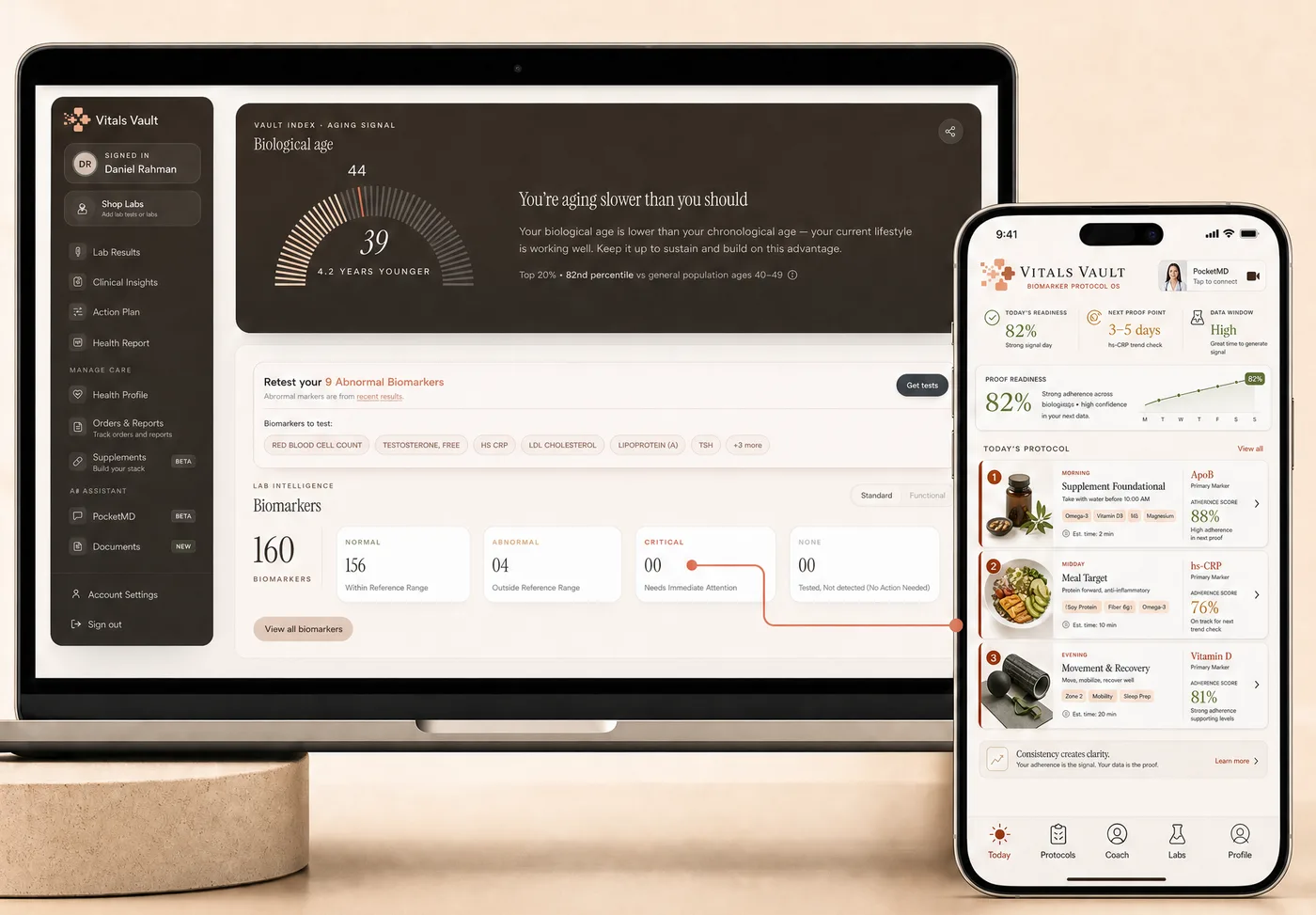
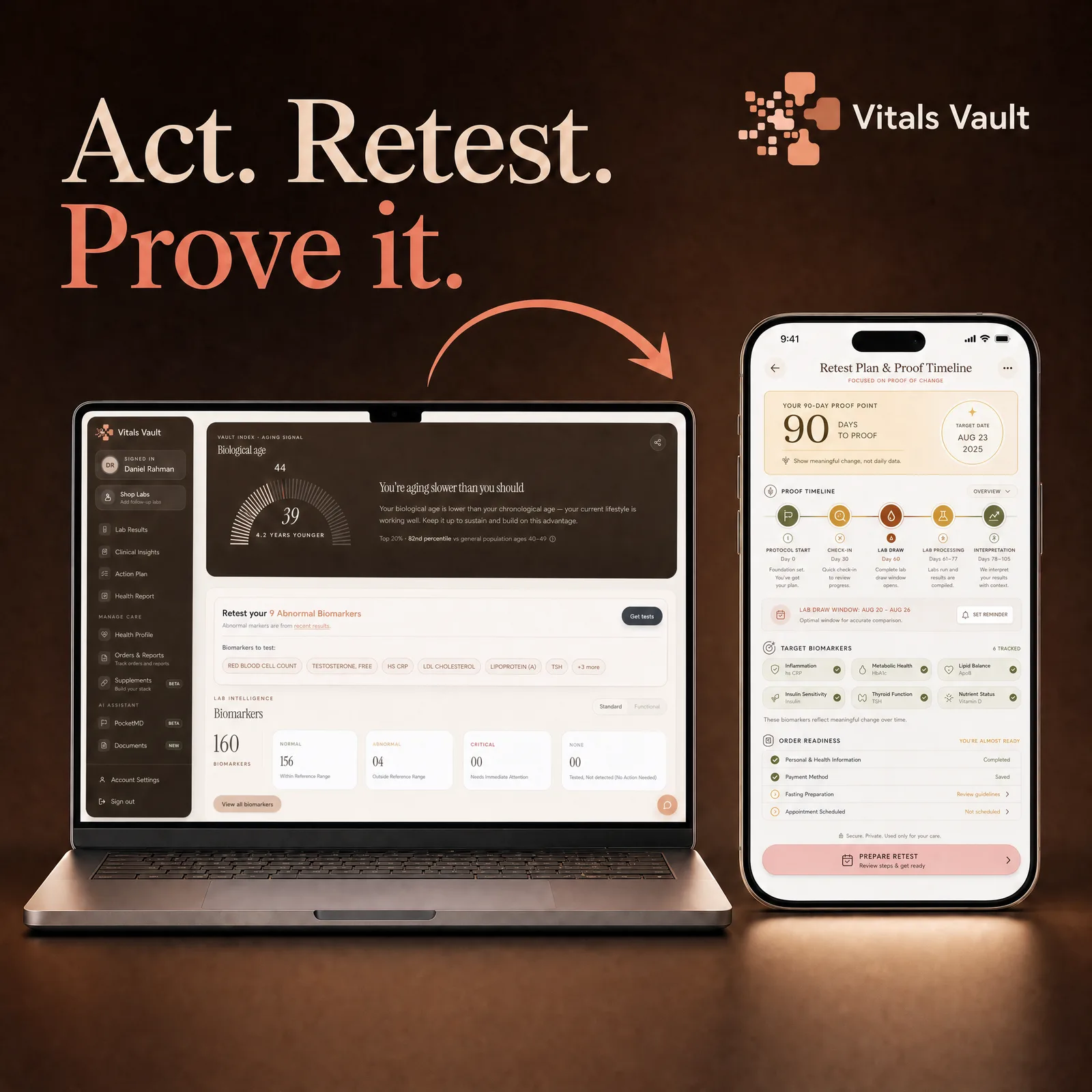
Biological age
Find out if your body is aging faster or slower than your actual age — and see how you rank against the general population.
39
Biological age
44
Actual age
4.2
Years younger
Free Testosterone
Results in about 7 days
% Testosterone Free (Percent Free Testosterone): What Your Result Means. It shows what percent of your testosterone is unbound and active, helping explain symptoms when totals mislead, with Quest labs via Vitals Vault.
% Testosterone Free (often called “percent free testosterone”) tells you what share of your total testosterone is circulating unbound to proteins. That unbound portion is the most immediately biologically active, because it can enter cells and signal directly. This marker is especially helpful when your symptoms do not match your total testosterone number. If binding proteins change, your total testosterone can look “fine” while the active fraction is lower (or higher) than expected. Because only a small fraction of testosterone is normally free—often around 1–3%—small shifts in binding can meaningfully change your percent free result. That is why this calculated value is usually interpreted alongside total testosterone, free testosterone, and binding proteins such as SHBG (sex hormone–binding globulin).
What to expect before and at your draw.
Sample Type
Blood
Collection Method
In person at a Quest Diagnostics location
Age
18+
This order includes the lab markers used for Free Testosterone.
Testosterone, Free
Included in this Quest Diagnostics order and reported in your Vitals Vault account.
Order Free Testosterone online.
Visit a Quest Diagnostics location near you for your blood draw. Appointments can be scheduled after checkout.
View easy-to-read results in your Vitals Vault account, with trends and a personalized action plan.
Included with every package
Function Health shows you numbers. Vitals Vault connects them — ratios, patterns, and a personalized action plan grounded in functional medicine.
Find out if your body is aging faster or slower than your actual age — and see how you rank against the general population.
39
Biological age
44
Actual age
4.2
Years younger
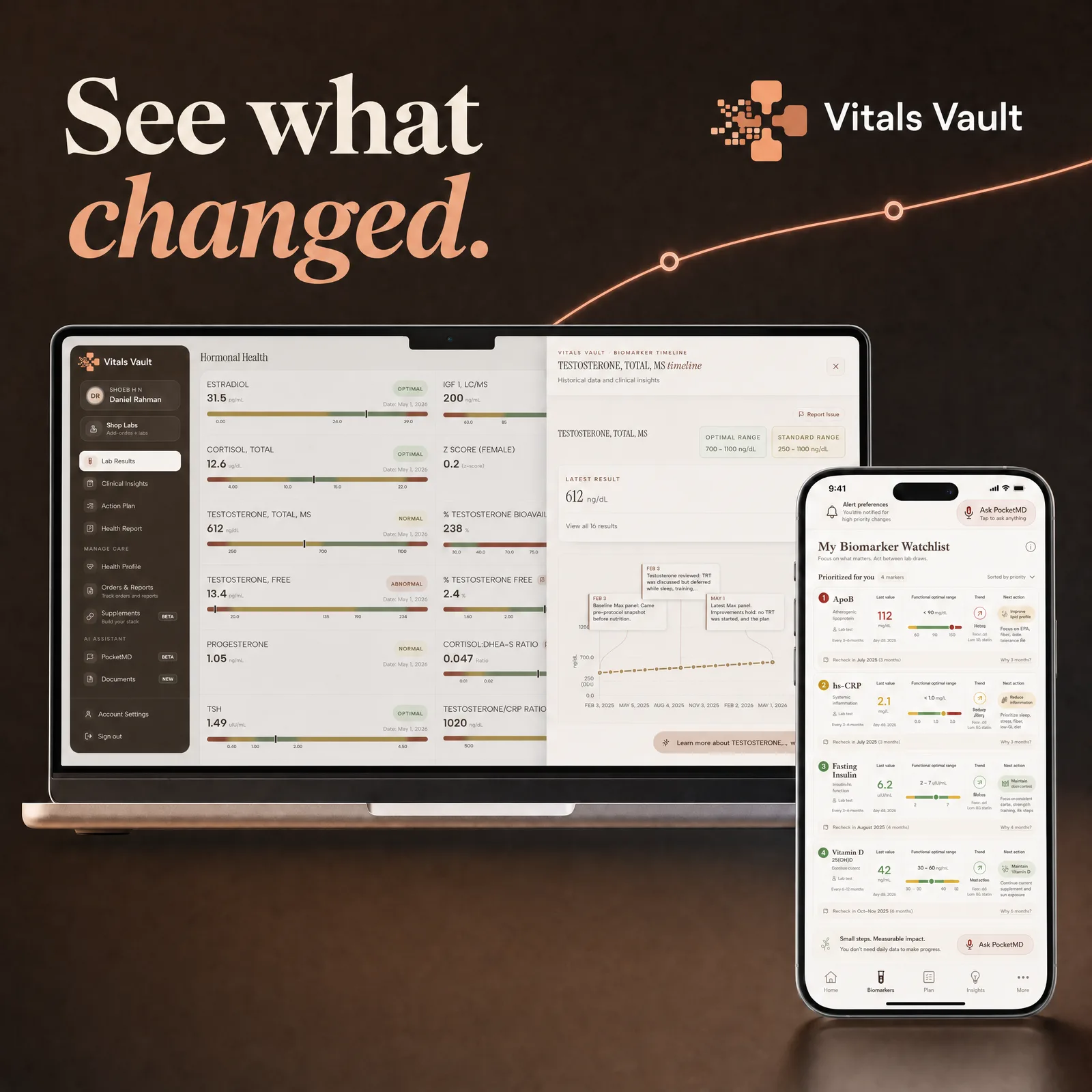
Turn lab data into what to do next—clear guidance on follow-ups, lifestyle context, and add-on testing when you need to go deeper. Make the healthy choice the obvious one.
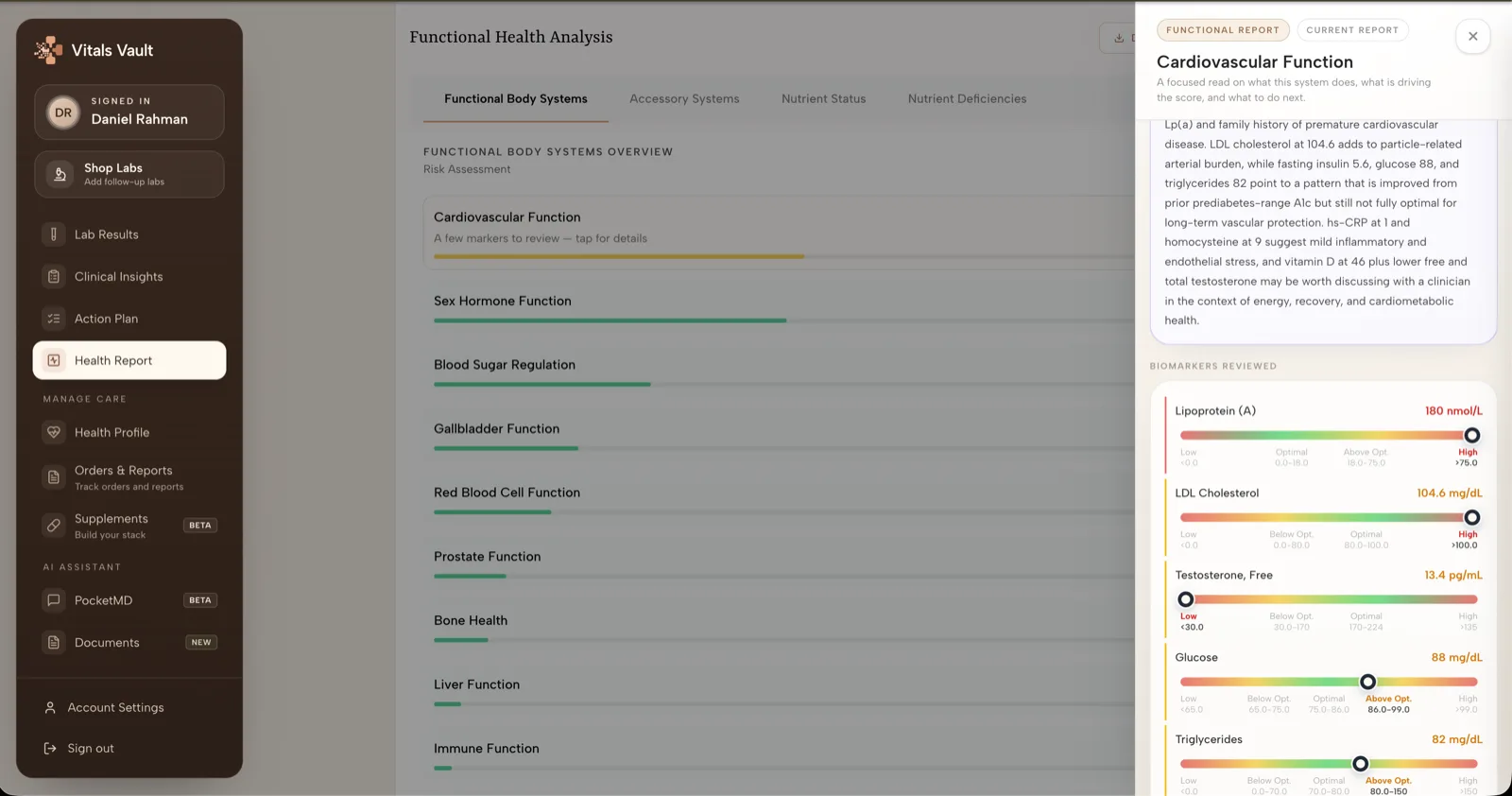
A personalized, plain-language walkthrough of your abnormal markers—reference ranges, pattern context, and what to watch next, grounded in your actual labs.
Personalized Insights
Clear Explanations
Actionable guidance
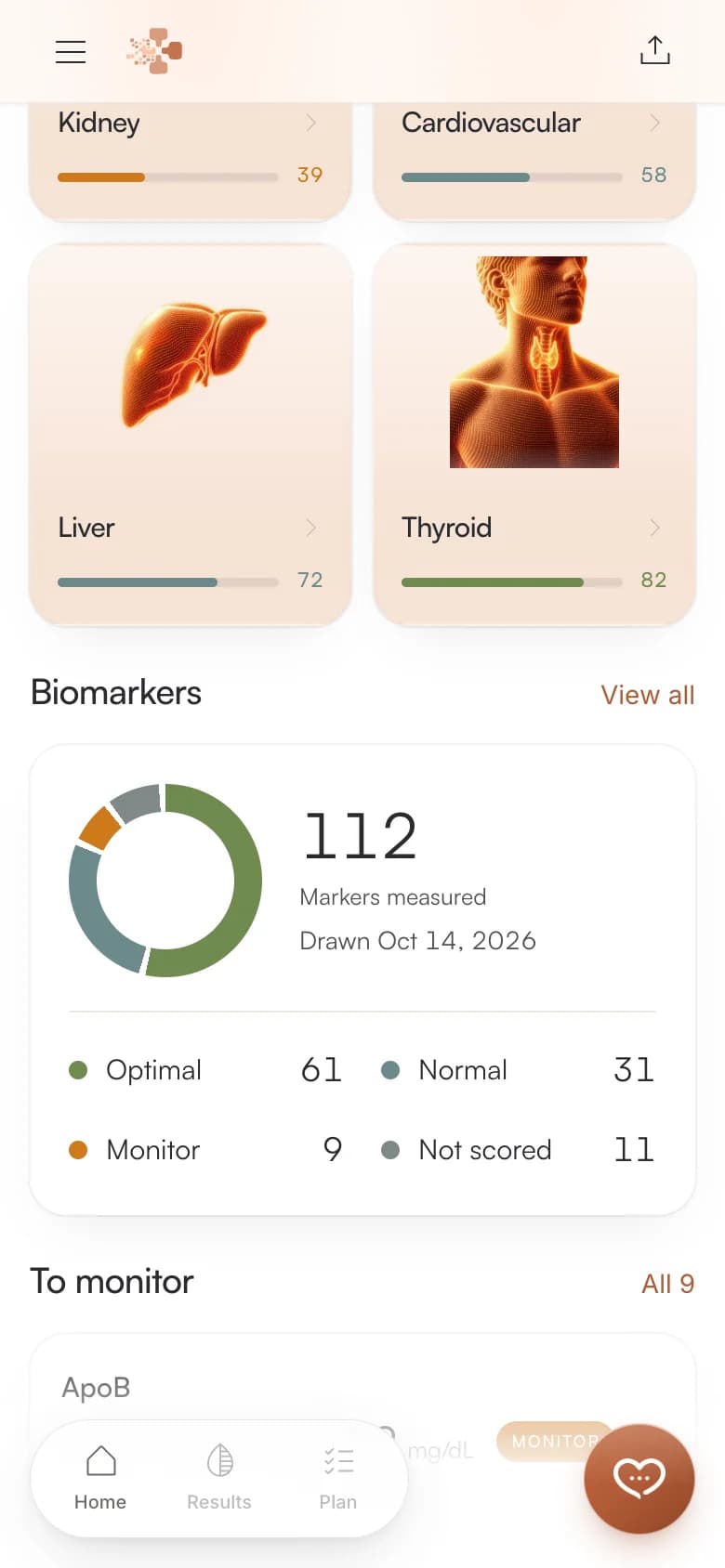
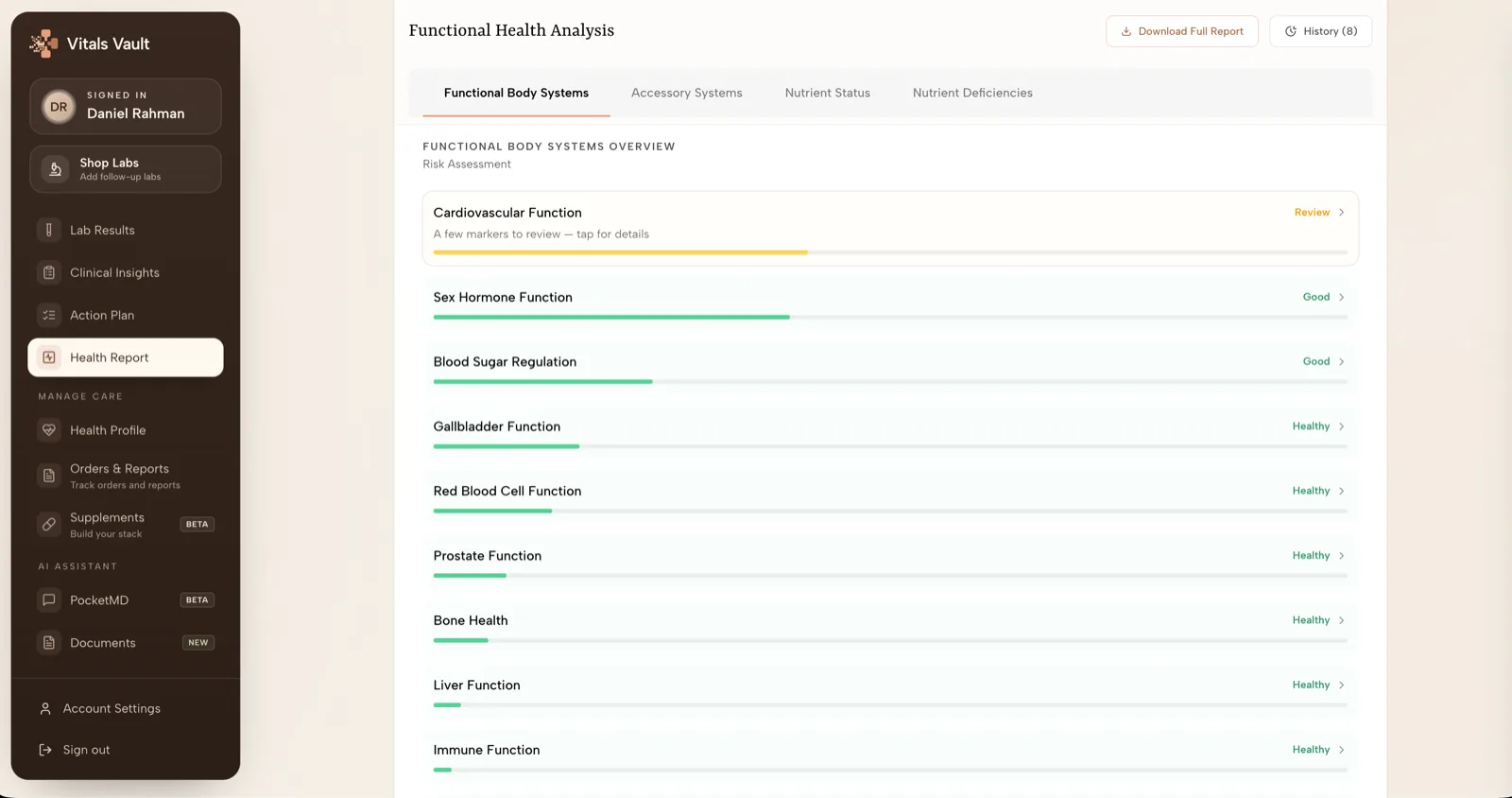
Explore your body systems with clear risk context — refresh your report, download the full PDF, and monitor hormones, heart, bone, and more in one place.
Explore hundreds of tests and panels, filter by concern, and manage your cart—member-exclusive pricing with quick checks and full-body options in one flow.
Wide test selection
300+ tests & panels available
Smart filtering
Find tests by symptoms or goals
Seamless ordering
Add to cart and manage easily
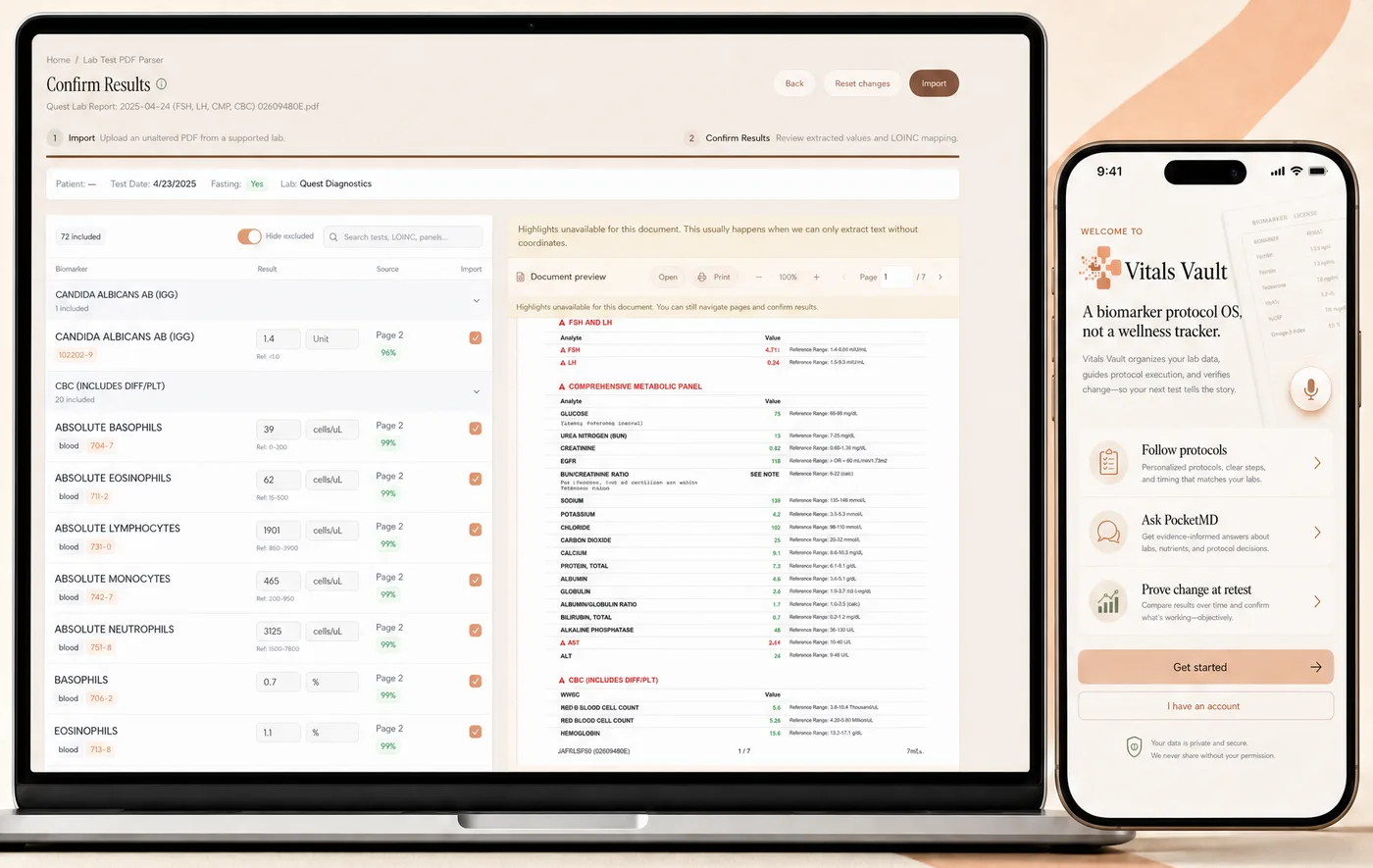
Upload past lab reports, search your documents, and keep appointments and results organized—our AI can extract biomarkers from PDFs so everything lives in one dashboard.
Browse longevity, nutrition, supplement, and movement protocols—structured plans you can follow with clear habits, labs, and targets tied to your profile.
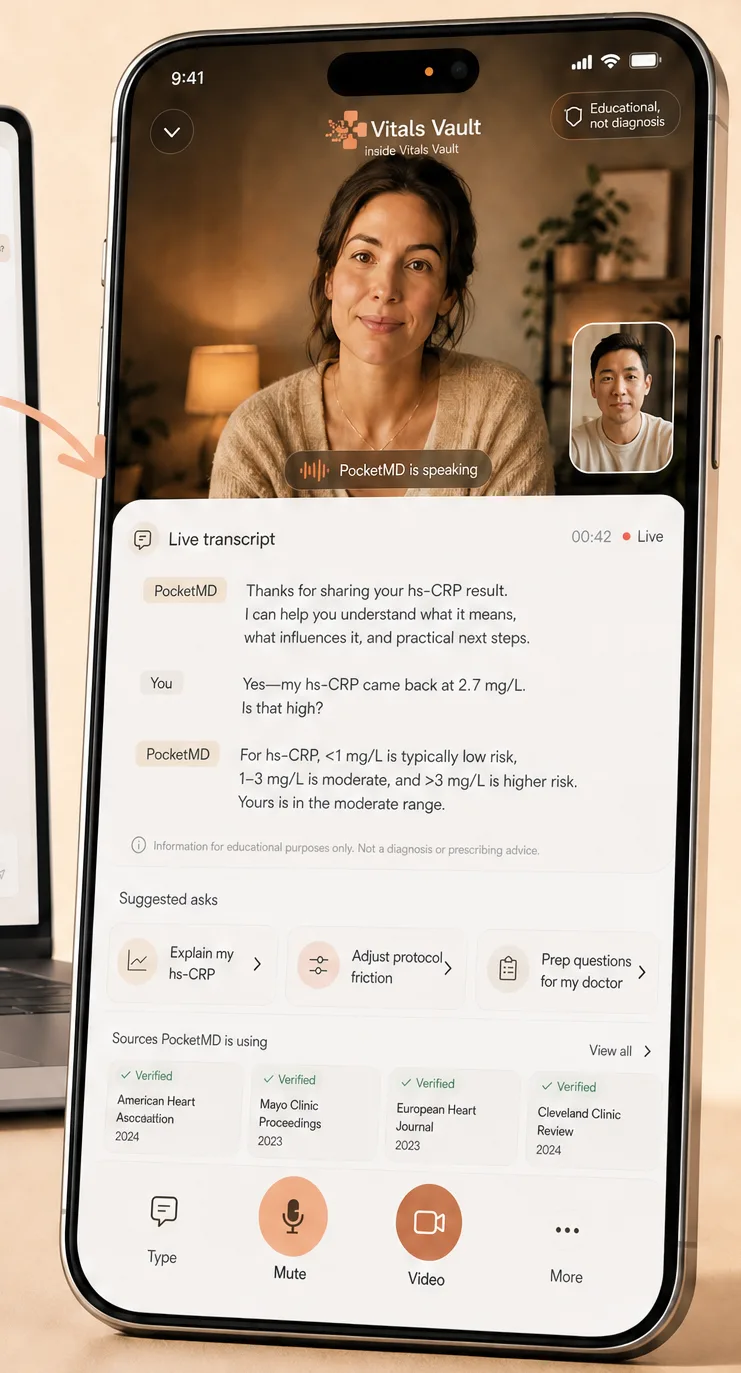
Ask for protocols, nutrition plans, supplement stacks, and education—context-aware suggestions powered by your labs and goals (beta experience).
Order online
Add Free Testosterone to your cart and check out. No doctor referral is required.
Visit a Quest lab
Provide your blood sample at a Quest Diagnostics location. Appointments can be scheduled after checkout.
Review in Vitals Vault
Results in about 7 days. They stay in your Vitals Vault account for trends and follow-up.
No special preparation is usually needed unless noted at checkout.
This order includes the lab markers used for Free Testosterone and reported in your Vitals Vault account.
Results
Results in about 7 days
HSA/FSA
Accepted
Who takes it
Must be taken by the purchaser
Preparation
No special preparation needed unless noted at checkout.
It shows what percent of your testosterone is unbound and active, helping explain symptoms when totals mislead, with Quest labs via Vitals Vault.


% Testosterone Free (often called “percent free testosterone”) tells you what share of your total testosterone is circulating unbound to proteins. That unbound portion is the most immediately biologically active, because it can enter cells and signal directly.
This marker is especially helpful when your symptoms do not match your total testosterone number. If binding proteins change, your total testosterone can look “fine” while the active fraction is lower (or higher) than expected.
Because only a small fraction of testosterone is normally free—often around 1–3%—small shifts in binding can meaningfully change your percent free result. That is why this calculated value is usually interpreted alongside total testosterone, free testosterone, and binding proteins such as SHBG (sex hormone–binding globulin).
You may want this test if you have symptoms that can fit with low androgen activity, such as fatigue, low libido, erectile dysfunction, mood changes, or reduced muscle mass, but your total testosterone result does not clearly explain what you are feeling.
It can also be useful if you are in a situation where binding proteins commonly shift. For example, aging and certain thyroid or liver patterns can raise SHBG and lower the free fraction, while insulin resistance and higher body fat can lower SHBG and raise the free fraction.
If you are monitoring hormone therapy or trying to understand why your testosterone-related symptoms change over time, percent free testosterone can add context to a single total testosterone number.
Testing supports clinician-directed care and better-informed decisions, but it cannot diagnose the cause of symptoms on its own. Your best next step is to interpret this result together with your overall hormone panel and health history.
This is a calculated ratio (not a standalone hormone assay) and should be interpreted in context with the underlying testosterone measurements and clinical picture.
from $49.99 at Quest Diagnostics
Results in days
Clear next steps
HSA / FSA
Vitals Vault makes it straightforward to order labs and understand what they mean without waiting weeks for an appointment. If you are comparing symptoms to your hormone numbers, percent free testosterone can be a practical way to see whether binding effects are changing your active testosterone signal.
After you order, you can complete your blood draw through the Quest network. When results are ready, you can use PocketMD to review your numbers, ask questions in plain language, and decide what to discuss with your clinician or what to recheck.
This approach is especially helpful for trend tracking. Percent free testosterone can move when SHBG changes, when weight or insulin sensitivity changes, or when medications affect binding, so having a consistent way to re-test can clarify whether a change is real or just noise.
% Testosterone Free is the percentage of your total testosterone that is circulating as free (unbound) testosterone. Testosterone in blood exists in three main “states”: tightly bound to SHBG, loosely bound to albumin, and free. The free portion is the fraction that can enter cells most readily and exert biological effects.
In many people, only a small portion of testosterone is free—often roughly 1–3%. That means your percent free result can change even when your body’s testosterone production has not changed, simply because binding proteins have changed.
This is why percent free testosterone is often used as a reality check on total testosterone. Total testosterone reflects the sum of bound and unbound hormone, while percent free testosterone reflects how much of that total is immediately available to tissues.
Your result is not interpreted in isolation. It is most useful when you also know your total testosterone, your free testosterone value, and factors that influence binding (especially SHBG, and sometimes albumin).
SHBG (sex hormone–binding globulin) binds testosterone strongly and reduces the free fraction. Albumin binds more loosely, and testosterone can more easily dissociate from it. When SHBG rises, percent free testosterone often falls even if total testosterone stays the same. When SHBG falls, percent free testosterone often rises, sometimes masking low production if you only look at total testosterone.
Percent free testosterone can be especially informative when your total testosterone is borderline, when symptoms and total testosterone do not match, or when you have known reasons for SHBG to be high or low. It can also help you and your clinician decide whether follow-up testing should focus on production (testes/ovaries and pituitary signaling) or on binding and metabolism.
Formula
Free Testosterone / Total Testosterone × 100
This calculation expresses free testosterone as a percentage of total testosterone. Your lab report may list the result as a percent (%), and it depends directly on the accuracy and timing of the underlying free testosterone and total testosterone measurements.
Because this is a derived value, it is most reliable when both inputs were measured from the same blood draw and interpreted with the same reference context. If either input is affected by timing (such as afternoon vs morning draws) or by assay differences, the percentage can shift even if your physiology has not meaningfully changed.
A low percent free testosterone result suggests that a smaller share of your total testosterone is unbound and readily available to tissues. One common reason is higher SHBG, which can increase with aging and can also rise with certain liver or thyroid patterns. If your total testosterone is normal but your percent free is low, your symptoms may reflect reduced active testosterone signaling rather than low production alone. A useful next step is to review SHBG (and sometimes albumin) and confirm that your testosterone testing was done under consistent conditions.
An in-range result suggests that the balance between bound and free testosterone is typical for the reference range used by your lab. This does not automatically mean your testosterone status is “perfect,” because total testosterone, free testosterone (absolute value), symptoms, and SHBG can still tell a different story. If you feel well and your related markers are consistent, an in-range percent free result often supports that binding is not the main issue. If symptoms persist, it can help narrow your focus to other contributors such as sleep, thyroid function, medications, mood, or overall metabolic health.
A high percent free testosterone result means a larger share of your total testosterone is unbound. This can happen when SHBG is lower than usual, which is often seen with obesity or insulin resistance and can also occur with hypothyroid patterns or certain kidney protein-loss conditions. A higher percentage does not always mean you have “high testosterone,” because the total amount may be normal or even low. If your percent free is high, it is worth checking whether SHBG is low and whether metabolic factors are influencing hormone binding.
SHBG is the biggest driver of changes in percent free testosterone, and it can shift with age, thyroid status, liver health, and some medications (including certain anticonvulsants). Body composition and insulin sensitivity also matter, because lower SHBG is commonly associated with higher body fat and insulin resistance. Timing and consistency of testing can influence results as well, since testosterone has a daily rhythm and can vary day to day. Finally, because this is a calculated marker, differences in how free testosterone and total testosterone are measured can affect the percentage, so trending is most meaningful when you repeat testing in a similar way.
Many labs consider only a small fraction of testosterone to be free, often around 1–3%, but “normal” depends on the lab’s reference range and the method used for the underlying free and total testosterone measurements. The most useful interpretation compares your percent free result with your total testosterone, free testosterone (absolute value), SHBG, symptoms, and testing conditions (such as morning vs afternoon draw). If you are trending results, try to use the same lab and similar timing so changes are easier to trust.
No. Free testosterone is an amount (a concentration) of unbound testosterone in your blood. % Testosterone Free is a percentage that describes how large the free portion is relative to your total testosterone. You can have a normal percentage with a low total amount, or a high percentage with a low total amount, so it helps to look at both the percent and the absolute free testosterone value.
This often happens when SHBG is higher than usual. SHBG binds testosterone tightly, which can keep total testosterone in a normal range while reducing the unbound fraction that can act on tissues. Aging, certain thyroid patterns (including hyperthyroidism), liver-related changes, and some medications can raise SHBG. In that situation, checking SHBG and confirming consistent testing conditions can clarify what is driving the mismatch.
A higher percentage commonly reflects lower SHBG, which can occur with obesity and insulin resistance and may also be seen with hypothyroid patterns or certain kidney conditions that affect proteins. A high percentage does not automatically mean your total testosterone is high; it may simply mean less of your testosterone is bound. Looking at total testosterone, SHBG, and metabolic markers can help explain why the percentage is elevated.
Fasting is not always required for testosterone testing, but many people schedule hormone labs in the morning and may combine them with fasting metabolic labs. The bigger issue for interpretability is consistency: try to test at a similar time of day, under similar conditions, and avoid major acute stressors when possible. If your clinician gave you specific instructions based on your broader panel, follow those directions.
Testosterone tends to be higher in the morning, especially in younger men, and it can vary day to day. For that reason, many clinicians prefer morning testing for comparison and repeatability. If you are monitoring a trend, the most helpful approach is to repeat your labs at a similar time of day and under similar conditions so the percent free calculation reflects physiology rather than timing differences.
Often, yes. SHBG is a key reason percent free testosterone shifts independent of testosterone production. If your percent free is low, SHBG may be high; if your percent free is high, SHBG may be low. Testing SHBG (and sometimes albumin) can help you and your clinician understand whether the issue is primarily binding, production, or a combination.
Purchase online through Vitals Vault. A licensed clinician reviews and approves your order, then you receive a digital requisition for a Quest Diagnostics blood draw.
Samples are collected in person at Quest Diagnostics locations nationwide. After checkout you can schedule your visit at a convenient site.
Most results in 3–5 business days. You can view them securely in your Vitals Vault account.
No separate referral appointment is required. Clinician review is included in the online order flow.
Yes. Eligible HSA/FSA cards can be used at checkout for qualifying lab orders.
Results are available in your secure Vitals Vault account. You control who you share them with, subject to applicable law.
Blood glucose shows the amount of sugar in your blood at a single moment. A1c (hemoglobin A1c) estimates your average blood sugar over roughly the past 8–12 weeks. Comparing them helps explain whether your long-term average lines up with your fasting glucose on draw day.
It helps you understand how this marker fits into your broader metabolic picture, with results tracked in your Vitals Vault account.
Elevated values can signal higher metabolic risk. Many people start with nutrition, activity, sleep, and weight management, then retest and review results with a clinician. This test is educational and does not replace medical advice or diagnosis.
Your sample is processed at CLIA-certified Quest Diagnostics laboratories. Results should still be interpreted with a qualified clinician alongside your history, symptoms, and other labs.
Consumer-initiated testing through Vitals Vault is limited to adults 18+ so ordering and interpretation stay aligned with clinical best practices for this channel.