01
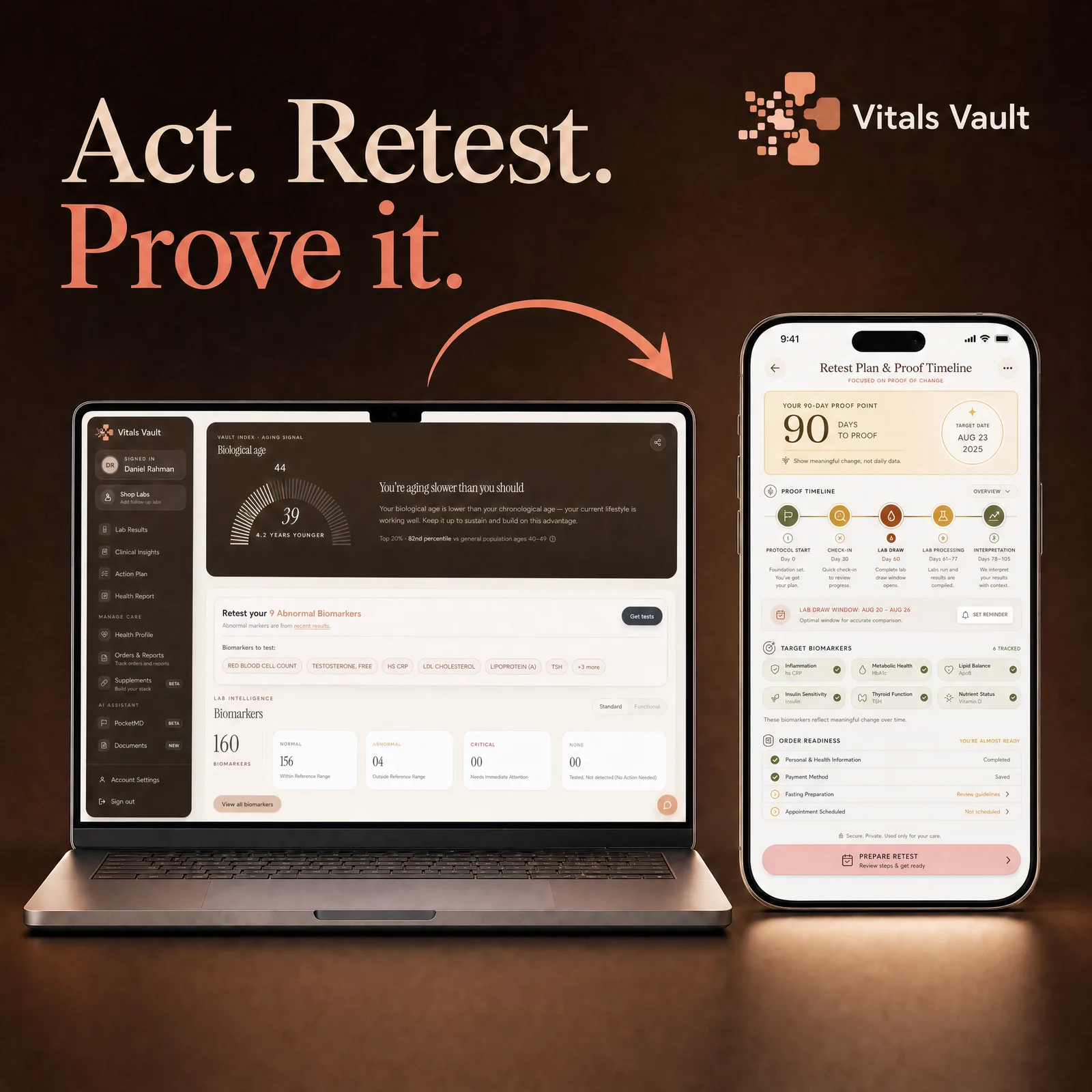
Biological age
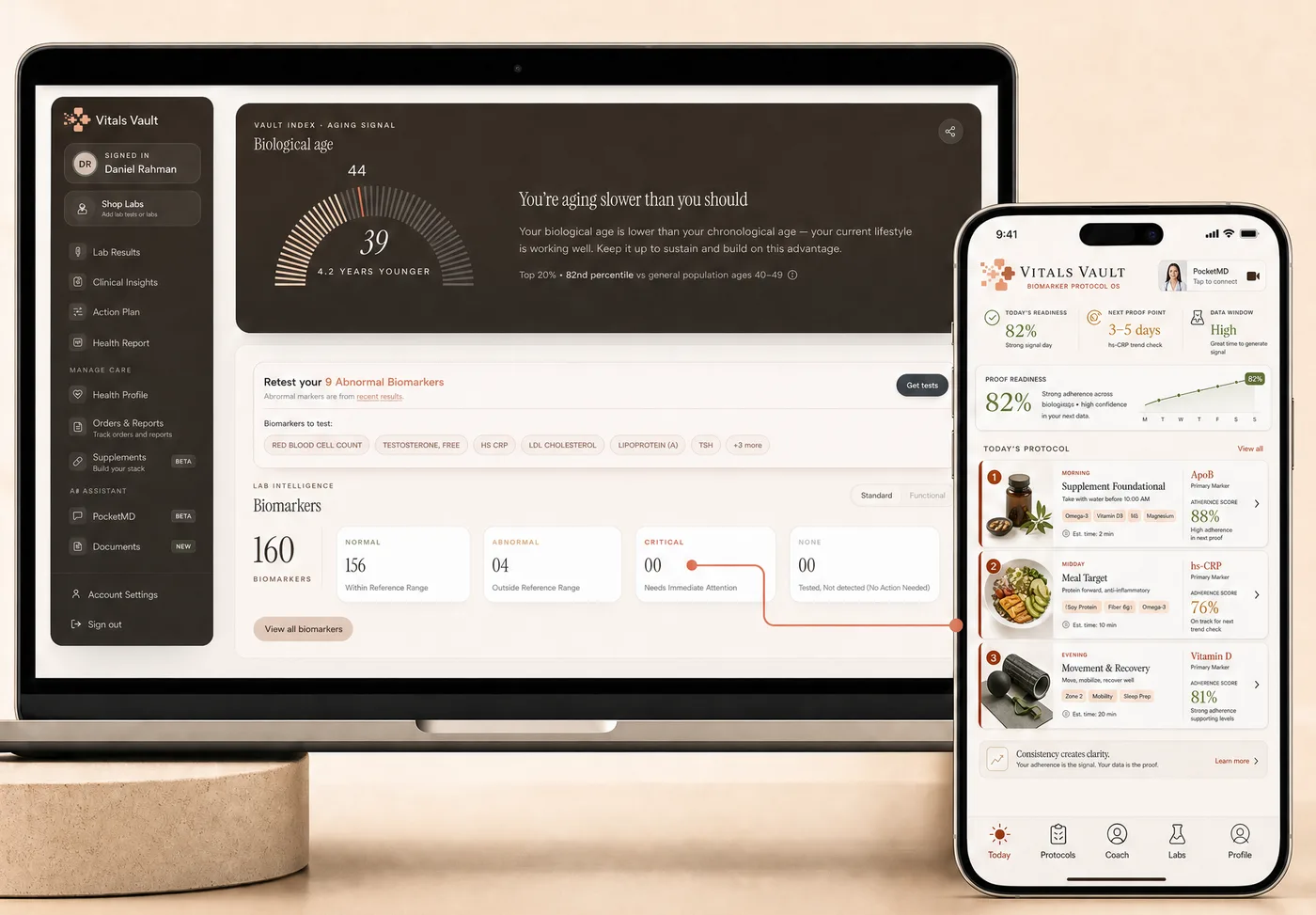
Find out if your body is aging faster or slower than your actual age — and see how you rank against the general population.
39
Biological age
44
Actual age
4.2
Years younger
PSA (Auto-Adds Free PSA if Elevated)
Results in about 4 days
PSA Total with Reflex to PSA Free: how to interpret your results. It measures PSA in your blood and, if elevated, adds free PSA to refine risk; order through Vitals Vault and test at Quest locations nationwide.
This test starts with a PSA total (prostate-specific antigen) blood level and automatically adds a free PSA measurement if your total PSA crosses the lab’s reflex threshold. That “reflex” step matters because the free-to-total pattern can help clarify whether a borderline or mildly elevated PSA is more consistent with benign prostate enlargement (BPH) or warrants closer follow-up. PSA is not a cancer diagnosis. It is a signal that needs context, including your age, prostate size, urinary symptoms, medications, and whether you recently had anything that can temporarily raise PSA. If you are deciding whether to screen, recheck an elevated result, or monitor known BPH, this combined approach can reduce unnecessary repeat blood draws and give you a more actionable next-step conversation with your clinician.
What to expect before and at your draw.
Sample Type
Blood
Collection Method
In person at a Quest Diagnostics location
Age
18+
This order includes the lab markers used for PSA (Auto-Adds Free PSA if Elevated).
Psa, Total
Included in this Quest Diagnostics order and reported in your Vitals Vault account.
Order PSA (Auto-Adds Free PSA if Elevated) online.
Visit a Quest Diagnostics location near you for your blood draw. Appointments can be scheduled after checkout.
View easy-to-read results in your Vitals Vault account, with trends and a personalized action plan.
Included with every package
Function Health shows you numbers. Vitals Vault connects them — ratios, patterns, and a personalized action plan grounded in functional medicine.
Find out if your body is aging faster or slower than your actual age — and see how you rank against the general population.
39
Biological age
44
Actual age
4.2
Years younger
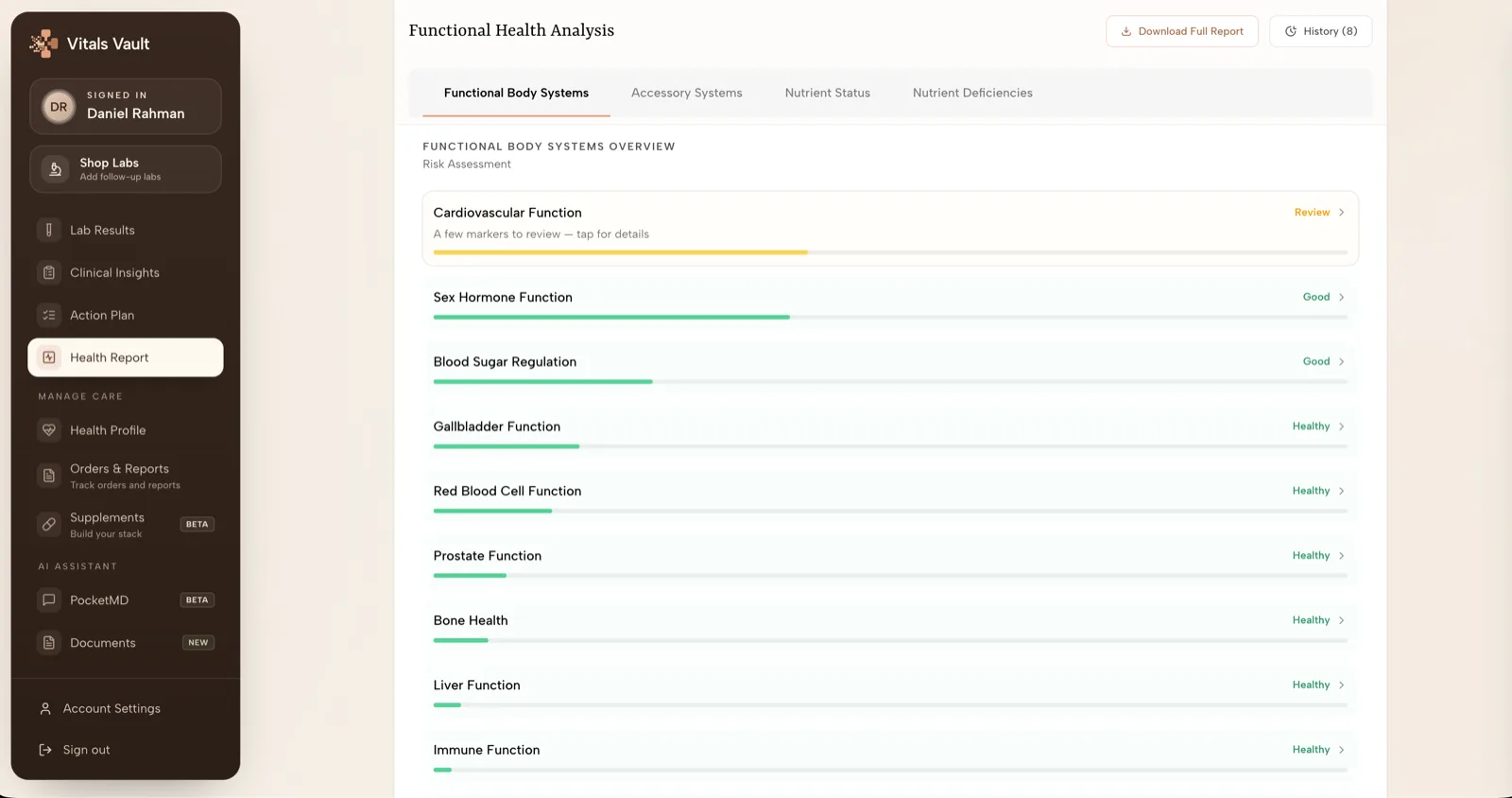
Turn lab data into what to do next—clear guidance on follow-ups, lifestyle context, and add-on testing when you need to go deeper. Make the healthy choice the obvious one.
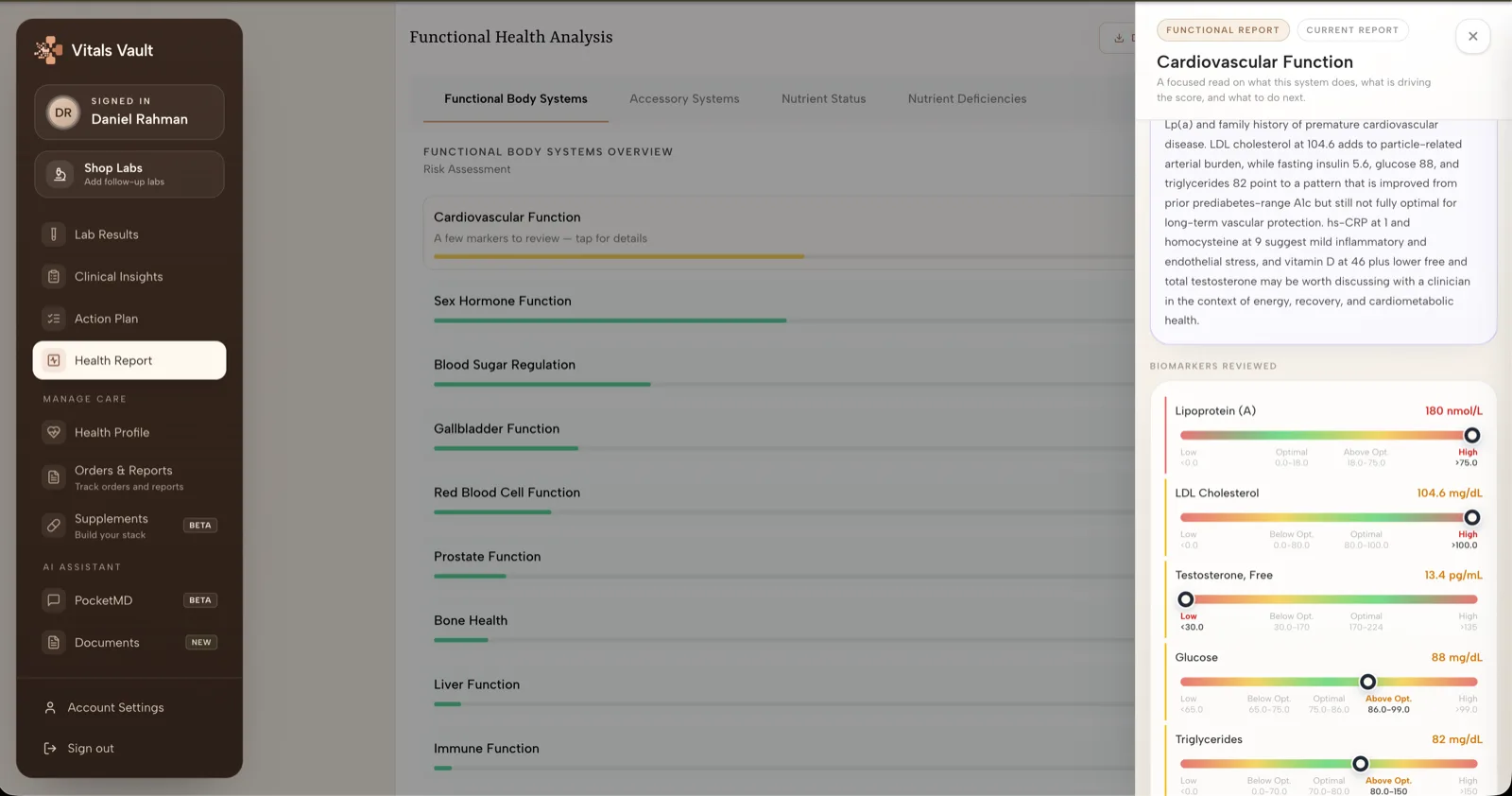
A personalized, plain-language walkthrough of your abnormal markers—reference ranges, pattern context, and what to watch next, grounded in your actual labs.
Personalized Insights
Clear Explanations
Actionable guidance
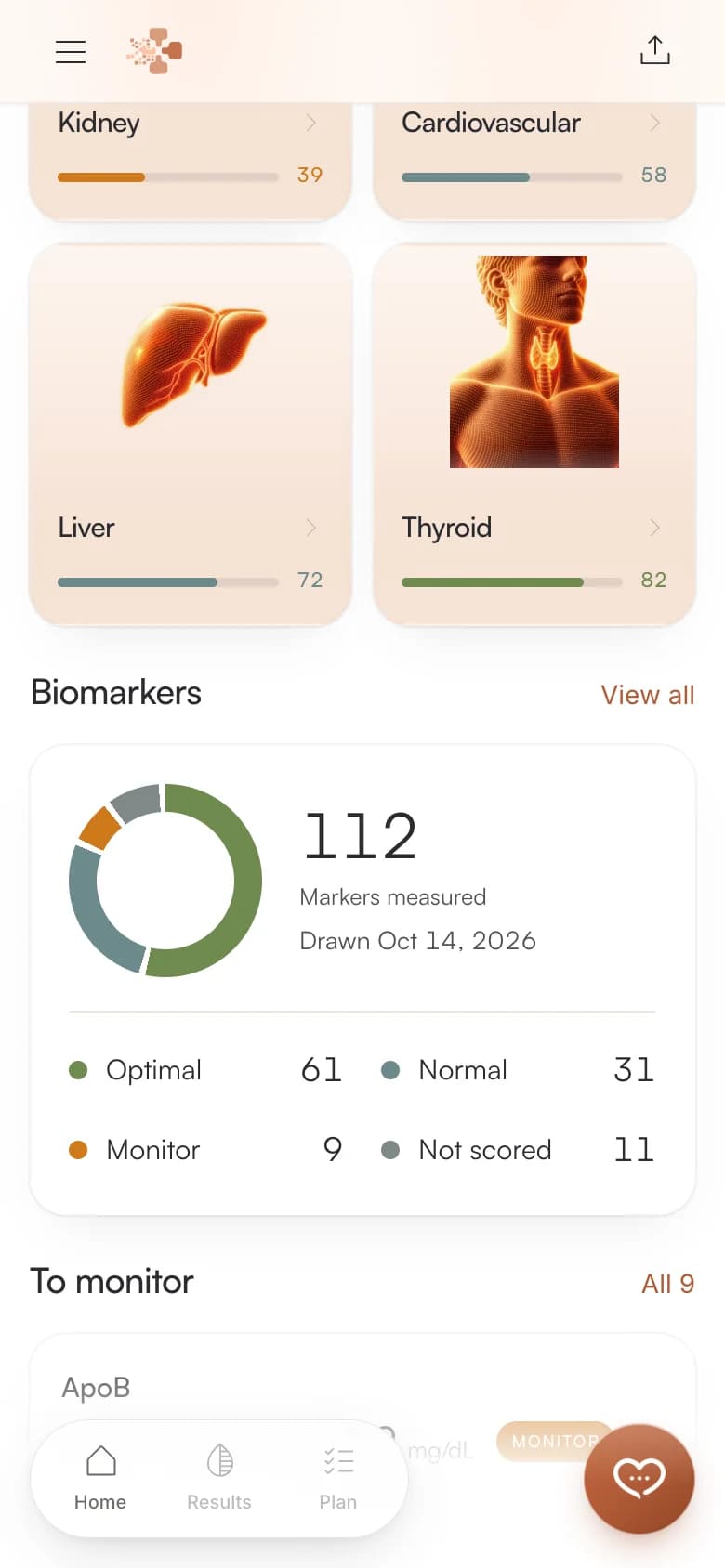
Explore your body systems with clear risk context — refresh your report, download the full PDF, and monitor hormones, heart, bone, and more in one place.
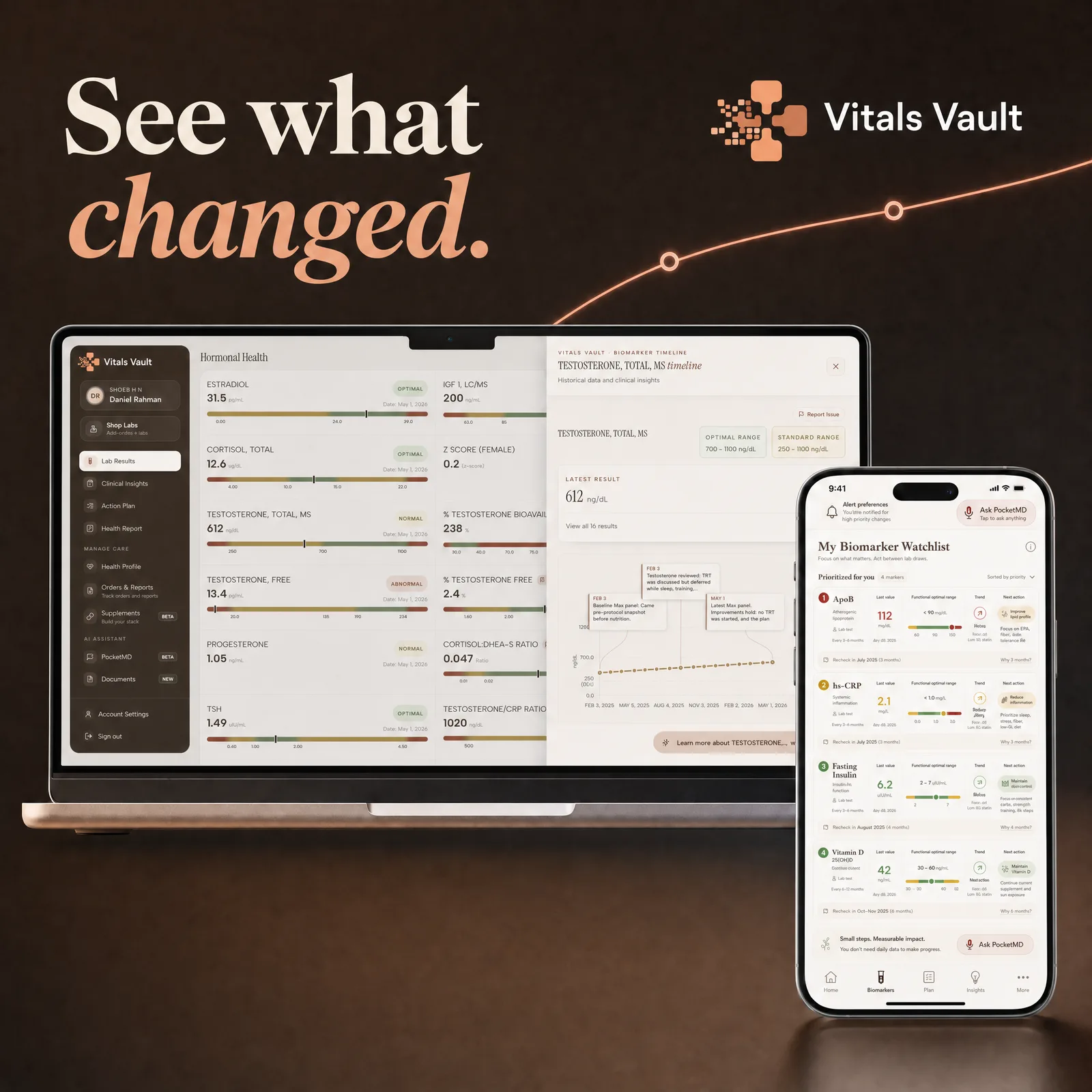
Explore hundreds of tests and panels, filter by concern, and manage your cart—member-exclusive pricing with quick checks and full-body options in one flow.
Wide test selection
300+ tests & panels available
Smart filtering
Find tests by symptoms or goals
Seamless ordering
Add to cart and manage easily
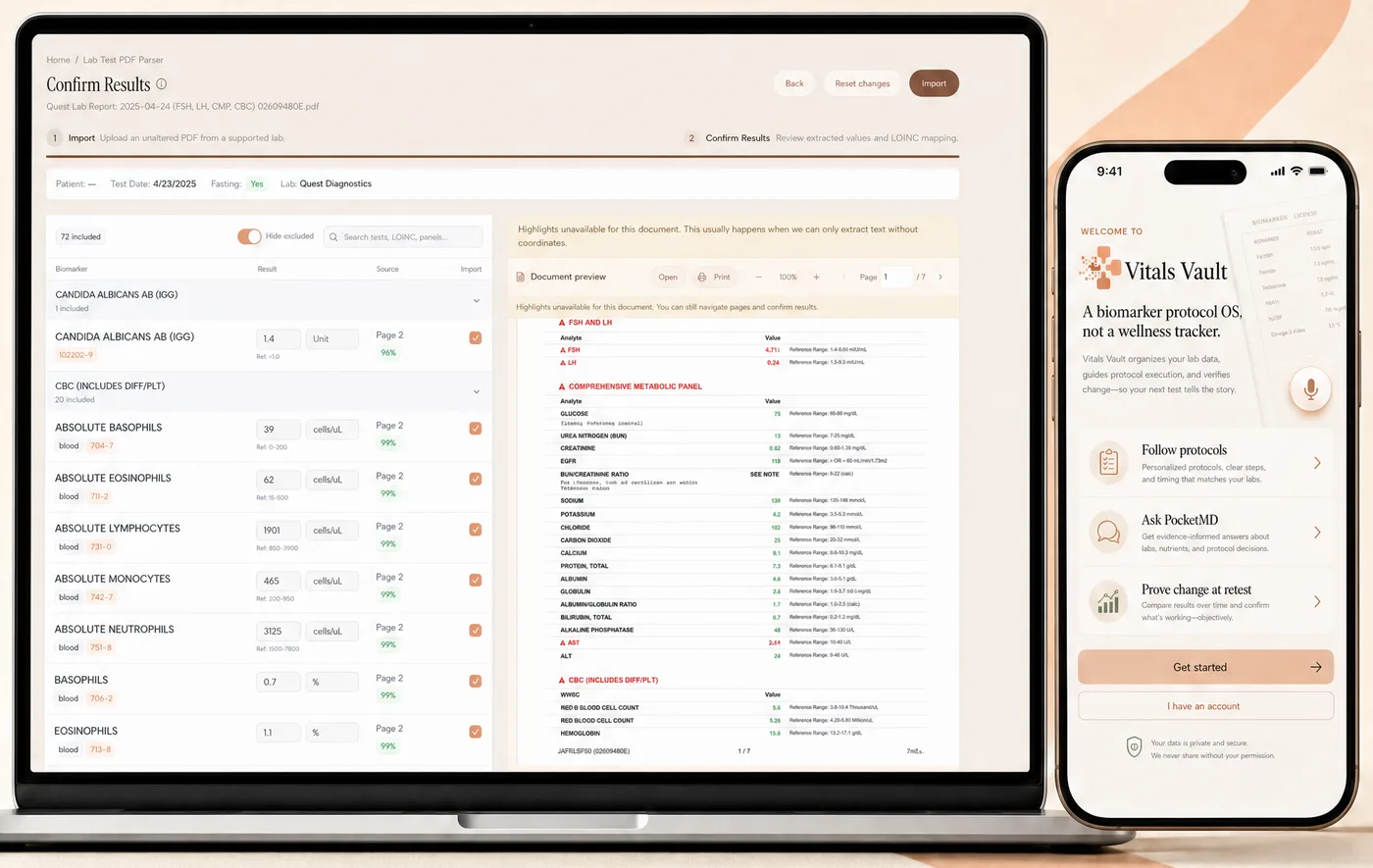
Upload past lab reports, search your documents, and keep appointments and results organized—our AI can extract biomarkers from PDFs so everything lives in one dashboard.
Browse longevity, nutrition, supplement, and movement protocols—structured plans you can follow with clear habits, labs, and targets tied to your profile.
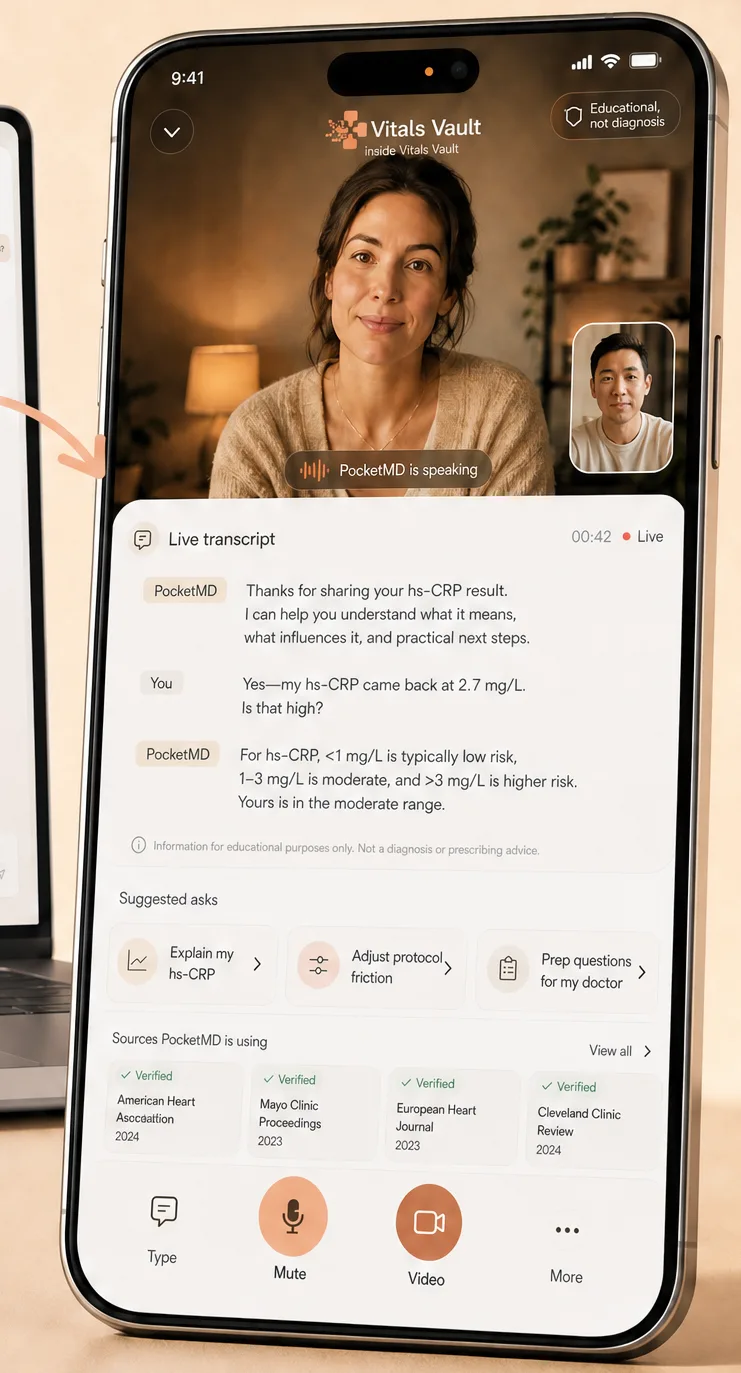
Ask for protocols, nutrition plans, supplement stacks, and education—context-aware suggestions powered by your labs and goals (beta experience).
Order online
Add PSA (Auto-Adds Free PSA if Elevated) to your cart and check out. No doctor referral is required.
Visit a Quest lab
Provide your blood sample at a Quest Diagnostics location. Appointments can be scheduled after checkout.
Review in Vitals Vault
Results in about 4 days. They stay in your Vitals Vault account for trends and follow-up.
No special preparation is usually needed unless noted at checkout.
This order includes the lab markers used for PSA (Auto-Adds Free PSA if Elevated) and reported in your Vitals Vault account.
Results
Results in about 4 days
HSA/FSA
Accepted
Who takes it
Must be taken by the purchaser
Preparation
No special preparation needed unless noted at checkout.
It measures PSA in your blood and, if elevated, adds free PSA to refine risk; order through Vitals Vault and test at Quest locations nationwide.


This test starts with a PSA total (prostate-specific antigen) blood level and automatically adds a free PSA measurement if your total PSA crosses the lab’s reflex threshold. That “reflex” step matters because the free-to-total pattern can help clarify whether a borderline or mildly elevated PSA is more consistent with benign prostate enlargement (BPH) or warrants closer follow-up.
PSA is not a cancer diagnosis. It is a signal that needs context, including your age, prostate size, urinary symptoms, medications, and whether you recently had anything that can temporarily raise PSA.
If you are deciding whether to screen, recheck an elevated result, or monitor known BPH, this combined approach can reduce unnecessary repeat blood draws and give you a more actionable next-step conversation with your clinician.
You might consider this test if you are discussing prostate cancer screening and you want a result that is easier to interpret than PSA total alone. Many people feel stuck between “screening saves lives” and “screening causes unnecessary worry.” A reflex-to-free PSA approach is designed for that gray zone, because it adds extra information only when it is most useful.
This test is also commonly used when you already have a PSA result that is higher than expected for you, especially if it is in a borderline range where short-term variation is common. If your PSA is elevated, the free PSA component can help your clinician decide whether to repeat the test, look for reversible causes (like inflammation), or consider additional evaluation.
You may also benefit if you have lower urinary tract symptoms that could be from BPH, such as weak stream, hesitancy, or getting up at night to urinate. PSA can rise with BPH, and trending PSA over time can be more informative than a single number.
Testing supports clinician-directed care and shared decision-making. It can help you choose sensible next steps, but it cannot tell you on its own whether you do or do not have prostate cancer.
This is a laboratory blood test typically performed in a CLIA-certified lab; results should be interpreted with your clinical history and are not a standalone diagnosis of cancer.
from $14.99 at Quest Diagnostics
Results in days
Clear next steps
HSA / FSA
Vitals Vault lets you order PSA Total with Reflex to PSA Free directly, so you can move from uncertainty to a clear baseline and a plan for follow-up. Because the free PSA measurement is added only when your total PSA meets the reflex criteria, you avoid ordering multiple tests “just in case.”
After your results post, you can use PocketMD to ask practical questions like whether your result should be repeated, what factors could have influenced it, and what additional labs might add context. That is especially helpful if you are trying to decide between watchful waiting, repeating PSA after avoiding confounders, or discussing imaging and referral.
If you are tracking PSA over time, Vitals Vault makes it easier to keep your results organized so you can focus on trend and rate of change, not just one isolated number.
PSA (prostate-specific antigen) is a protein made mainly by prostate tissue. A small amount normally enters your bloodstream, and the measured value is called PSA total.
In blood, PSA exists in different forms. Some PSA circulates attached to other proteins (bound PSA), and some circulates on its own (free PSA). “PSA Total with Reflex to PSA Free” means the lab measures total PSA first, and if it is above a preset threshold, the lab automatically measures free PSA on the same sample.
The free PSA result is often used to calculate a free-to-total PSA percentage. In general, a lower percentage of free PSA (more PSA is bound) is associated with a higher likelihood that an elevated PSA is related to prostate cancer rather than benign causes, while a higher percentage of free PSA is more consistent with benign enlargement. This is not absolute, but it can be helpful when total PSA is mildly elevated and you are deciding what to do next.
PSA can increase when the prostate is larger (BPH), inflamed (prostatitis), irritated by recent ejaculation, or affected by urinary retention or instrumentation. Because PSA is sensitive but not specific, the best interpretation usually combines your PSA value, your symptoms, your exam history, and your prior PSA trend.
A reflex test is triggered by a predefined rule. If your total PSA is below the reflex cutoff, you typically will not see a free PSA number reported because it was not run. If your total PSA meets the cutoff, the lab runs free PSA automatically, which helps avoid delays and repeat visits.
A low PSA total is generally reassuring, especially if you have no concerning symptoms and your result is stable over time. PSA can be very low in younger people and may remain low for years. If you are taking medications that shrink the prostate (such as 5-alpha-reductase inhibitors), PSA can be artificially lowered, so your clinician may interpret your value differently. A low PSA does not completely rule out prostate cancer, but it makes clinically significant disease less likely in many screening contexts.
An “in-range” PSA depends on the lab reference interval and your personal baseline, including age and prostate size. A stable PSA over time is often more meaningful than a single value, so keeping prior results for comparison helps. If your total PSA does not meet the reflex threshold, free PSA may not be reported, which is normal for this test. If you are screening, your next step is usually deciding when to repeat based on your risk factors and prior trend.
A high PSA total means more PSA is reaching the bloodstream than expected, but it does not tell you the cause by itself. When free PSA is reported, the free-to-total pattern can add context: a lower free PSA percentage tends to be more concerning, while a higher percentage is more consistent with benign enlargement, especially when total PSA is only mildly elevated. Your clinician may recommend repeating PSA after avoiding temporary triggers, evaluating for infection or inflammation, or discussing additional assessment such as imaging or specialist referral. Rapid rises over time can also matter, so trend and timing are important.
PSA can rise temporarily after ejaculation, vigorous cycling, prostatitis, urinary retention, or recent procedures involving the prostate or urethra. BPH commonly increases PSA because there is more prostate tissue producing it. Certain medications can lower PSA (notably 5-alpha-reductase inhibitors), and that needs to be accounted for when comparing to reference ranges or prior results. Lab methods and reference intervals can vary, so it helps to compare results from the same lab when you are trending over time.
It means your blood sample is tested for PSA total first. If the total PSA is above a preset cutoff, the lab automatically runs free PSA on the same sample and may report a free-to-total PSA percentage to help interpret a borderline elevation.
“Normal” depends on the lab’s reference range, your age, and your baseline. Many clinicians focus on your PSA trend over time and whether the value is unexpected for you rather than relying on one universal cutoff.
In general, a higher percentage of free PSA is more consistent with benign causes of PSA elevation, while a lower percentage can be more concerning. The exact cut points and how they apply to you depend on your total PSA level, age, and overall risk, so it is best used as part of a bigger decision about follow-up.
Fasting is not usually required for PSA testing. What matters more is avoiding temporary triggers that can raise PSA, such as ejaculation or heavy cycling shortly before the blood draw, and letting your clinician know about recent infections, urinary retention, or procedures.
Yes. Ejaculation can temporarily raise PSA in some people, and activities that put pressure on the perineum (like long bike rides) may also affect PSA for a short period. If your result is borderline high, repeating the test after avoiding these triggers is a common next step.
Repeat intervals vary based on age, baseline PSA, risk factors, and whether you are monitoring an elevated value. If PSA is unexpectedly high, a repeat test after a short interval may be used to confirm the result once temporary influences are addressed.
No. PSA is a sensitive marker but not specific to cancer, and BPH or inflammation can raise it. A high PSA is a reason to look for context, consider repeating the test, and discuss whether additional evaluation is appropriate.
Purchase online through Vitals Vault. A licensed clinician reviews and approves your order, then you receive a digital requisition for a Quest Diagnostics blood draw.
Samples are collected in person at Quest Diagnostics locations nationwide. After checkout you can schedule your visit at a convenient site.
Most results in 3–5 business days. You can view them securely in your Vitals Vault account.
No separate referral appointment is required. Clinician review is included in the online order flow.
Yes. Eligible HSA/FSA cards can be used at checkout for qualifying lab orders.
Results are available in your secure Vitals Vault account. You control who you share them with, subject to applicable law.
Blood glucose shows the amount of sugar in your blood at a single moment. A1c (hemoglobin A1c) estimates your average blood sugar over roughly the past 8–12 weeks. Comparing them helps explain whether your long-term average lines up with your fasting glucose on draw day.
It helps you understand how this marker fits into your broader metabolic picture, with results tracked in your Vitals Vault account.
Elevated values can signal higher metabolic risk. Many people start with nutrition, activity, sleep, and weight management, then retest and review results with a clinician. This test is educational and does not replace medical advice or diagnosis.
Your sample is processed at CLIA-certified Quest Diagnostics laboratories. Results should still be interpreted with a qualified clinician alongside your history, symptoms, and other labs.
Consumer-initiated testing through Vitals Vault is limited to adults 18+ so ordering and interpretation stay aligned with clinical best practices for this channel.