01
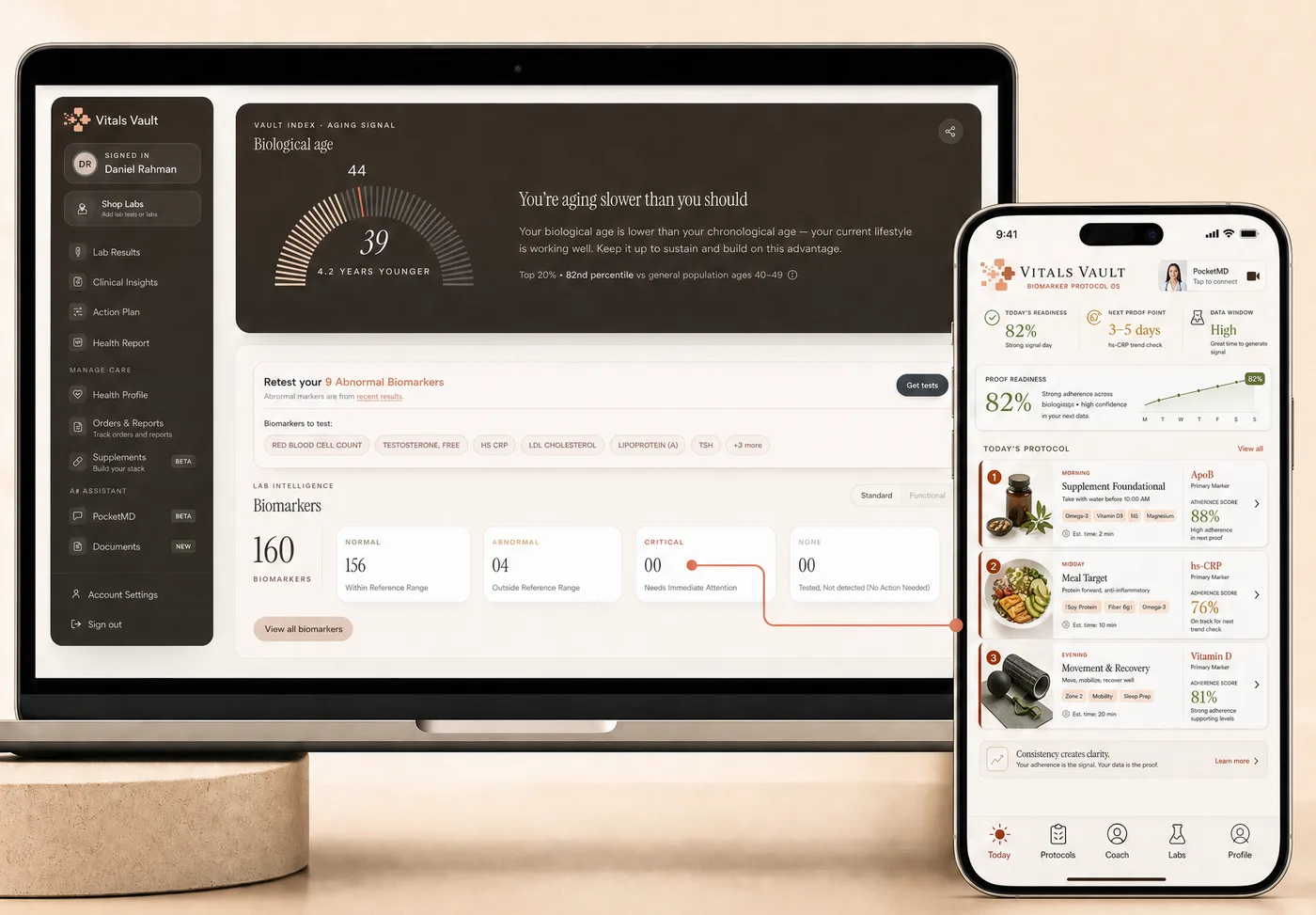
Biological age
Find out if your body is aging faster or slower than your actual age — and see how you rank against the general population.
39
Biological age
44
Actual age
4.2
Years younger
Cortisol
Results in about 4 days
Cortisol:DHEA-S Ratio: What your results mean. It shows how much cortisol you make relative to DHEA-S to gauge stress balance and adrenal adaptation, with easy ordering through Vitals Vault + Quest.
Your Cortisol:DHEA-S ratio is a calculated marker that compares two adrenal-related hormones: cortisol (your main stress hormone) and DHEA-S (a more “protective” androgen precursor that tends to decline with age). Because it is a ratio, it is less about one single number and more about balance. A higher ratio often means cortisol is dominating relative to DHEA-S, which can fit with chronic stress patterns, poor recovery, and disrupted sleep. This ratio does not diagnose an “adrenal” condition by itself. It is most useful when you interpret it alongside your symptoms, your medication and lifestyle context, and the actual cortisol and DHEA-S results used to calculate it.
What to expect before and at your draw.
Sample Type
Blood
Collection Method
In person at a Quest Diagnostics location
Age
18+
This order includes the lab markers used for Cortisol.
Cortisol, Total
Included in this Quest Diagnostics order and reported in your Vitals Vault account.
Order Cortisol online.
Visit a Quest Diagnostics location near you for your blood draw. Appointments can be scheduled after checkout.
View easy-to-read results in your Vitals Vault account, with trends and a personalized action plan.
Included with every package
Function Health shows you numbers. Vitals Vault connects them — ratios, patterns, and a personalized action plan grounded in functional medicine.
Find out if your body is aging faster or slower than your actual age — and see how you rank against the general population.
39
Biological age
44
Actual age
4.2
Years younger
Turn lab data into what to do next—clear guidance on follow-ups, lifestyle context, and add-on testing when you need to go deeper. Make the healthy choice the obvious one.
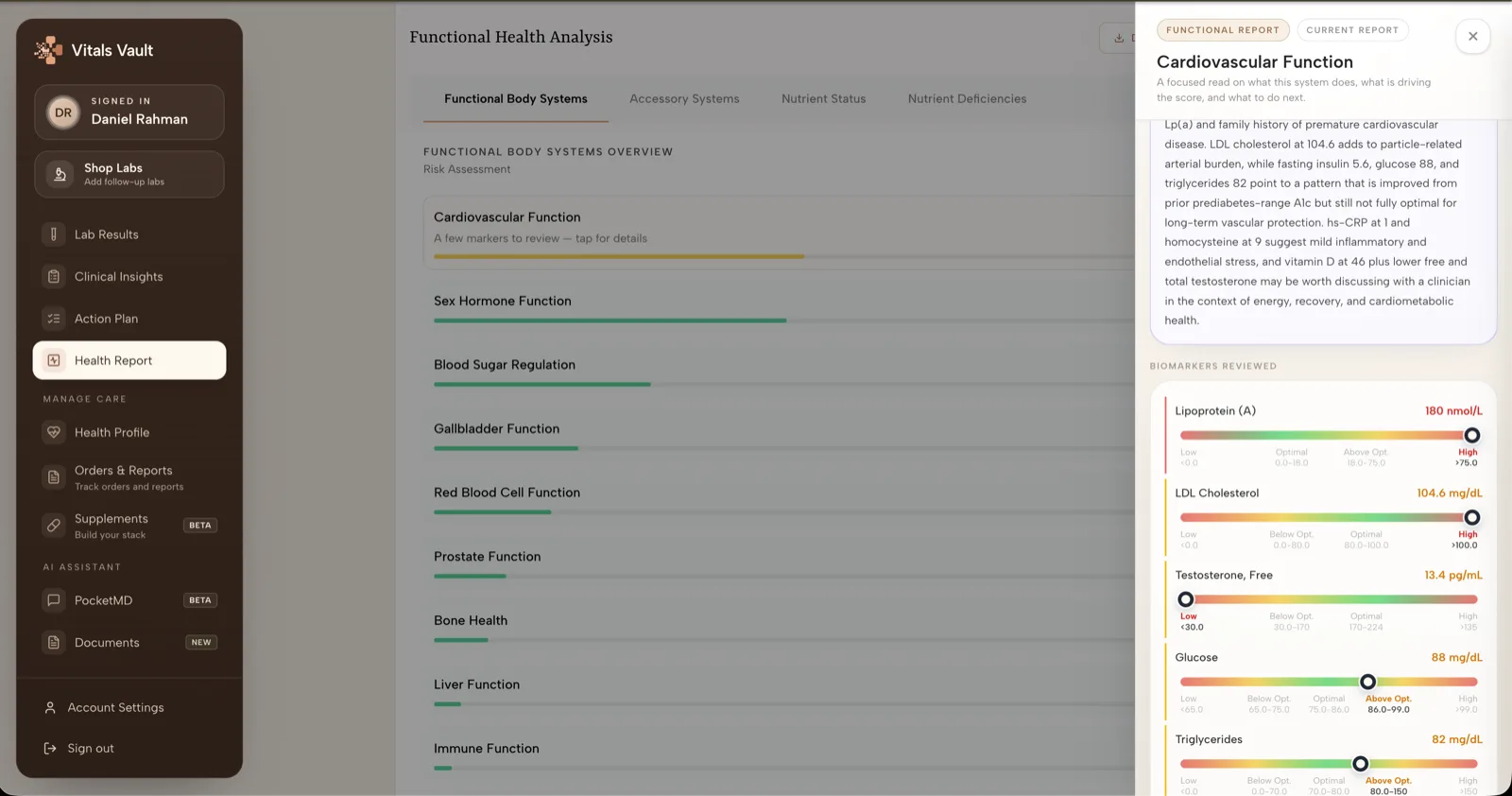
A personalized, plain-language walkthrough of your abnormal markers—reference ranges, pattern context, and what to watch next, grounded in your actual labs.
Personalized Insights
Clear Explanations
Actionable guidance
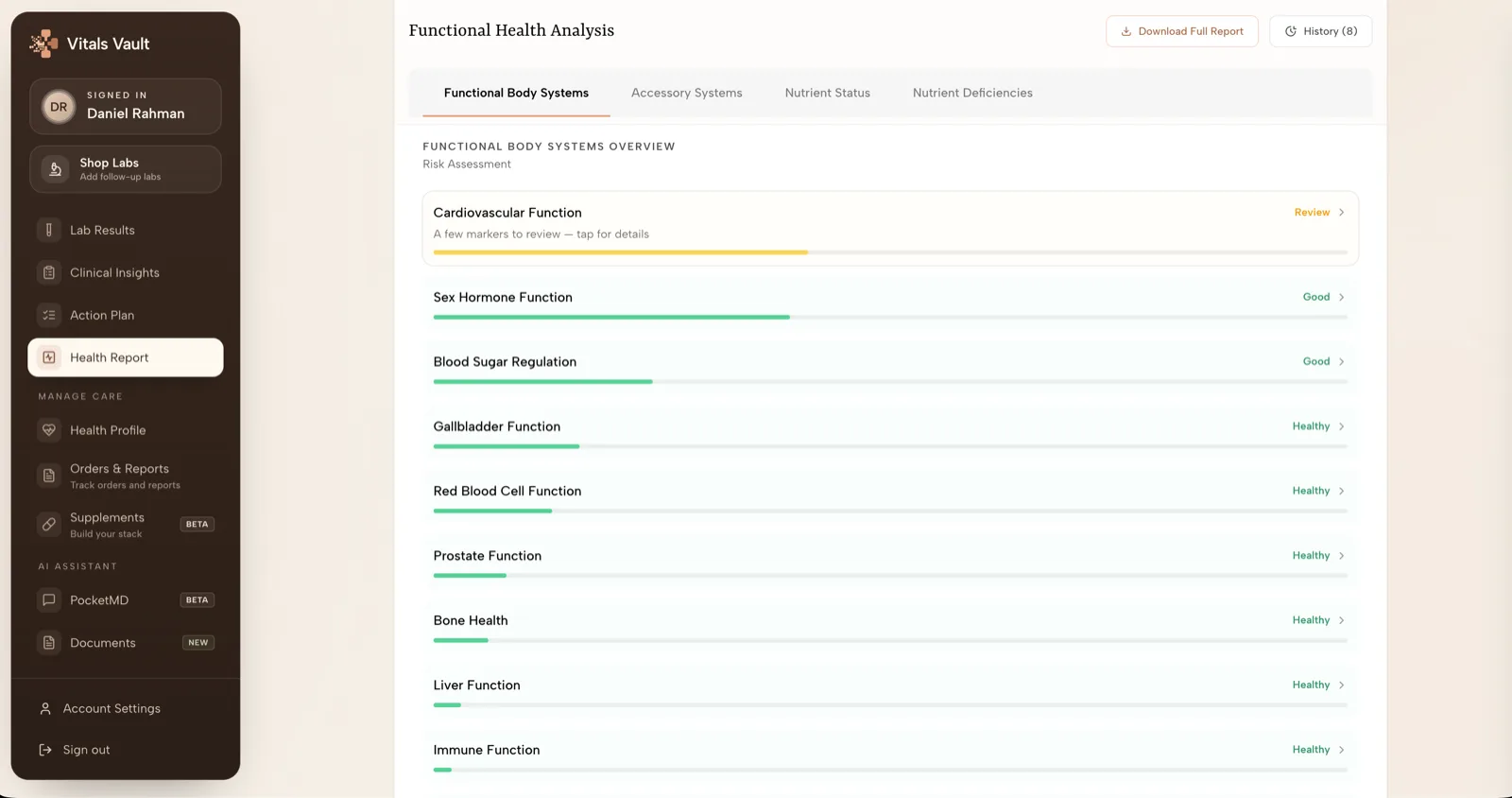
Explore your body systems with clear risk context — refresh your report, download the full PDF, and monitor hormones, heart, bone, and more in one place.
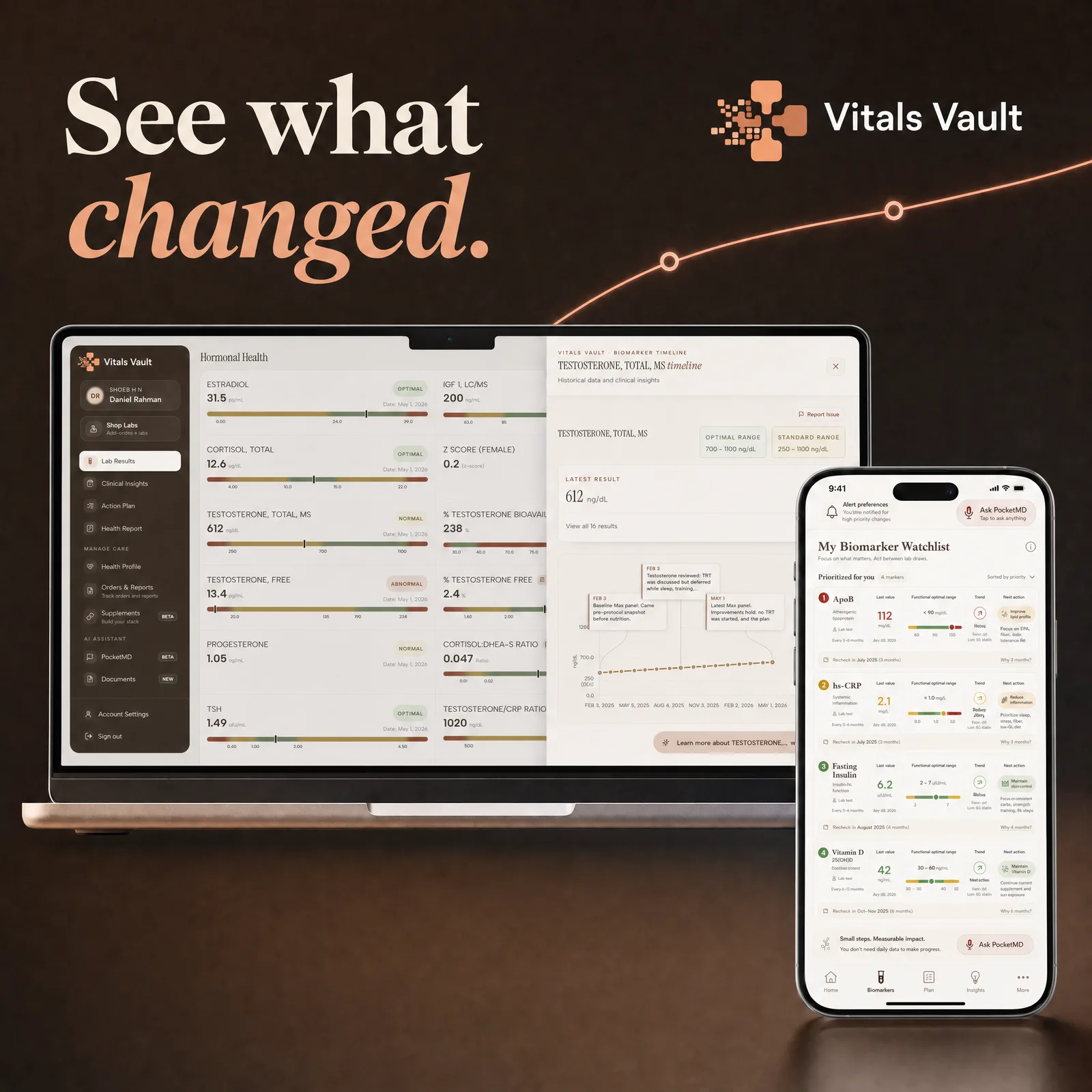
Explore hundreds of tests and panels, filter by concern, and manage your cart—member-exclusive pricing with quick checks and full-body options in one flow.
Wide test selection
300+ tests & panels available
Smart filtering
Find tests by symptoms or goals
Seamless ordering
Add to cart and manage easily
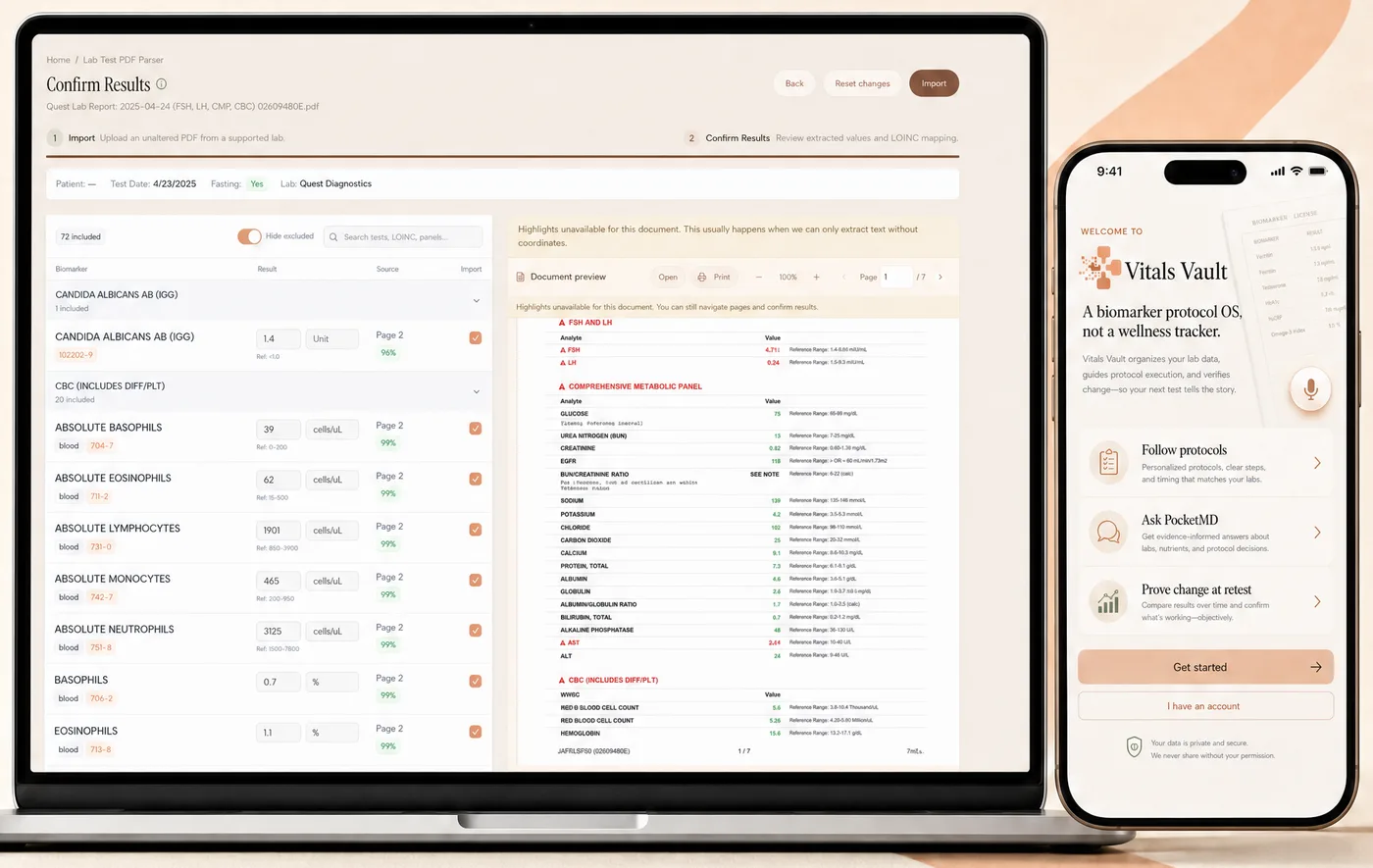
Upload past lab reports, search your documents, and keep appointments and results organized—our AI can extract biomarkers from PDFs so everything lives in one dashboard.
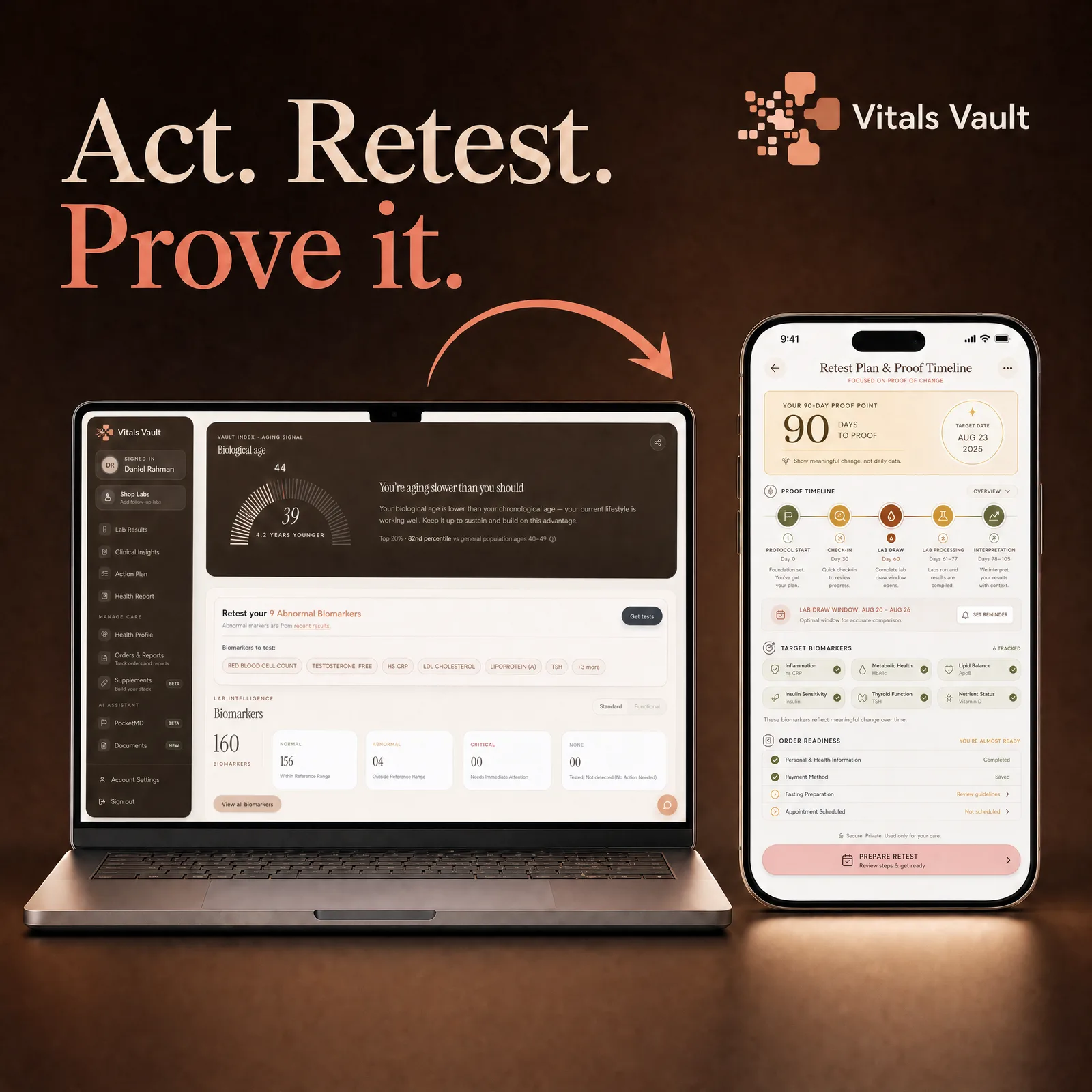
Browse longevity, nutrition, supplement, and movement protocols—structured plans you can follow with clear habits, labs, and targets tied to your profile.
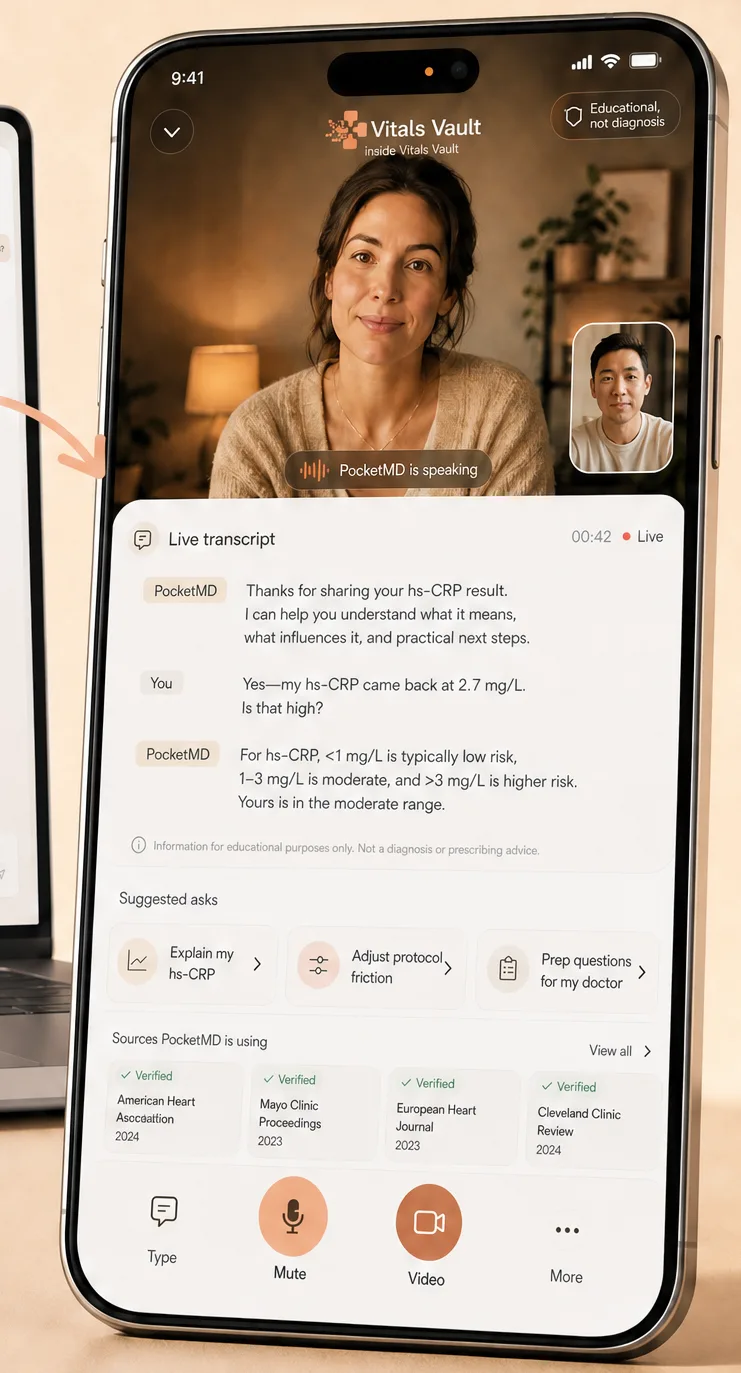
Ask for protocols, nutrition plans, supplement stacks, and education—context-aware suggestions powered by your labs and goals (beta experience).
Order online
Add Cortisol to your cart and check out. No doctor referral is required.
Visit a Quest lab
Provide your blood sample at a Quest Diagnostics location. Appointments can be scheduled after checkout.
Review in Vitals Vault
Results in about 4 days. They stay in your Vitals Vault account for trends and follow-up.
No special preparation is usually needed unless noted at checkout.
This order includes the lab markers used for Cortisol and reported in your Vitals Vault account.
Results
Results in about 4 days
HSA/FSA
Accepted
Who takes it
Must be taken by the purchaser
Preparation
No special preparation needed unless noted at checkout.
It shows how much cortisol you make relative to DHEA-S to gauge stress balance and adrenal adaptation, with easy ordering through Vitals Vault + Quest.





Your Cortisol:DHEA-S ratio is a calculated marker that compares two adrenal-related hormones: cortisol (your main stress hormone) and DHEA-S (a more “protective” androgen precursor that tends to decline with age).
Because it is a ratio, it is less about one single number and more about balance. A higher ratio often means cortisol is dominating relative to DHEA-S, which can fit with chronic stress patterns, poor recovery, and disrupted sleep.
This ratio does not diagnose an “adrenal” condition by itself. It is most useful when you interpret it alongside your symptoms, your medication and lifestyle context, and the actual cortisol and DHEA-S results used to calculate it.
You may consider checking the Cortisol:DHEA-S ratio if you feel like your stress response is “stuck on,” especially when symptoms do not match what you see on basic labs. People often look at this ratio when they have fatigue with poor stress tolerance, sleep disruption, anxiety or low mood, or when they gain weight around the abdomen despite stable habits.
This ratio can also be useful if you are training hard but recovering poorly, getting frequent illnesses, or noticing decreased libido and reduced resilience. In those situations, the balance between catabolic signaling (cortisol) and anabolic/protective signaling (DHEA-S) can add context that a single hormone value may miss.
Testing is also reasonable if you are monitoring a plan that could affect these hormones, such as changes in sleep schedule, workload, exercise volume, or clinician-directed hormone therapy. Your result should support informed next steps with a clinician, not self-diagnosis.
This is a derived marker calculated from measured cortisol and DHEA-S results; it is not a standalone diagnosis and should be interpreted in clinical context.
from $22.99 at Quest Diagnostics
Results in days
Clear next steps
HSA / FSA
With Vitals Vault, you can order labs that include the inputs needed to calculate your Cortisol:DHEA-S ratio and then review the pattern in a clear, practical way. This is especially helpful when you are trying to connect day-to-day symptoms—like sleep quality, energy, and recovery—to objective hormone data.
After your results are back, PocketMD can help you summarize what changed, what looks most likely to be driving the ratio, and which follow-up labs or timing adjustments might make the next test more meaningful. If you are repeating labs, trending your results over time is often more informative than reacting to a single draw.
You stay in control of ordering and follow-up, while still having a structured path to interpretation and next steps.
The Cortisol:DHEA-S ratio is a calculated value that compares your cortisol level to your DHEA-S (dehydroepiandrosterone sulfate) level. Cortisol is a glucocorticoid hormone involved in energy regulation, inflammation control, and your “fight-or-flight” response. DHEA-S is an adrenal-produced hormone that serves as a precursor to sex hormones and is often described as more anabolic or protective in contrast to cortisol’s more catabolic effects.
Because these hormones can move in different directions with stress, illness, aging, sleep loss, and training load, the ratio is used as a snapshot of balance. A higher ratio generally suggests that cortisol is relatively high compared with DHEA-S, which can align with reduced stress resilience and slower recovery. A lower ratio is often interpreted as more favorable stress adaptation, especially when it matches how you feel and your other labs.
You get the most value from this marker when you interpret it alongside the actual cortisol and DHEA-S numbers, the time of day your sample was collected, and factors like medications or recent stressors.
Cortisol and DHEA-S do not always change together. For example, your cortisol might be in range, but your DHEA-S could be low for your age, which still produces a higher ratio. Looking at the relationship can help explain why you feel “wired but tired,” why recovery is lagging, or why stress feels harder to handle than it used to.
This ratio can suggest patterns consistent with chronic stress exposure or reduced anabolic reserve, but it cannot diagnose HPA-axis (hypothalamic-pituitary-adrenal axis) disorders on its own. If your symptoms are significant or your cortisol is clearly abnormal, you may need clinician-directed confirmatory testing and a broader endocrine evaluation.
Formula
Cortisol / DHEA-S
A lab calculates this marker by dividing your measured cortisol value by your measured DHEA-S value. Because cortisol and DHEA-S are often reported in different units and can be collected under different conditions, the ratio is most meaningful when the lab uses consistent internal rules and you compare results over time from the same testing approach.
If either input is near the assay’s detection limits, or if your cortisol was drawn at an unusual time of day, the ratio can look misleading. Always review the underlying cortisol and DHEA-S results rather than relying on the ratio alone.
A lower ratio generally means your cortisol is relatively low compared with DHEA-S, which is often considered a favorable balance for stress adaptation. If you feel well, sleep well, and recover normally, a low ratio can simply reflect good resilience. However, if your cortisol is truly low and you have symptoms like dizziness, low blood pressure, or unexplained weight loss, you should discuss the full cortisol result with a clinician because the ratio alone can hide an absolute cortisol problem.
An “optimal” ratio is one that fits your life stage, symptoms, and the actual cortisol and DHEA-S values behind it. In general, you want a balance where cortisol is not chronically dominating and DHEA-S is not markedly low for your age. If your ratio is stable across repeat testing and you feel steady energy, solid recovery, and reasonable stress tolerance, that pattern is usually reassuring.
A higher ratio often suggests cortisol is elevated relative to DHEA-S, which can fit with chronic stress load, sleep deprivation, overtraining, inflammation, or illness. It can also happen when DHEA-S is low (common with aging), even if cortisol is not dramatically high. If your ratio is high and you also have fatigue, poor stress tolerance, abdominal weight gain, anxiety, low mood, or reduced libido, it is a sign to look closely at sleep, workload, and the timing and context of the cortisol draw.
Time of day matters for cortisol, which typically peaks in the morning and declines later, so a morning draw versus an afternoon draw can change the ratio. DHEA-S is more stable day-to-day, but it trends lower with age and can be affected by chronic illness. Medications can also shift results, including glucocorticoids (steroids), some hormonal therapies, and drugs that affect cortisol metabolism. Recent acute stress, poor sleep, intense exercise, infection, and inflammation can temporarily raise cortisol and push the ratio higher.
There is not one universal “normal” number because the ratio depends on the lab’s calculation rules, the units used, and when cortisol was collected. The most reliable approach is to interpret your ratio alongside the underlying cortisol and DHEA-S values and compare to the reference information provided with your report. If you are tracking progress, use the same lab method and similar collection timing each time.
A high ratio can match a pattern people describe as “adrenal fatigue,” meaning cortisol is relatively dominant compared with DHEA-S and you may feel depleted or less resilient. However, “adrenal fatigue” is not a formal diagnosis, and the ratio cannot confirm a specific adrenal disorder by itself. If symptoms are significant, you should review the full hormone picture and consider clinician-directed evaluation.
Yes. DHEA-S commonly declines with age, and that alone can raise the ratio even if cortisol does not increase. That is why it helps to look at your DHEA-S level relative to age expectations and not interpret the ratio in isolation.
Fasting is not always required for cortisol or DHEA-S, but your collection timing and recent stressors matter more than fasting for this ratio. Follow the collection instructions on your order, and try to keep conditions consistent if you plan to repeat the test (similar wake time, similar exercise and caffeine pattern, and similar time of blood draw when possible).
A ratio can look high if cortisol is temporarily elevated from poor sleep, acute stress, illness, inflammation, or intense exercise shortly before the draw. It can also look high if DHEA-S is low due to age or chronic illness. Medications, especially steroid medications, can significantly affect cortisol results and should be discussed before interpreting the ratio.
Retesting can be useful if your result does not match how you feel, if the draw timing was unusual, or if you are making changes aimed at improving sleep, recovery, or stress load. If you retest, try to standardize timing and conditions so you can tell whether the pattern is truly changing. PocketMD can help you decide what to repeat and what additional markers might clarify the picture.
Purchase online through Vitals Vault. A licensed clinician reviews and approves your order, then you receive a digital requisition for a Quest Diagnostics blood draw.
Samples are collected in person at Quest Diagnostics locations nationwide. After checkout you can schedule your visit at a convenient site.
Most results in 3–5 business days. You can view them securely in your Vitals Vault account.
No separate referral appointment is required. Clinician review is included in the online order flow.
Yes. Eligible HSA/FSA cards can be used at checkout for qualifying lab orders.
Results are available in your secure Vitals Vault account. You control who you share them with, subject to applicable law.
Blood glucose shows the amount of sugar in your blood at a single moment. A1c (hemoglobin A1c) estimates your average blood sugar over roughly the past 8–12 weeks. Comparing them helps explain whether your long-term average lines up with your fasting glucose on draw day.
It helps you understand how this marker fits into your broader metabolic picture, with results tracked in your Vitals Vault account.
Elevated values can signal higher metabolic risk. Many people start with nutrition, activity, sleep, and weight management, then retest and review results with a clinician. This test is educational and does not replace medical advice or diagnosis.
Your sample is processed at CLIA-certified Quest Diagnostics laboratories. Results should still be interpreted with a qualified clinician alongside your history, symptoms, and other labs.
Consumer-initiated testing through Vitals Vault is limited to adults 18+ so ordering and interpretation stay aligned with clinical best practices for this channel.