Why You Can’t Focus (and What to Do About It)
Lack of focus in men often comes from poor sleep, low iron, or thyroid issues that slow your brain down. Targeted labs at Quest—no referral needed.






Lack of focus in men is most often your brain running low on fuel or signal clarity, usually from poor sleep, iron problems, or thyroid slowdown. It can also come from ADHD traits that were always there but only became obvious once work and stress got heavier. Simple labs can help you tell the difference so you stop guessing and start fixing the right thing. If you’re frustrated because you “should” be able to concentrate but your mind keeps sliding off the task, you’re not lazy. Focus is a physical function that depends on sleep depth, oxygen delivery, hormones, and how stimulated your nervous system is all day. This page walks you through the most common reasons men lose focus, what actually helps in real life, and which blood tests can clarify what’s going on. If you want help matching your pattern to a likely cause, PocketMD can talk it through with you, and Vitals Vault labs can confirm or rule out common medical contributors.
Why you’re struggling to focus
Sleep debt and fragmented nights
When your sleep is short or broken, your brain has a harder time holding information “online,” which is why you reread the same sentence or forget what you just opened a tab for. Even if you get enough hours, frequent awakenings can keep you from deep sleep, and that’s the part that restores attention and emotional control. If you snore, wake up with a dry mouth, or feel unrefreshed after 7–8 hours, treat sleep as a medical lead, not a willpower problem.
Low iron stores (low ferritin)
Iron is how your body moves oxygen and supports brain energy production, so low stores can feel like mental sluggishness, low motivation, and “cotton in your head.” Men can run low from frequent blood donation, endurance training, stomach irritation from anti-inflammatories, or hidden bleeding in the gut. A ferritin test tells you about your iron reserves, and it is often more informative for focus than a basic hemoglobin result.
Thyroid slowdown
Your thyroid sets your metabolic pace, and when it runs low, your thinking can feel slow and effortful, like your brain is stuck in low gear. You might also notice feeling colder than others, dry skin, constipation, or a lower-than-usual drive. Because thyroid symptoms overlap with stress and depression, checking a thyroid-stimulating hormone test is a practical way to avoid mislabeling a fixable problem.
ADHD traits showing up in adulthood
Adult ADHD is often less about “hyperactivity” and more about inconsistent attention, time blindness, and needing urgency to start. You can be smart and still struggle with boring tasks, long meetings, or switching between remote-work distractions. If you’ve had this pattern since childhood or school, it is worth treating as a neurodevelopmental wiring issue rather than a character flaw, because the strategies and treatments are different.
Chronic stress and high alert mode
When your body stays in threat mode, your attention narrows to whatever feels urgent, and everything else becomes hard to start and hard to finish. That can look like procrastination, irritability, and bouncing between tasks because your brain is scanning for relief. If your focus is worst on days you feel tense, wired, or emotionally flat, the goal is not “more discipline,” it is lowering the baseline stress load so your brain can allocate attention again.
What actually helps you focus again
Fix sleep first, not last
Give yourself a two-week experiment where sleep is the main project: a consistent wake time, a dark cool room, and no work screens for the last 45 minutes. If you suspect sleep apnea because of loud snoring or morning headaches, ask for an evaluation, because treating it can improve focus more than any supplement. The point is to restore deep sleep so attention stops feeling like a constant push.
Use a “single-task” work block
Your brain pays a real switching cost every time you check messages, and that cost feels like fog and frustration. Try a 25–40 minute block where you close email and chat, write down the one outcome you want, and keep a scratch pad for distracting thoughts so you don’t have to act on them. You are not trying to be perfect; you are trying to reduce the number of resets your brain has to do.
Caffeine with a cutoff and purpose
Caffeine can help attention, but it can also quietly wreck sleep and create a next-day focus crash. Use it like a tool: take it after you’ve been awake for 60–90 minutes, and set a hard cutoff about 8 hours before bedtime so it is not still in your system. If you need caffeine just to feel normal, that is a clue to look harder at sleep quality, iron, or thyroid.
Eat for steady brain fuel
If your focus tanks mid-morning or mid-afternoon, it is often a blood sugar swing rather than a motivation issue. Build meals around protein and fiber, and notice whether a high-sugar breakfast makes you feel sharp for an hour and then scattered. A simple change like adding eggs or Greek yogurt at breakfast can make your workday feel less like a roller coaster.
Get evaluated when ADHD fits
If your focus problems are lifelong, show up across settings, and come with time management issues, an ADHD evaluation can be a turning point. Treatment is not only medication; coaching, external structure, and the right work environment can reduce the daily friction dramatically. Bring concrete examples, like missed deadlines and task paralysis, because that helps a clinician assess what is really happening.
Useful biomarkers to discuss with your clinician
Ferritin
Ferritin is your body's iron storage protein, reflecting total iron stores in the body. In functional medicine, ferritin assessment is crucial for identifying both iron deficiency and iron overload, conditions that can significantly impact energy levels and overall health. Low ferritin is the earliest sign of iron deficiency, often occurring before anemia develops. This can cause fatigue, weakness, restless leg syndrome, and cognitive impairment. Conversely, elevated ferritin may indicate iron overload, inflamma…
Learn moreTSH
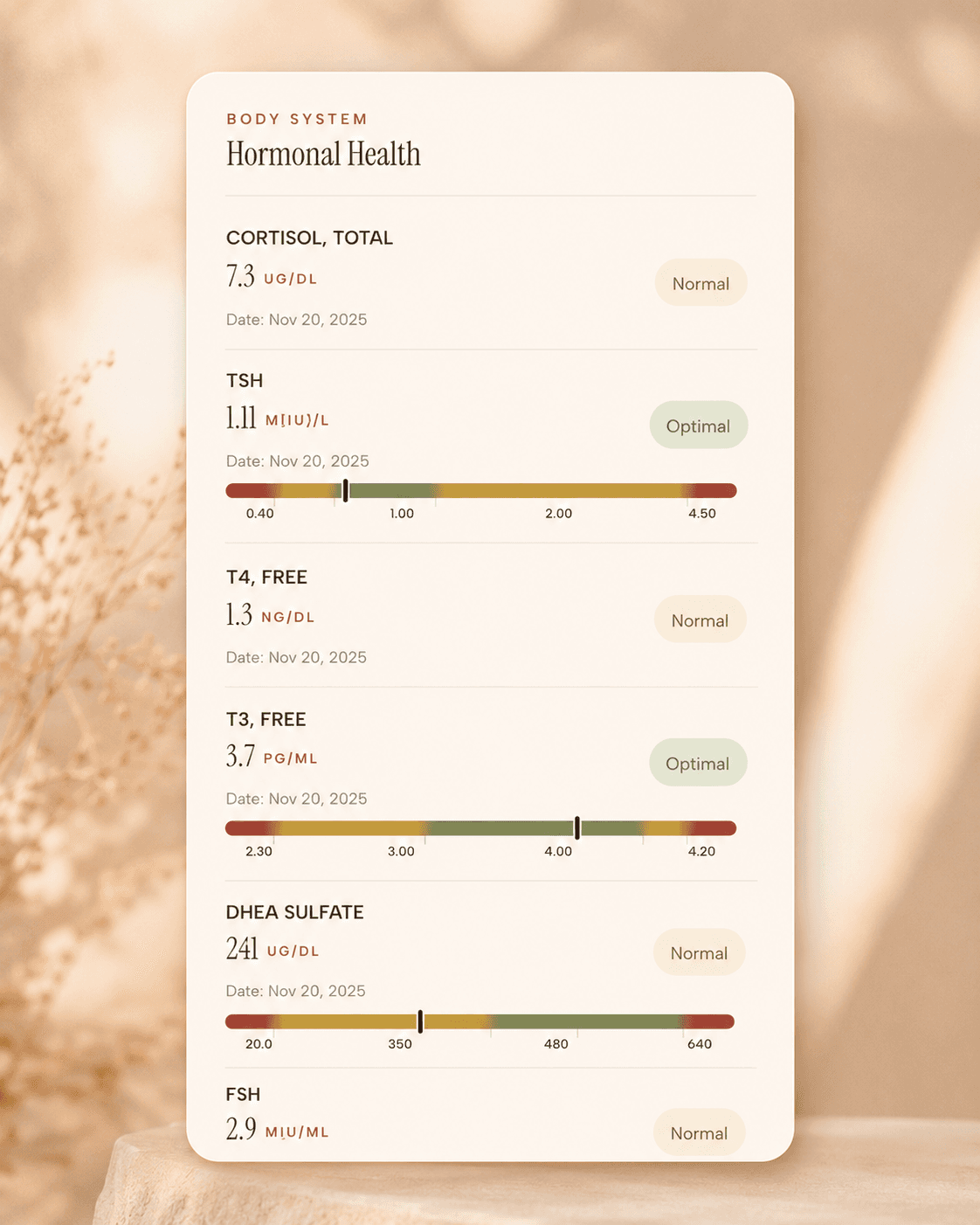
TSH is the master regulator of thyroid function, controlling the production of thyroid hormones T4 and T3. In functional medicine, we use narrower TSH ranges than conventional medicine to identify subclinical thyroid dysfunction early. Even mildly elevated TSH can indicate thyroid insufficiency, leading to fatigue, weight gain, depression, and metabolic dysfunction. TSH levels are influenced by stress, nutrient deficiencies, autoimmune conditions, and environmental toxins. Optimal TSH supports energy, metabolism…
Learn moreGlucose
Fasting glucose is a fundamental marker of glucose metabolism and insulin function. In functional medicine, we recognize that even 'normal' glucose levels in the upper range may indicate early insulin resistance. Optimal fasting glucose reflects efficient glucose regulation and insulin sensitivity. Elevated fasting glucose suggests the body's inability to maintain normal glucose levels overnight, indicating hepatic insulin resistance or insufficient insulin production. This marker is essential for early detectio…
Learn moreLab testing
Get TSH, ferritin, and vitamin B12 checked at Quest
starting from $99 panel with 100+ tests, one visit
No referral needed
About 1 week
Schedule online — results typically within a week
Clear next steps
Guidance included, with follow-up care available
HSA / FSA
Eligible for pre-tax health spending accounts
Pro Tips
Run a 10-day “focus audit” where you rate focus from 1–10 at three set times (late morning, mid-afternoon, evening) and write one sentence about sleep, caffeine timing, and what you ate. Patterns show up faster than you expect.
If you work from home, put your phone in another room for your first work block and turn on a website blocker for your two biggest time-sinks. Your brain relaxes when temptation is physically harder to reach.
Try the “two-minute start” rule for tasks you avoid: set a timer for two minutes and only commit to opening the document and writing a messy first line. Starting is often the real bottleneck when attention feels unreliable.
If you suspect low iron, do not start high-dose iron blindly. Get ferritin checked first, because too much iron is not harmless, and the right plan depends on whether the issue is low intake, absorption, or blood loss.
When you drink coffee, pair it with water and a small protein snack, then stop at your cutoff time even if you feel fine. The payoff is tomorrow’s focus, not today’s extra hour of jittery productivity.
Frequently Asked Questions
Why can’t I focus even when I’m motivated?
Motivation and focus are different systems. You can care a lot and still struggle if your sleep is fragmented, your thyroid is running slow, or your iron stores are low, because your brain literally has less energy to allocate to attention. Start by checking sleep quality and consider labs like TSH and ferritin if the problem has lasted more than a few weeks.
Is lack of focus in men a sign of low testosterone?
Low testosterone can contribute to low drive and low energy, which can indirectly affect focus, but it is not the most common reason men feel scattered. Sleep problems, iron deficiency, thyroid issues, and ADHD patterns usually explain more cases. If you also have reduced morning erections, lower libido, and loss of strength, that is when a testosterone discussion becomes more relevant.
How do I know if it’s ADHD or just stress?
Stress-related focus issues often start after a life change and fluctuate with workload, sleep, and anxiety. ADHD traits usually show a longer pattern that began in childhood or school and includes time blindness, chronic disorganization, and needing urgency to start. If you recognize the lifelong pattern, ask for an adult ADHD evaluation and bring examples from different parts of your life.
What vitamin deficiency causes brain fog and poor concentration?
Vitamin B12 deficiency is a common, testable cause of brain fog and slowed thinking, and it can happen even with a decent diet if absorption is poor. Many people feel best when B12 is above about 400–500 pg/mL, especially if symptoms fit. If your result is borderline, ask whether methylmalonic acid or homocysteine testing is appropriate to confirm it.
What labs should I get for brain fog and lack of focus?
A practical starting trio is TSH for thyroid signaling, ferritin for iron stores, and vitamin B12 for nerve and brain function. These tests help separate “I’m depleted” from “this is more about attention wiring or stress.” If any are abnormal, use that result to guide the next step rather than adding random supplements.