Why Your Sleep Gets Worse When You’re Working Full-Time
Poor sleep in working women often comes from stress hormones, low iron, or thyroid shifts that keep your brain “on.” Targeted labs, no referral needed.






Poor sleep in working women is usually a mix of a revved-up stress system, a circadian rhythm that’s been pushed later by light and screens, and a body issue that quietly worsens sleep like low iron or thyroid imbalance. The frustrating part is that all of these can feel the same at 2 a.m., but a few targeted labs and a clear pattern check can help you figure out which one is driving your nights. If you’re juggling deadlines, family needs, and a brain that won’t shut off, you’re not “bad at sleeping.” Your body is responding to pressure, timing cues, and sometimes a correctable deficiency. This page walks you through the most common root causes, what actually helps (including CBT-I style strategies that work even when you’re busy), and which blood tests can be worth doing. If you want help connecting your specific symptoms to the most likely causes, PocketMD can talk it through with you, and Vitals Vault labs can help you confirm what’s going on without a referral.
Why your sleep gets worse when you’re working full-time
Your stress system stays switched on
When your body thinks it has to stay alert, it keeps stress hormones like cortisol higher later into the evening, which makes you feel tired but wired. You might fall asleep and then pop awake with a busy mind, or you may wake too early and can’t get back down. The takeaway is to treat this like a timing problem, not a willpower problem: you need a deliberate “downshift” routine that starts before you feel sleepy.
Your sleep schedule drifts later
Long workdays, late emails, and bright light at night can push your internal clock later, even if your alarm stays early. That mismatch often feels like lying awake for an hour, then getting a “second wind,” and then feeling awful in the morning. If weekends turn into sleep-ins, the drift gets reinforced, so a consistent wake time is usually more powerful than an early bedtime.
Low iron stores (ferritin) drain you
You can have “normal” hemoglobin and still have low iron stores, which your brain and muscles notice first. Low ferritin can show up as restless legs, a racing heart when you finally lie down, or a deep fatigue that makes you nap and then sleep worse at night. If your periods are heavy, you’re postpartum, or you’ve been training hard, ferritin is a high-yield test to check.
Thyroid imbalance keeps you restless
If your thyroid is running fast, your body can feel like it’s stuck in high gear, with light sleep, heat intolerance, and a heart that won’t fully settle. If it’s running slow, you may feel exhausted all day but still sleep poorly because your mood, breathing, and temperature regulation get thrown off. A simple TSH test is often the first clue, and it’s especially worth checking if sleep changes came with weight change, hair shedding, or new anxiety.
Perimenopause changes sleep depth
In your late 30s through 50s, shifting estrogen and progesterone can make sleep lighter and more easily interrupted, even before periods become irregular. You may notice more middle-of-the-night waking, warmer nights, or a sudden sensitivity to alcohol that didn’t used to affect you. If this fits, the most useful next step is usually symptom-pattern tracking and targeted treatment options rather than trying to “power through” with more caffeine.
What actually helps you sleep again
Use CBT-I rules, not “try harder”
Cognitive behavioral therapy for insomnia (CBT-I) works because it retrains your brain to associate bed with sleep instead of struggle. The core move is simple: if you’re awake for about 20–30 minutes, get out of bed and do something quiet in dim light until you feel sleepy again. It feels counterintuitive, but it reduces the nightly “performance anxiety” that keeps insomnia going.
Set a hard wake time
A consistent wake time anchors your body clock, which is the fastest way to reduce long sleep-onset delays. Pick a wake time you can keep within about 30–60 minutes even on weekends, and let bedtime float earlier only when you’re truly sleepy. After a week or two, most people notice fewer 2 a.m. wake-ups because their sleep drive is stronger at the right time.
Build a 30-minute downshift routine
Your brain needs a clear signal that the workday is over, especially if you’re switching between roles like employee, parent, and partner. Choose two calming steps you can repeat nightly, such as a warm shower and ten minutes of a paper book, and keep lights low so melatonin can rise naturally. The goal is not perfection; it’s repetition, because your nervous system learns by pattern.
Treat iron deficiency if confirmed
If ferritin is low, improving iron stores can reduce restless legs and that “can’t get comfortable” feeling that sabotages sleep. Iron is not a casual supplement, though, because the dose and form matter and it can upset your stomach, so it’s best done with a plan and follow-up labs. Pairing iron with vitamin C and taking it away from calcium often improves absorption.
Cut the one sleep saboteur
Instead of trying to overhaul your whole life, pick the single factor that most reliably ruins your night and change only that for two weeks. For many working women it’s late caffeine, alcohol as a “wind down,” or scrolling in bed that keeps your brain engaged. A short experiment gives you real data, which is more motivating than generic advice.
Useful biomarkers to discuss with your clinician
Ferritin
Ferritin is your body's iron storage protein, reflecting total iron stores in the body. In functional medicine, ferritin assessment is crucial for identifying both iron deficiency and iron overload, conditions that can significantly impact energy levels and overall health. Low ferritin is the earliest sign of iron deficiency, often occurring before anemia develops. This can cause fatigue, weakness, restless leg syndrome, and cognitive impairment. Conversely, elevated ferritin may indicate iron overload, inflamma…
Learn moreTSH
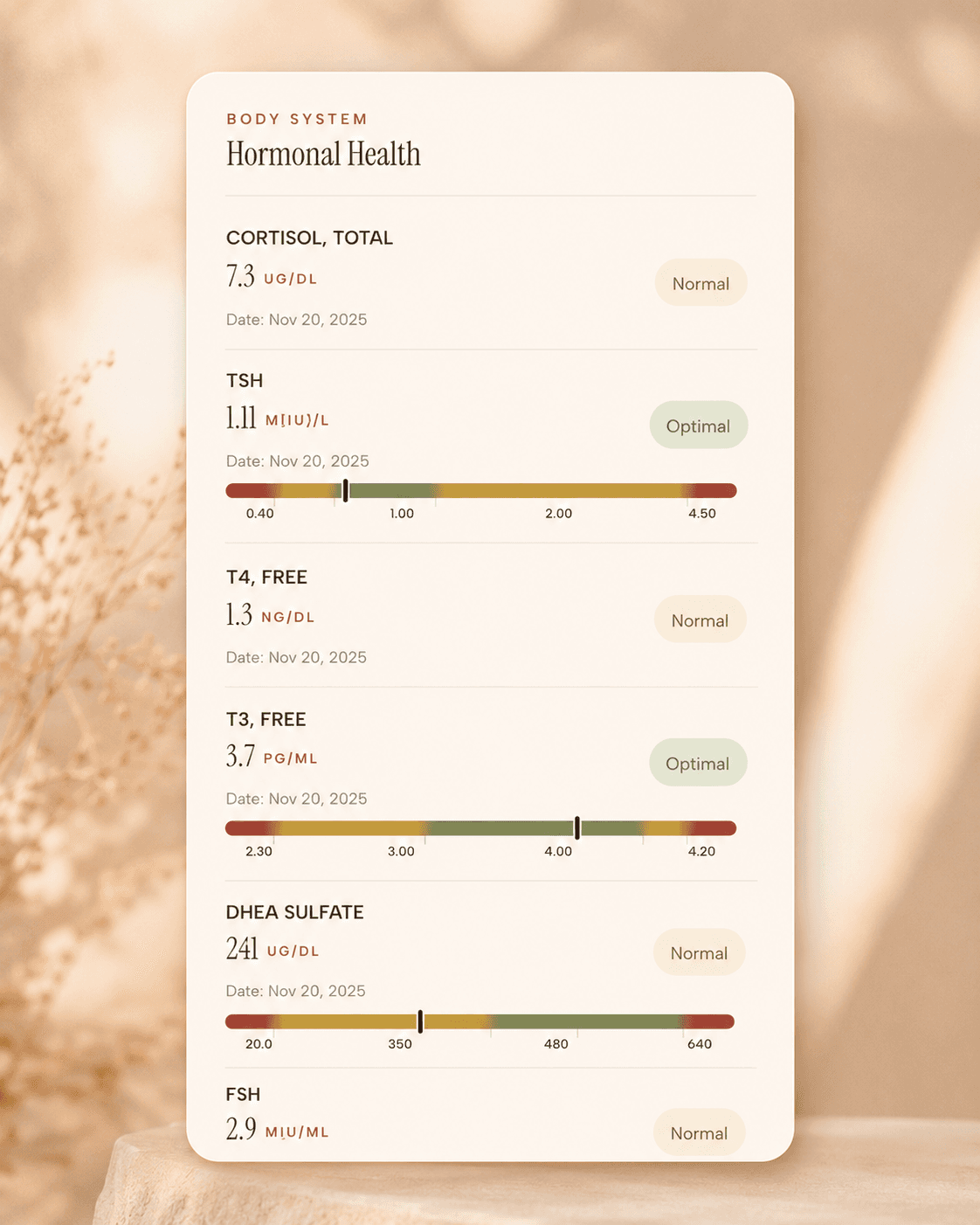
TSH is the master regulator of thyroid function, controlling the production of thyroid hormones T4 and T3. In functional medicine, we use narrower TSH ranges than conventional medicine to identify subclinical thyroid dysfunction early. Even mildly elevated TSH can indicate thyroid insufficiency, leading to fatigue, weight gain, depression, and metabolic dysfunction. TSH levels are influenced by stress, nutrient deficiencies, autoimmune conditions, and environmental toxins. Optimal TSH supports energy, metabolism…
Learn moreCortisol, Total
Cortisol is the primary stress hormone that regulates metabolism, immune function, and blood pressure. In functional medicine, cortisol assessment is crucial for understanding stress response and its impact on overall health. Chronic elevation suppresses testosterone production and immune function, while low cortisol indicates adrenal insufficiency. Optimal cortisol rhythm supports energy, mood stability, and hormone balance. Cortisol orchestrates the body's stress response and daily energy rhythms. Balanced cor…
Learn moreLab testing
Check ferritin, TSH, and vitamin D at Quest
starting from $99 panel with 100+ tests, one visit
No referral needed
About 1 week
Schedule online — results typically within a week
Clear next steps
Guidance included, with follow-up care available
HSA / FSA
Eligible for pre-tax health spending accounts
Pro Tips
Try a “worry download” 2 hours before bed: set a 10-minute timer, write what’s on your mind, and then write the next tiny action for each item. Your brain relaxes faster when it sees a plan, not just a pile of thoughts.
If you wake at 3 a.m., avoid checking the time. Turn the clock away and use a low-stimulation routine (dim light, boring book) so your brain doesn’t learn that 3 a.m. is “thinking time.”
Make your bed a sleep-only zone for two weeks. If you need to scroll, answer messages, or watch a show, do it somewhere else so your brain stops pairing your pillow with alertness.
Do a caffeine “curfew” experiment: stop caffeine 8 hours before bedtime for 10 days. If your sleep improves, you’ve found a lever you can use even on high-stress weeks.
If you suspect restless legs, track it for a week by rating the urge-to-move from 0–10 and noting whether it improves when you walk. Bring that log to a visit and ask specifically about ferritin and iron treatment thresholds.
Frequently Asked Questions
Why am I exhausted but can’t fall asleep at night?
That pattern usually means your sleep drive is there, but your alerting system is still running, often from stress hormones, late light exposure, or a conditioned “bed = thinking” loop. It can also happen when you nap to survive the day, which steals sleep pressure from nighttime. Try a consistent wake time for 7–10 days and a 30-minute downshift routine, and consider checking ferritin and TSH if it’s persistent.
Is waking up at 3 a.m. a hormone problem?
Sometimes, but it’s not automatically “hormones.” A 3 a.m. wake-up can come from stress arousal, alcohol wearing off, sleep apnea, or perimenopause-related lighter sleep that makes you easier to wake. If it’s new and you also have hot flashes, cycle changes, or night sweats, track those patterns and talk through options; if you snore or wake gasping, get evaluated for sleep apnea.
What labs should I get for insomnia and fatigue?
For many working women, three high-yield starting points are ferritin (iron stores), TSH (thyroid signal), and 25(OH) vitamin D. Low ferritin can worsen restless legs and unrefreshing sleep, thyroid imbalance can fragment sleep, and low vitamin D is linked with poorer sleep quality in some people. If any are abnormal, follow up with your clinician for the right next tests and a treatment plan.
How long does CBT-I take to work?
Many people notice changes within 2–4 weeks, although the full benefit often builds over 6–8 weeks because your brain is relearning a pattern. The early phase can feel harder because you stop “trying” in bed and instead use consistent rules like getting up after 20–30 minutes awake. If you want the fastest results, keep the wake time consistent and track sleep in a simple diary.
Should I take melatonin if I’m a light sleeper?
Melatonin works best as a clock-shifter, not a knockout pill, so it’s most helpful when your schedule has drifted later or you’re dealing with late-night light exposure. A low dose like 0.3–1 mg taken about 2–3 hours before your target bedtime is often enough, and higher doses can sometimes leave you groggy or give vivid dreams. If you’re waking frequently from noise or stress, CBT-I strategies and environment changes usually matter more than melatonin.