Why You’re Such a Light Sleeper (Especially When You’re Working)
Light sleep in working women often comes from stress cortisol, low iron, or thyroid imbalance, and targeted labs can pinpoint it—no referral needed.






Light sleep in working women is most often your nervous system staying on “alert” because of stress, irregular schedules, or hormonal shifts, and it can also be pushed along by low iron stores or an overactive thyroid. When your brain keeps scanning for threats, you wake more easily and you spend less time in deep, restorative sleep. A few targeted blood tests can help you figure out which driver fits your body instead of guessing. If you’re waking up to every sound, feeling like you “slept” but didn’t recover, or dragging through meetings on caffeine and willpower, you’re not imagining it. Sleep depth is sensitive to your stress chemistry, your circadian rhythm (your internal clock), and the basics your brain needs to settle down at night. This guide walks you through the most common reasons light sleep shows up in busy working women, what actually helps in real life, and which labs can clarify the picture. If you want help connecting your symptoms to a plan, PocketMD can talk it through with you, and Vitals Vault labs can help you check the most relevant markers without a referral.
Why you’re sleeping lightly at night
Stress keeps your body on guard
When your day is packed and your brain never fully “clocks out,” your stress system can stay revved even after you lie down. That makes your sleep lighter because you spend more time in easily disrupted stages and less time in deep sleep, which is the part that makes you feel physically restored. A useful clue is waking up with your mind already racing or feeling wired-tired at bedtime. If this sounds like you, the goal is not perfect relaxation — it is giving your nervous system a predictable off-ramp every night.
Your schedule fights your body clock
Shift work, late-night emails, early commutes, and weekend sleep-ins can all pull your internal clock out of sync. When your clock is confused, your body may produce sleep signals at the wrong time, so you fall asleep but pop awake after a few hours or wake too early. You might notice you sleep better on vacation or on days when you keep the same wake time. Consistency matters more than you think, because your brain uses morning light and wake time as the anchor.
Perimenopause makes sleep lighter
In your late 30s through 50s, changing estrogen and progesterone can make sleep more fragile even if you do not have obvious hot flashes. Progesterone tends to be calming, so when it dips, you may feel more nighttime alertness and more 2–4 a.m. wake-ups. Some women also get subtle temperature swings or heart-pounding episodes that jolt them awake. If your sleep changed alongside cycle changes, new anxiety, or night sweats, it is worth treating this as a hormone-transition issue rather than a willpower issue.
Low iron stores drain sleep quality
You can have “normal” hemoglobin and still have low iron stores, which is measured by ferritin. Low ferritin is linked to restless legs and a jittery, uncomfortable urge to move at night, and that kind of micro-arousal keeps your sleep shallow. Heavy periods, frequent blood donation, pregnancy history, and endurance training all raise the odds. If your legs feel jumpy at night or you crave ice, ask specifically about ferritin, not just a basic blood count.
Thyroid overdrive or underdrive
Your thyroid sets the pace for many body systems, including heart rate and temperature, which means it can quietly sabotage sleep. When thyroid function runs high, you can feel wired, warm, and prone to middle-of-the-night wake-ups with a pounding heart. When it runs low, you may sleep long hours but still wake unrefreshed, because sleep can become less efficient and more fragmented. If light sleep comes with new palpitations, heat intolerance, constipation, hair changes, or unexplained weight shifts, a TSH test is a practical place to start.
What actually helps you sleep deeper
Set a “hard stop” wind-down
Light sleepers usually need a clear boundary between work-brain and sleep-brain, even if you cannot make evenings perfectly calm. Pick a 20–30 minute routine you can repeat most nights, such as a shower, dim lights, and a paper book, and treat it like a meeting you do not cancel. The repetition trains your brain to predict sleep, which lowers the chance of popping awake at every small noise. If you can only do one thing, stop work messages at least 30 minutes before bed.
Anchor your morning with light
Morning light is the strongest signal for your body clock, and it helps you build sleep pressure for deeper sleep later. Try to get 10–20 minutes of outdoor light within an hour of waking, even if it is cloudy, because windows filter the intensity. This tends to reduce early-morning awakenings over 1–2 weeks by stabilizing your rhythm. If you work nights, flip the idea: use bright light when you start your “day,” and keep your bedroom as dark as possible when you sleep.
Use caffeine like a medication
If you are a light sleeper, caffeine often lingers longer than you expect, and it can shave off deep sleep even when you fall asleep easily. A practical experiment is a two-week “caffeine cutoff” set 8 hours before bedtime, and then see if your wake-ups drop. If you need a boost later, a short walk or a brief bright-light break often helps without stealing sleep depth. The point is not quitting forever — it is finding your personal cutoff time.
Treat restless legs, not just insomnia
If your legs feel creepy-crawly or you get an urge to move when you lie down, you will not “sleep-hygiene” your way out of it. Start by checking ferritin, because many women improve when low iron stores are corrected, and the sleep benefit can be dramatic. Magnesium glycinate can help some people feel less twitchy, but it is not a substitute for fixing iron deficiency. If symptoms are frequent, talk with a clinician because there are specific treatments that target the nerve signaling involved.
Match the fix to hormone timing
If light sleep clusters in the week before your period, or it started with perimenopause changes, your best strategy may be timing-based rather than “every night the same.” Cooling the bedroom, avoiding alcohol close to bed, and using a consistent bedtime can reduce hormone-related arousals, and some women benefit from targeted therapy for hot flashes or anxiety. If you are considering hormone therapy or sleep medication, it helps to bring a simple two-week sleep log so the plan fits your pattern. You deserve a solution that matches your biology, not a generic lecture.
Useful biomarkers to discuss with your clinician
Ferritin
Ferritin is your body's iron storage protein, reflecting total iron stores in the body. In functional medicine, ferritin assessment is crucial for identifying both iron deficiency and iron overload, conditions that can significantly impact energy levels and overall health. Low ferritin is the earliest sign of iron deficiency, often occurring before anemia develops. This can cause fatigue, weakness, restless leg syndrome, and cognitive impairment. Conversely, elevated ferritin may indicate iron overload, inflamma…
Learn moreCortisol, Total
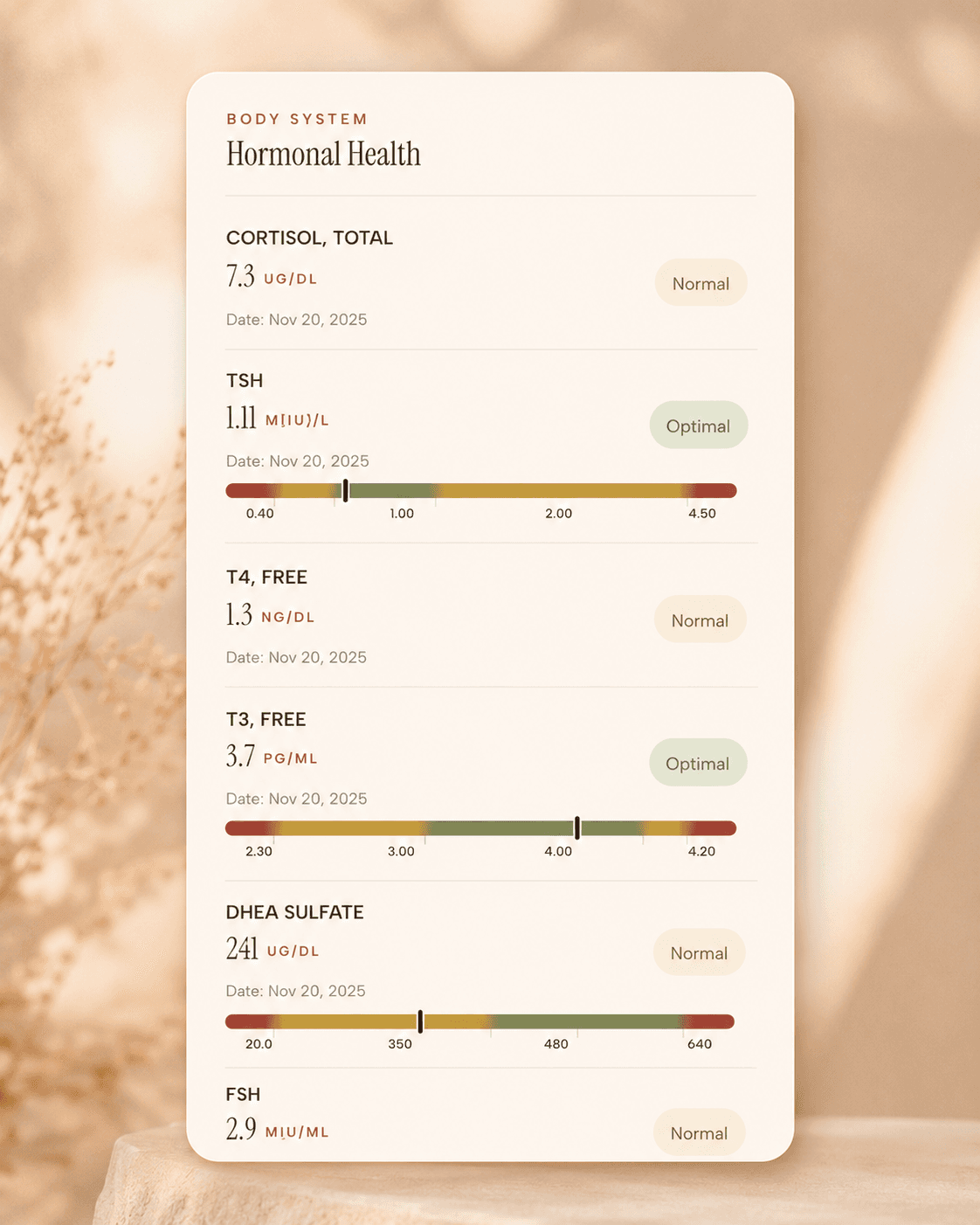
Cortisol is the primary stress hormone that regulates metabolism, immune function, and blood pressure. In functional medicine, cortisol assessment is crucial for understanding stress response and its impact on overall health. Chronic elevation suppresses testosterone production and immune function, while low cortisol indicates adrenal insufficiency. Optimal cortisol rhythm supports energy, mood stability, and hormone balance. Cortisol orchestrates the body's stress response and daily energy rhythms. Balanced cor…
Learn moreTSH
TSH is the master regulator of thyroid function, controlling the production of thyroid hormones T4 and T3. In functional medicine, we use narrower TSH ranges than conventional medicine to identify subclinical thyroid dysfunction early. Even mildly elevated TSH can indicate thyroid insufficiency, leading to fatigue, weight gain, depression, and metabolic dysfunction. TSH levels are influenced by stress, nutrient deficiencies, autoimmune conditions, and environmental toxins. Optimal TSH supports energy, metabolism…
Learn moreLab testing
Check ferritin, TSH, and vitamin D at Quest
starting from $99 panel with 100+ tests, one visit
No referral needed
About 1 week
Schedule online — results typically within a week
Clear next steps
Guidance included, with follow-up care available
HSA / FSA
Eligible for pre-tax health spending accounts
Pro Tips
Run a 14-night “wake-up audit”: each time you wake, jot the time and the most likely trigger (heat, noise, worry, bathroom, legs). Patterns show up fast, and they point you toward the right fix.
If you wake between 2–4 a.m., do a quick body check instead of negotiating with your thoughts: are you too warm, too cold, hungry, or wired? Fix the physical cue first, because it is often the real reason your brain won’t settle.
Try a two-week experiment where you keep the same wake time every day, including weekends, and let bedtime float earlier as you get sleepy. This is one of the quickest ways to deepen sleep if your schedule has been irregular.
If your mind spins at bedtime, keep a “tomorrow list” on paper and write down the next step for each worry in one sentence. Your brain relaxes when it sees a plan, even a tiny one.
If you suspect restless legs, pay attention to the hour before bed: symptoms that worsen when you rest and improve when you move are a strong clue. Bring that detail when you ask for ferritin testing, because it changes what “normal” means.
Frequently Asked Questions
Why do I wake up at every little noise?
You usually wake easily when your nervous system is running “high alert,” which can happen with stress, irregular sleep schedules, or hormone transitions like perimenopause. In that state, your brain spends more time in lighter sleep stages, so small sounds or movement pull you to the surface. Try earplugs or white noise for a week while you also work on a consistent wake time, because both reduce the number of awakenings.
Is light sleep the same as insomnia?
Not exactly. Insomnia is trouble falling asleep, staying asleep, or feeling restored, while “light sleep” usually describes the feeling that you never get deep, solid sleep even if you spend enough hours in bed. The overlap is huge, but light sleep often has a specific driver like stress arousal, shift work, restless legs, or thyroid changes. A two-week sleep log can help you and your clinician decide which category fits best.
Can low iron cause light sleep even if my hemoglobin is normal?
Yes. Hemoglobin can look normal while ferritin (your iron stores) is low, and low ferritin is linked to restless legs and frequent micro-awakenings that make sleep feel shallow. For sleep symptoms, many clinicians look for ferritin above about 50 ng/mL, and sometimes closer to 75 ng/mL if restless legs are present. If you have heavy periods or leg discomfort at night, ask specifically for ferritin testing.
What thyroid level is linked to poor sleep?
Both high and low thyroid function can disrupt sleep, which is why TSH is a useful screening test when sleep changes suddenly. Many people feel best with TSH roughly in the 0.5–2.5 mIU/L range, but symptoms and other thyroid labs matter too. If you also have palpitations, heat intolerance, constipation, hair changes, or unexplained weight shifts, bring those details when you get tested.
What’s the fastest way to sleep deeper if I’m stressed from work?
The fastest “high yield” combo is a consistent wake time plus a short, repeatable wind-down that starts 20–30 minutes before bed. That pairing stabilizes your body clock and tells your brain that the day is over, which reduces the hair-trigger awakenings that come with stress. If you want an immediate environmental boost, add white noise and keep your bedroom slightly cool for the next week while you build the routine.