Fatigue Under Stress: Why You’re So Tired and What to Do
Fatigue under stress often comes from poor sleep, low iron, or thyroid slowdown. Get targeted blood tests at Quest—no referral needed.






Fatigue under stress usually happens because your sleep stops being restorative, your stress hormones keep your body “on” even when you’re resting, or an underlying issue like low iron or thyroid slowdown gets unmasked when life gets intense. The good news is that you can often narrow it down by matching your pattern of symptoms to a few common mechanisms, and targeted labs can help confirm what’s driving it for you. Stress-related fatigue is frustrating because it can feel like you’re doing everything “right” and still running on empty. You might be dragging through the day, losing motivation to exercise, or feeling like your brain is wrapped in cotton. This page walks you through the most common reasons stress makes you tired, what tends to help in real life, and which blood tests are worth your time. If you want help connecting your specific symptoms to next steps, PocketMD can talk it through with you, and Vitals Vault labs can help you check the most relevant markers without turning this into a months-long guessing game.
Why stress can make you exhausted
Your sleep stops being restorative
Stress can keep your brain in a lighter, more vigilant sleep state, even if you’re technically “asleep” for 7–8 hours. That means you wake up unrefreshed, you hit a wall mid-afternoon, and caffeine starts feeling like a lifeline instead of a choice. A useful clue is how you feel 30–60 minutes after waking: if you’re already tired, the problem is often sleep quality, not willpower.
Stress hormones stay switched on
When your body treats everyday life like an emergency, you can run on adrenaline and cortisol for a while, but it is a costly fuel source. You may feel wired at night, crash after meetings, or get shaky and irritable when you miss a meal because your blood sugar swings more. The takeaway is to look for “tired but revved” signs, because that pattern responds better to calming your nervous system than to pushing harder.
Low iron stores, even without anemia
You can have normal hemoglobin and still be low on iron reserves, which is what ferritin measures. Under stress, your body is less forgiving of small deficits, so you notice heavy legs, shortness of breath on stairs, or exercise that suddenly feels harder than it should. If you have heavy periods, donate blood, or eat little red meat, ferritin is one of the highest-yield checks for stress fatigue.
Thyroid slowdown you didn’t notice
A slightly underactive thyroid can fly under the radar until stress piles on and your energy buffer disappears. You might also notice feeling colder than others, constipation, dry skin, or a slower recovery from workouts. If fatigue is paired with those “slowed down” body signals, checking TSH is a practical way to see whether your thyroid is contributing.
Burnout and mood strain drain energy
Chronic stress can shift your motivation and attention systems so everything feels harder, even small tasks, which is why fatigue can show up as procrastination, brain fog, or feeling emotionally flat. This is not laziness; it is your brain protecting itself by reducing output when demand stays high for too long. If you also feel hopeless, numb, or anxious most days, that is a sign to treat the mood piece directly, not just chase “energy” supplements.
What actually helps when stress drains you
Do a two-week energy pattern check
For 14 days, write down your wake time, your first energy dip, your biggest stressor, and when you used caffeine or alcohol. Patterns show up fast, and they often reveal a specific lever, like a 3 p.m. crash after a skipped lunch or a second wind after late-night scrolling. Once you can predict your fatigue, you can change it.
Protect one “anchor” sleep window
Instead of trying to perfect sleep, pick a non-negotiable 60–90 minute window that stays consistent, usually your wake time plus the first hour of your morning. A stable wake time anchors your body clock, which makes it easier to feel sleepy at night and reduces that wired-but-tired feeling. If you wake at 6:30 a.m. all week, your weekend should not drift to 10:30 a.m. if you want your energy back.
Use a nervous system downshift
When stress fatigue comes with a racing mind, you need a signal that tells your body it is safe to power down. Try 5 minutes of slow breathing with a longer exhale, such as inhaling for 4 seconds and exhaling for 6–8 seconds, right after work and again before bed. It sounds simple, but it directly reduces the “on” signals that sabotage deep sleep.
Fix the midday crash with protein timing
If you crash a few hours after lunch, it is often a blood sugar swing made worse by stress. A practical experiment is to eat 25–35 grams of protein at breakfast and lunch for one week and see if your afternoon energy steadies. If that helps, you have learned something important: your fatigue is partly metabolic, not purely mental.
Treat the underlying deficiency if found
If ferritin is low, iron repletion can be genuinely life-changing, but it needs to be done thoughtfully because iron can upset your stomach and too much is harmful. If TSH suggests hypothyroidism, the right next step is a clinician conversation, not self-medicating with thyroid supplements. The point is simple: when a lab points to a real driver, you stop guessing and start targeting.
Useful biomarkers to discuss with your clinician
Ferritin
Ferritin is your body's iron storage protein, reflecting total iron stores in the body. In functional medicine, ferritin assessment is crucial for identifying both iron deficiency and iron overload, conditions that can significantly impact energy levels and overall health. Low ferritin is the earliest sign of iron deficiency, often occurring before anemia develops. This can cause fatigue, weakness, restless leg syndrome, and cognitive impairment. Conversely, elevated ferritin may indicate iron overload, inflamma…
Learn moreTSH
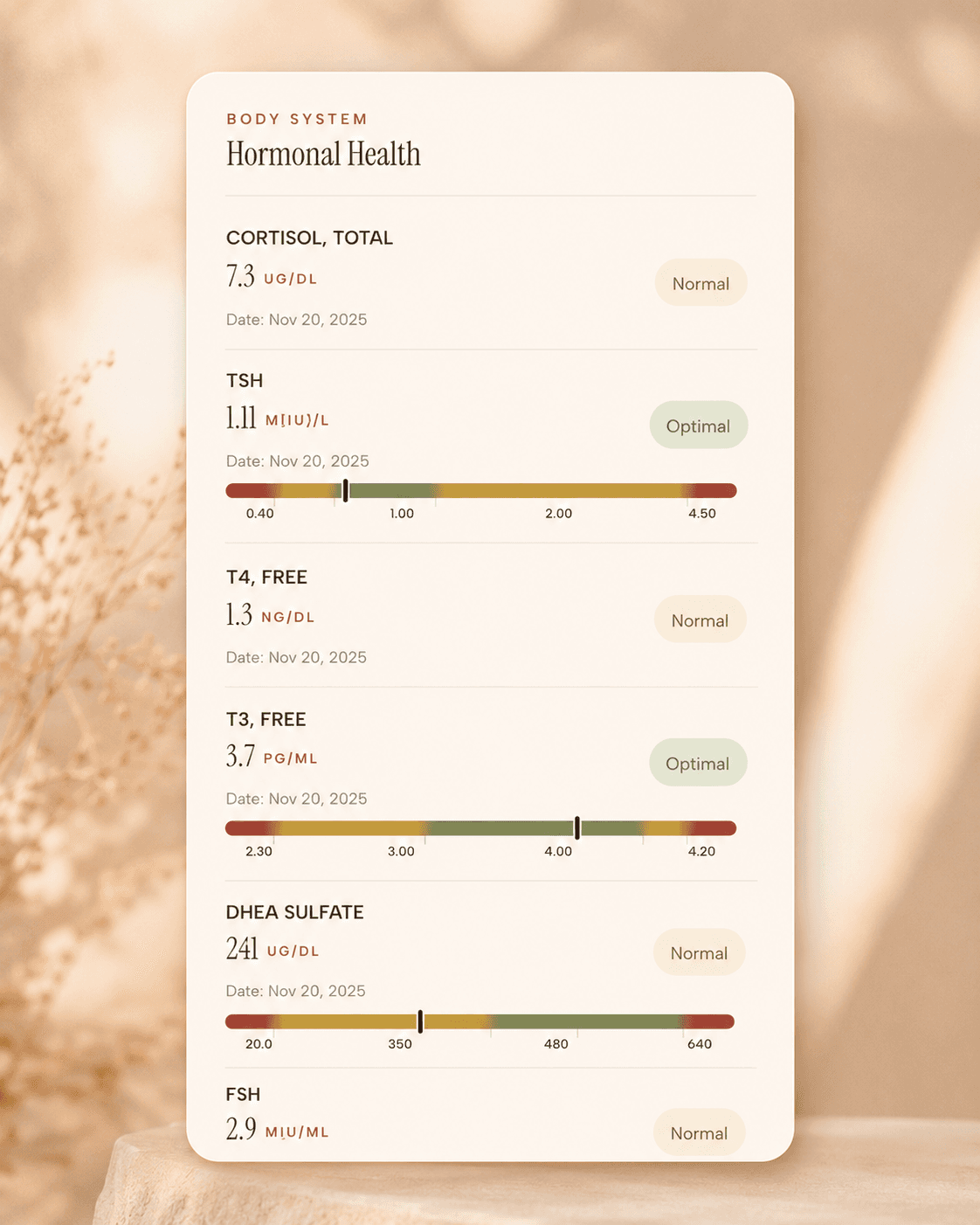
TSH is the master regulator of thyroid function, controlling the production of thyroid hormones T4 and T3. In functional medicine, we use narrower TSH ranges than conventional medicine to identify subclinical thyroid dysfunction early. Even mildly elevated TSH can indicate thyroid insufficiency, leading to fatigue, weight gain, depression, and metabolic dysfunction. TSH levels are influenced by stress, nutrient deficiencies, autoimmune conditions, and environmental toxins. Optimal TSH supports energy, metabolism…
Learn moreIron Binding Capacity
TIBC helps distinguish between different causes of abnormal iron levels. High TIBC indicates iron deficiency (the body increases transferrin to capture more iron), while low TIBC suggests iron overload or chronic disease. It's essential for accurate iron status assessment. Total Iron Binding Capacity (TIBC) measures the blood's capacity to bind iron with transferrin, the main iron transport protein. It indirectly reflects transferrin levels and iron status.
Learn moreLab testing
Check ferritin, TSH, and vitamin B12 at Quest
starting from $99 panel with 100+ tests, one visit
No referral needed
About 1 week
Schedule online — results typically within a week
Clear next steps
Guidance included, with follow-up care available
HSA / FSA
Eligible for pre-tax health spending accounts
Pro Tips
Try a “stress-to-fatigue” timeline: when you feel wiped out, ask what happened 6–18 hours earlier (late emails, conflict, intense training). That delay often explains why you crash on a “random” day.
If you wake at 3–4 a.m. with your mind racing, keep lights low and do 10 minutes of slow breathing before you decide whether to get out of bed. The goal is to prevent your brain from learning that 3 a.m. is thinking time.
Use caffeine like a tool, not a drip: wait 60–90 minutes after waking, then stop by 2 p.m. for a week. If your sleep deepens, your baseline energy usually rises within 7–10 days.
If workouts are making you more tired for days, swap two high-intensity sessions for easy “zone 2” movement for two weeks. Stress plus intense training can look like laziness, but it is often just overload.
When you get labs, write down your top three symptoms next to the numbers (for example: ‘3 p.m. crash, heavy legs, brain fog’). It helps you and your clinician connect results to real life instead of chasing perfect ranges.
Frequently Asked Questions
Can stress really make you tired even if you sleep enough?
Yes. Stress can fragment your sleep and reduce deep sleep, so you get the hours but not the recovery. It can also keep your nervous system in a “ready” state, which feels like being tired and wired at the same time. If you wake unrefreshed most days for two weeks, treat it as a sleep-quality problem, not a motivation problem.
How do I know if my fatigue is burnout or a medical issue?
Burnout fatigue often comes with emotional exhaustion, cynicism, and feeling like even small tasks are heavy, while medical causes more often add body clues like cold intolerance, hair changes, heavy periods, or shortness of breath on stairs. The fastest way to triage is to pair your symptom pattern with a few targeted labs such as ferritin, TSH, and vitamin B12. If fatigue is new, worsening, or paired with chest pain, fainting, or unintentional weight loss, get checked promptly.
What ferritin level is too low for energy?
Many people start noticing fatigue when ferritin drops below about 30 ng/mL, even if hemoglobin is still normal. For symptom improvement, a common practical target is at least ~50 ng/mL, and some people do best higher depending on training load and menstrual blood loss. If your ferritin is low, ask about the cause and a safe repletion plan rather than guessing with supplements.
What TSH level suggests my thyroid is causing fatigue?
A clearly elevated TSH (often above ~4–5 mIU/L) raises suspicion for hypothyroidism, especially if you also feel cold, constipated, or mentally slowed. Even within the lab range, some people feel best with TSH around 0.5–2.5 mIU/L, but interpretation depends on your history and whether free T4 is normal. If your TSH is abnormal, the next step is a clinician review rather than self-treating.
What’s the fastest way to feel less exhausted this week?
Pick one anchor: a consistent wake time for seven days, and protect the first hour after waking from email and doom-scrolling so your stress response does not spike immediately. Then run a simple experiment with breakfast protein (25–35 g) to reduce the afternoon crash. If you want a clearer plan, bring your sleep pattern and a short symptom list to PocketMD or your clinician and consider checking ferritin, TSH, and vitamin B12.