Mood Swings in Teenagers: What They Mean and What Helps
Mood swings in teenagers often come from sleep loss, stress overload, or thyroid and iron issues. Targeted blood tests are available—no referral needed.






Mood swings in teenagers are usually your brain reacting to a mix of shifting hormones, not-enough sleep, and stress that keeps your body stuck in “on” mode. Sometimes, though, the mood changes are being amplified by something fixable like low iron, a thyroid problem, or blood sugar swings, and labs can help sort out which one fits you. If your emotions feel like they change faster than you can explain, you are not “broken” and you are not alone. Teen brains are still building the circuits that handle impulse control and emotional regulation, so the same stressor can hit harder than it would later in life. The tricky part is that normal teen volatility can look a lot like anxiety, depression, ADHD burnout, or even early bipolar symptoms, which is why it helps to look at patterns, triggers, and a few targeted health checks. If you want help thinking through your specific situation, PocketMD can walk you through what’s normal, what’s not, and what to do next, and Vitals Vault labs can help you rule in or rule out common medical contributors.
Why mood swings hit so hard in your teens
Sleep debt and a reactive brain
When you are short on sleep, the emotional “brakes” in your brain do not work as well, and the threat detector becomes jumpier. That can feel like snapping at people, crying over small things, or going from fine to furious in minutes. A useful clue is timing: if your worst mood swings cluster after late nights, early school days, or weekend sleep shifts, sleep is probably a main driver.
Hormone shifts during puberty
Puberty changes how your brain responds to stress and reward, and it also changes how strongly you feel social feedback. That can make rejection feel huge and excitement feel unstoppable, even when you logically know it is “not that deep.” If your mood swings come in waves with growth spurts, acne flares, or big changes in your body, it is a sign your system is still calibrating.
Chronic stress and burnout
If your body is running on stress hormones all day, your mood can swing because you are constantly switching between pushing through and crashing. You might feel wired at night, exhausted in the morning, and emotionally thin-skinned by afternoon. One practical takeaway is to look for the stress “stack,” because mood swings often improve when you remove even one daily pressure point, like an overloaded schedule or nonstop notifications.
Low iron stores (iron deficiency)
Low iron can reduce oxygen delivery and affect brain chemicals involved in motivation and mood, which can show up as irritability, low energy, and feeling overwhelmed by normal tasks. This is especially common if you have heavy periods, follow a low-meat diet, or are in a rapid growth phase. If you also get headaches, feel unusually tired, or crave ice, it is worth checking ferritin, which reflects your iron reserves.
Thyroid imbalance affecting mood
Your thyroid sets the pace for your whole body, so when it runs too fast or too slow, your mood often changes with it. An overactive thyroid can feel like anxiety with a racing heart and irritability, while an underactive thyroid can feel like depression, brain fog, and low drive. If mood swings come with heat or cold intolerance, constipation, tremor, or unexplained weight change, a TSH test can be a smart next step.
What actually helps you feel steadier
Build a “same wake time” anchor
If you only change one sleep habit, keep your wake time within about an hour every day, including weekends, because that stabilizes your internal clock. Your mood often follows your sleep rhythm more than you expect, especially if you are sensitive to late-night scrolling. After a week of a consistent wake time, many people notice fewer sudden spikes of irritability.
Use a two-week mood map
Track mood once in the morning and once at night on a 1–10 scale, and add one sentence about what happened right before the shift. This is not about judging yourself; it is about finding patterns you can actually change, like “arguments happen after I skip lunch” or “I spiral after TikTok at midnight.” Bring the map to a parent, counselor, or clinician if you want help interpreting it.
Eat for fewer blood sugar crashes
Big gaps between meals and sugary snacks can create a crash that feels like sudden anger, shakiness, or “I hate everyone” energy. You do not need a perfect diet, but you do need predictable fuel, especially on school days. Try a protein-plus-carb snack after school, like yogurt with fruit or a sandwich, and see if your late-day mood swings soften within several days.
Practice a fast de-escalation script
When your mood spikes, your brain is not in debate mode, so arguing usually makes it worse. A simple script like “I’m at an 8/10 right now, I need 10 minutes, then I can talk” protects relationships and gives your nervous system time to settle. Pair it with a physical reset, such as a brisk walk around the block or slow breathing with a longer exhale.
Get screened when it’s more than swings
If your mood changes come with weeks of feeling hopeless, losing interest in everything, panic attacks, self-harm thoughts, or risky behavior that feels out of control, you deserve more support than self-help tips. A primary care clinician or mental health professional can screen for depression, anxiety, ADHD, trauma, or bipolar-spectrum symptoms and match you to therapy or medication when needed. If you ever feel unsafe, tell a trusted adult right away and seek urgent help.
Lab tests that help explain mood swings in teenagers
Ferritin
Ferritin is your body's iron storage protein, reflecting total iron stores in the body. In functional medicine, ferritin assessment is crucial for identifying both iron deficiency and iron overload, conditions that can significantly impact energy levels and overall health. Low ferritin is the earliest sign of iron deficiency, often occurring before anemia develops. This can cause fatigue, weakness, restless leg syndrome, and cognitive impairment. Conversely, elevated ferritin may indicate iron overload, inflamma…
Learn moreIron, Total
Serum iron measures the amount of iron circulating in your blood at the time of testing. In functional medicine, we recognize that serum iron alone provides limited information about iron status, as it fluctuates throughout the day and is affected by recent iron intake, inflammation, and diurnal variation. However, when combined with other iron studies, it helps assess iron metabolism and transport. Iron is essential for oxygen transport, energy production, DNA synthesis, and immune function. Optimal serum iron…
Learn moreTSH
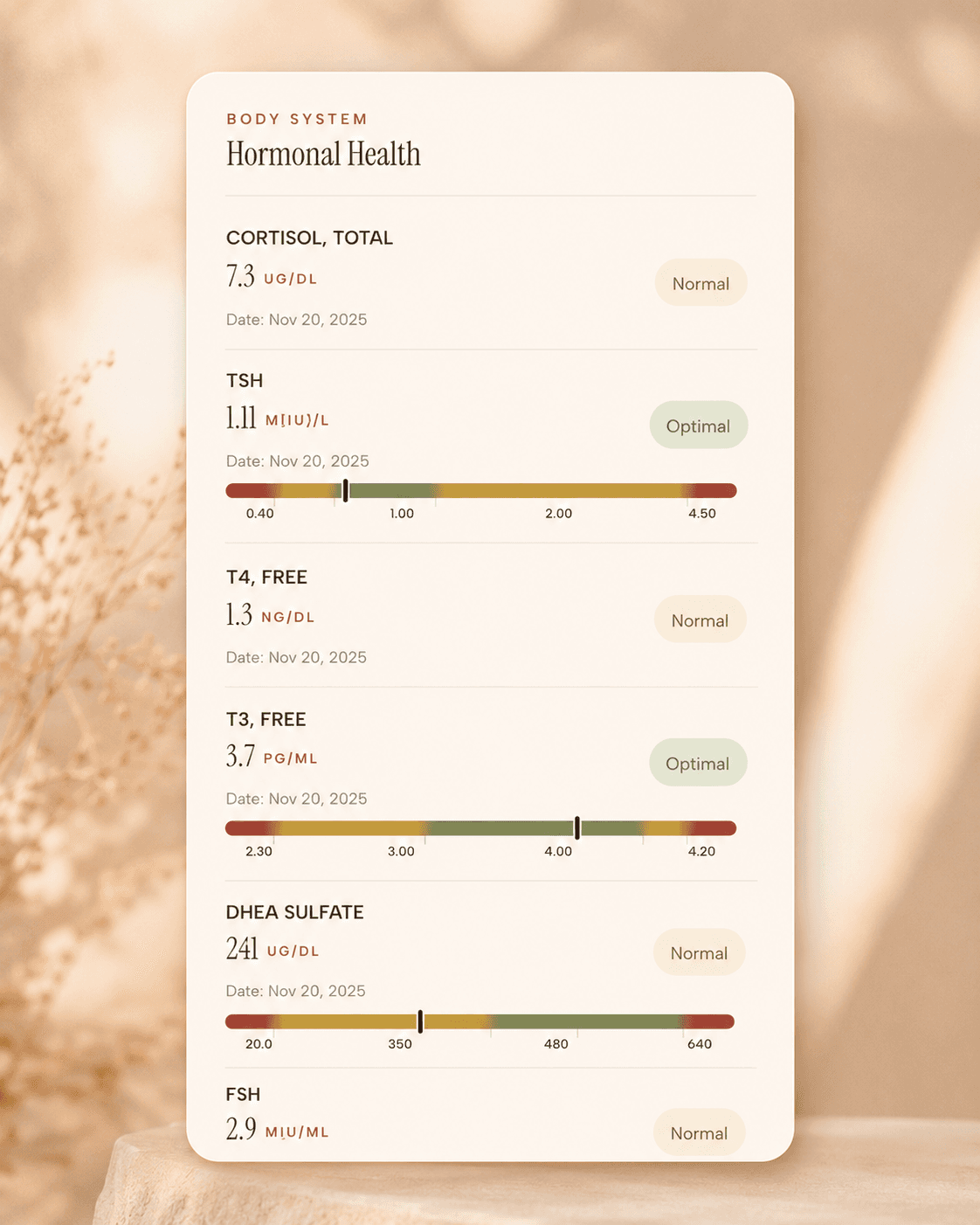
TSH is the master regulator of thyroid function, controlling the production of thyroid hormones T4 and T3. In functional medicine, we use narrower TSH ranges than conventional medicine to identify subclinical thyroid dysfunction early. Even mildly elevated TSH can indicate thyroid insufficiency, leading to fatigue, weight gain, depression, and metabolic dysfunction. TSH levels are influenced by stress, nutrient deficiencies, autoimmune conditions, and environmental toxins. Optimal TSH supports energy, metabolism…
Learn moreLab testing
Check thyroid, iron stores, and vitamin D at Quest
starting from $99 panel with 100+ tests, one visit
No referral needed
About 1 week
Schedule online — results typically within a week
Clear next steps
Guidance included, with follow-up care available
HSA / FSA
Eligible for pre-tax health spending accounts
Pro Tips
Try the “HALT” check when your mood flips: ask yourself if you are Hungry, Angry, Lonely, or Tired, because fixing just one of those can bring you down from an 8/10 to a 5/10 fast.
If mornings are your worst time, put your phone across the room and get outside light within 30 minutes of waking for 5–10 minutes; it helps set your body clock and can make your mood less spiky by afternoon.
If arguments keep happening at home, agree on a repair routine ahead of time, like “pause, cool down for 10 minutes, then restart with one sentence each,” because you cannot invent a plan in the middle of a blow-up.
If you have periods, write down day 1 of bleeding and rate mood daily for two cycles; if the worst swings reliably hit the week before your period, that pattern is actionable and worth bringing to a clinician.
If you suspect iron is part of the picture, do not guess with supplements first; get ferritin checked so you know whether you need iron, how much, and for how long.
Frequently Asked Questions
Are mood swings normal in teenagers?
Some mood variability is normal in your teens because your brain is still developing emotion regulation, and puberty changes how strongly you react to stress and social feedback. It becomes less “normal” when swings are intense, frequent, or start causing school problems, relationship blowups, or risky behavior. If the pattern is new or worsening, a simple mood map for two weeks plus a check for thyroid (TSH) and iron stores (ferritin) can be very clarifying.
How do I know if it’s hormones or depression?
Hormone-related mood changes often come in a pattern, such as worsening the week before a period or during big sleep disruptions, and you still have stretches where you feel like yourself. Depression is more about persistence, such as two weeks or more of low mood or irritability most days, plus changes in sleep, appetite, energy, or interest in things you used to enjoy. If you are unsure, ask for a depression screen and bring a two-week mood log so the conversation is based on data, not guesswork.
Can low iron cause mood swings in teens?
Yes, low iron stores can contribute to irritability, low motivation, fatigue, and feeling emotionally overwhelmed, especially if you have heavy periods or are growing fast. Ferritin is the key test because it shows your iron reserves, and symptoms can happen even when hemoglobin is still in the “normal” range. If ferritin is low, treating the cause and replenishing iron often improves both energy and mood over weeks.
What vitamin deficiency causes mood swings?
Vitamin D deficiency is a common one to check because low 25(OH) vitamin D is linked with fatigue and low mood in some people, which can make mood swings harder to manage. Many clinicians aim for about 30–50 ng/mL, since very low levels are more likely to be symptomatic. If your level is low, repletion is usually straightforward, but it should be based on your actual result rather than a random high-dose supplement.
When should I worry about bipolar disorder in a teenager?
Bipolar-spectrum symptoms are less about quick mood changes from a bad day and more about distinct episodes, such as several days of unusually high energy, little need for sleep, racing thoughts, and risky behavior that is out of character. If you have periods like that, especially with a family history of bipolar disorder, it is worth getting a professional evaluation rather than trying to self-diagnose. Start by tracking sleep and mood daily and bring that record to a clinician or therapist so they can assess the pattern accurately.