Why Anxiety Can Feel Like Memory Loss (and What to Do Next)
Memory loss with anxiety often comes from stress hormones, poor sleep, or low B12/thyroid shifts. Targeted blood tests available at Quest—no referral needed.






Memory loss with anxiety is usually not your brain “breaking” — it is your attention and recall getting disrupted by stress chemistry, poor sleep, and sometimes a fixable medical issue like low vitamin B12 or thyroid imbalance. When your body is in threat mode, your brain prioritizes scanning for danger over storing new details, which can look like forgetfulness. Simple labs can help sort out whether this is mainly anxiety-and-sleep, a nutrient or thyroid problem, or something that needs a different workup. This symptom is scary because it pokes the exact fear many people have: “What if this is dementia?” The good news is that anxiety commonly causes very real memory lapses, especially for names, conversations, and why you walked into a room. The tricky part is that anxiety can also ride along with other issues, including post-viral fatigue, depression, medication side effects, and age-related changes. Below you will see the most common patterns, what helps in day-to-day life, and which tests are most useful. If you want help matching your specific pattern to the right next step, PocketMD can talk it through with you, and Vitals Vault labs can help you check the most relevant biomarkers without a referral.
Why anxiety can feel like memory loss
Stress mode blocks new memories
When you are anxious, your body releases stress hormones like cortisol and adrenaline, which push your brain into “scan for danger” mode. That state narrows attention, so you do not encode details well in the first place, and later it feels like your memory failed. A useful clue is that you can often remember fine when you are calm, but you blank during meetings, social situations, or when you feel judged.
Poor sleep wrecks recall
Sleep is when your brain files away what you learned during the day, especially during deep sleep and REM. Anxiety can make it hard to fall asleep, keep you waking at 3 a.m., or leave you with light, unrefreshing sleep, which means yesterday’s information never gets stored properly. If your “memory loss” is worst after a bad night and improves after two solid nights, sleep is probably a big driver.
Panic symptoms mimic brain fog
During panic, you may breathe faster and blow off carbon dioxide, which can cause lightheadedness, tingling, and a spaced-out feeling. In that moment, it is hard to track conversations or remember what someone just said, and afterward you may replay the episode and feel even less confident. If your forgetfulness clusters around racing heart, chest tightness, or feeling unreal, treating the panic physiology often improves the memory problem.
Low B12 slows brain processing
Vitamin B12 helps maintain nerve insulation and supports brain chemistry, so when it is low you can feel mentally slow, forgetful, or oddly “not sharp,” and anxiety can get louder on top of that. This is more likely if you eat little animal protein, take acid-suppressing meds long-term, have digestive issues, or are over 60. The key takeaway is that B12-related cognitive symptoms can be reversible, but you have to measure it and treat it correctly.
Thyroid imbalance changes thinking speed
Your thyroid sets the pace for many brain processes, so when it is underactive you may feel sluggish, forgetful, and depressed, and when it is overactive you may feel keyed up, restless, and unable to focus. Either way, anxiety can be the headline symptom while the thyroid issue is the amplifier underneath. If your memory changes came with new heat or cold intolerance, weight change, hair shedding, or a new tremor, thyroid testing is a smart next step.
What actually helps you remember better
Treat anxiety like a body state
If your nervous system is stuck in high alert, your memory will keep feeling unreliable, even if you “know” you are safe. Try a 2-minute downshift before memory-heavy tasks: slow breathing with longer exhales, then relax your jaw and shoulders, because that tells your brain the threat has passed. Do it before you walk into the meeting, not after you blank.
Use external memory on purpose
Anxiety makes you second-guess yourself, so you keep information in your head to “prove” you can remember, and that backfires. Pick one trusted capture system, such as a notes app or a small notebook, and write down names, tasks, and decisions immediately. The win is not perfect recall; it is reducing the mental load so your brain can focus again.
Fix sleep with a tight experiment
Instead of vague “sleep hygiene,” run a 10-night experiment: set a consistent wake time, stop caffeine after noon, and keep your phone out of the bed so you are not feeding your brain new threats at 1 a.m. If you snore, wake up choking, or feel exhausted despite enough hours, ask about sleep apnea, because treating it can dramatically improve attention and memory. Track your next-day recall on a 1–10 scale so you can see the pattern.
Review, don’t re-read
When you are anxious, re-reading feels productive, but it does not build strong memory. Instead, do one quick “active recall” pass: close the page and write three bullet points from memory, then check what you missed. This trains retrieval, which is the part that feels broken when anxiety is high.
Target reversible medical drivers
If labs show low B12 or thyroid imbalance, treating those can make your brain feel faster and steadier, which also makes anxiety easier to manage. Do not guess with supplements if you have symptoms, because the right dose depends on the level and the cause of the deficiency. Bring your results to a clinician and ask, “What is the plan to recheck and confirm it is working?”
Useful biomarkers to discuss with your clinician
Vitamin B12
Vitamin B12 (cobalamin) is essential for DNA synthesis, red blood cell formation, neurological function, and energy metabolism. In functional medicine, we recognize that B12 deficiency is surprisingly common, especially in older adults, vegetarians, vegans, and those with digestive issues. B12 deficiency can cause irreversible neurological damage if left untreated. The vitamin is crucial for methylation reactions, which affect cardiovascular health, detoxification, and gene expression. Even subclinical deficienc…
Learn moreTSH
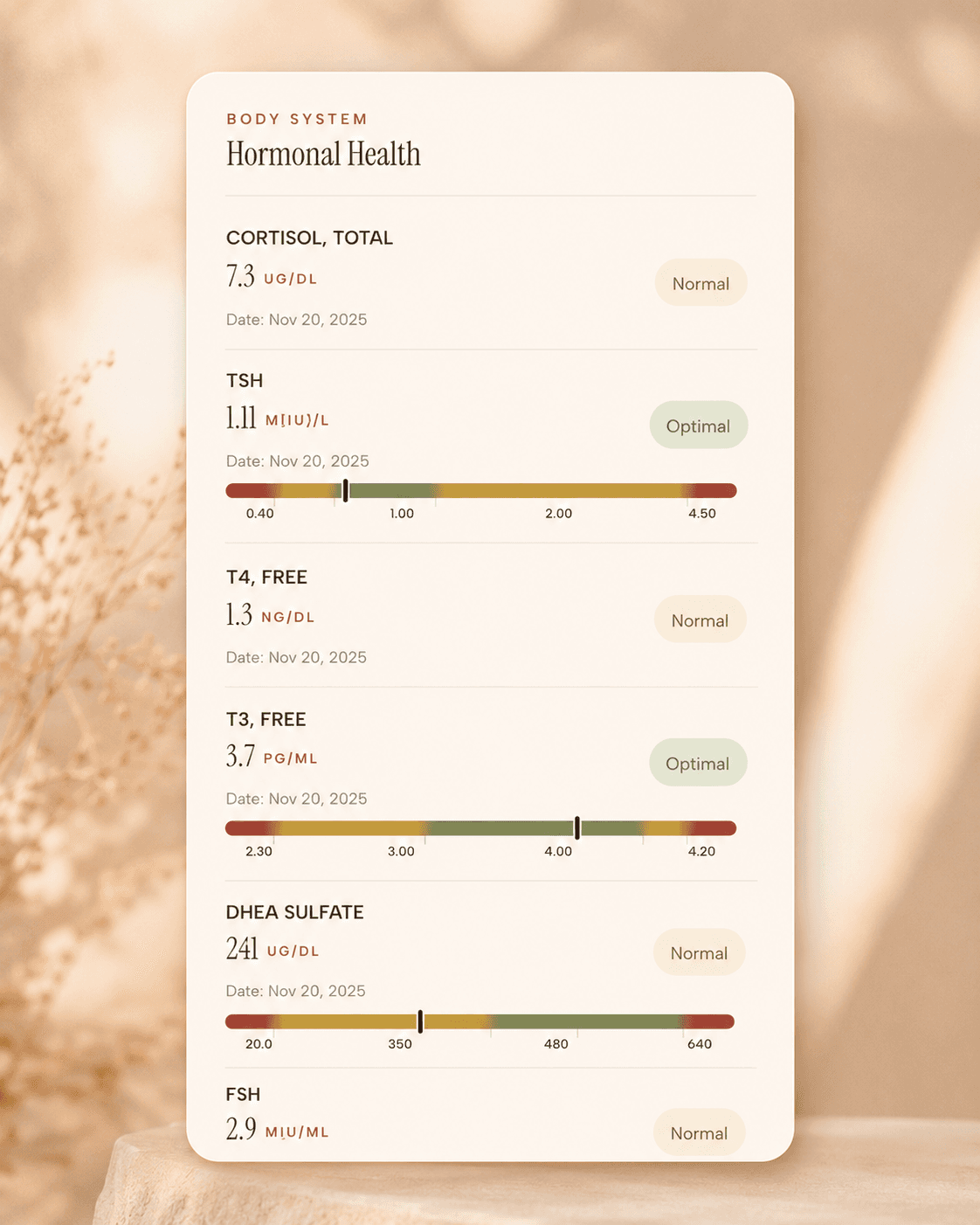
TSH is the master regulator of thyroid function, controlling the production of thyroid hormones T4 and T3. In functional medicine, we use narrower TSH ranges than conventional medicine to identify subclinical thyroid dysfunction early. Even mildly elevated TSH can indicate thyroid insufficiency, leading to fatigue, weight gain, depression, and metabolic dysfunction. TSH levels are influenced by stress, nutrient deficiencies, autoimmune conditions, and environmental toxins. Optimal TSH supports energy, metabolism…
Learn moreCortisol, Total
Cortisol is the primary stress hormone that regulates metabolism, immune function, and blood pressure. In functional medicine, cortisol assessment is crucial for understanding stress response and its impact on overall health. Chronic elevation suppresses testosterone production and immune function, while low cortisol indicates adrenal insufficiency. Optimal cortisol rhythm supports energy, mood stability, and hormone balance. Cortisol orchestrates the body's stress response and daily energy rhythms. Balanced cor…
Learn moreLab testing
Check B12, thyroid, and inflammation markers at Quest
starting from $99 panel with 100+ tests, one visit
No referral needed
About 1 week
Schedule online — results typically within a week
Clear next steps
Guidance included, with follow-up care available
HSA / FSA
Eligible for pre-tax health spending accounts
Pro Tips
Do a “memory reality check” for one week: each time you forget something, write down whether you were rushed, multitasking, or anxious in that moment. Patterns show up fast, and they usually point to attention problems rather than true storage loss.
If names are the problem, use a two-step script: repeat the name out loud once, then connect it to a visual detail you can actually see (like “Sam with the red glasses”). That tiny extra encoding step often beats trying harder later.
When you feel a blank coming on, stop searching your brain for 10 seconds and look at your environment instead. Anxiety makes you dig a deeper hole, but a brief reset often lets the word or task pop back up.
Try a “one-tab rule” for your brain: for any task that matters, close extra browser tabs and silence notifications for 15 minutes. Anxiety plus constant switching is a perfect recipe for forgetting what you just read.
If you are worried about dementia, write down three concrete examples of what is happening and whether you can retrace your steps to find the answer. Being able to problem-solve your way back is reassuring and gives your clinician better information than “my memory is bad.”
Frequently Asked Questions
Can anxiety really cause memory loss?
Yes. Anxiety shifts your brain into threat mode, which reduces attention and makes it harder to store new information, so later it feels like memory loss. It is especially common to forget recent conversations, names, and why you started a task. If your recall improves when you are calm or well-rested, that pattern strongly supports anxiety as a driver.
How do I know if it’s anxiety or dementia?
Anxiety-related forgetfulness usually comes with strong worry about the symptom and tends to fluctuate day to day, while dementia more often shows a steady decline and problems with daily function over time. With anxiety, you might misplace items but can often retrace your steps; with dementia, you may not recognize the steps at all. If you are getting lost in familiar places, having major word-finding trouble, or others notice clear decline, schedule a medical evaluation soon.
What vitamin deficiency causes memory problems and anxiety?
Low vitamin B12 is a common, testable cause of brain fog, forgetfulness, and mood changes, including anxiety. Symptoms can happen even when B12 is “low-normal,” so many clinicians pay attention when levels are below about 400–500 pg/mL, especially if you have tingling or fatigue. Ask for a B12 test and discuss whether methylmalonic acid is needed if results are borderline.
Can thyroid problems cause anxiety and forgetfulness?
They can. An overactive thyroid can feel like constant nervous energy with poor focus, while an underactive thyroid can cause slowed thinking, low mood, and memory complaints that are easy to mistake for aging. A TSH blood test is the usual starting point, and many people feel best when TSH is roughly 0.5–2.5 mIU/L, depending on context. If you also notice weight change, temperature intolerance, tremor, or hair changes, testing is especially worthwhile.
What should I do first if I’m forgetting things and panicking about it?
Start by stabilizing the basics that most affect memory: get two nights of protected sleep, reduce multitasking, and use one external system to capture tasks so you stop relying on anxious recall. Then consider targeted labs such as TSH and vitamin B12, because fixing a reversible driver can make the anxiety spiral quieter. If symptoms are rapidly worsening, you have new confusion, or you cannot manage daily activities, get urgent medical care.