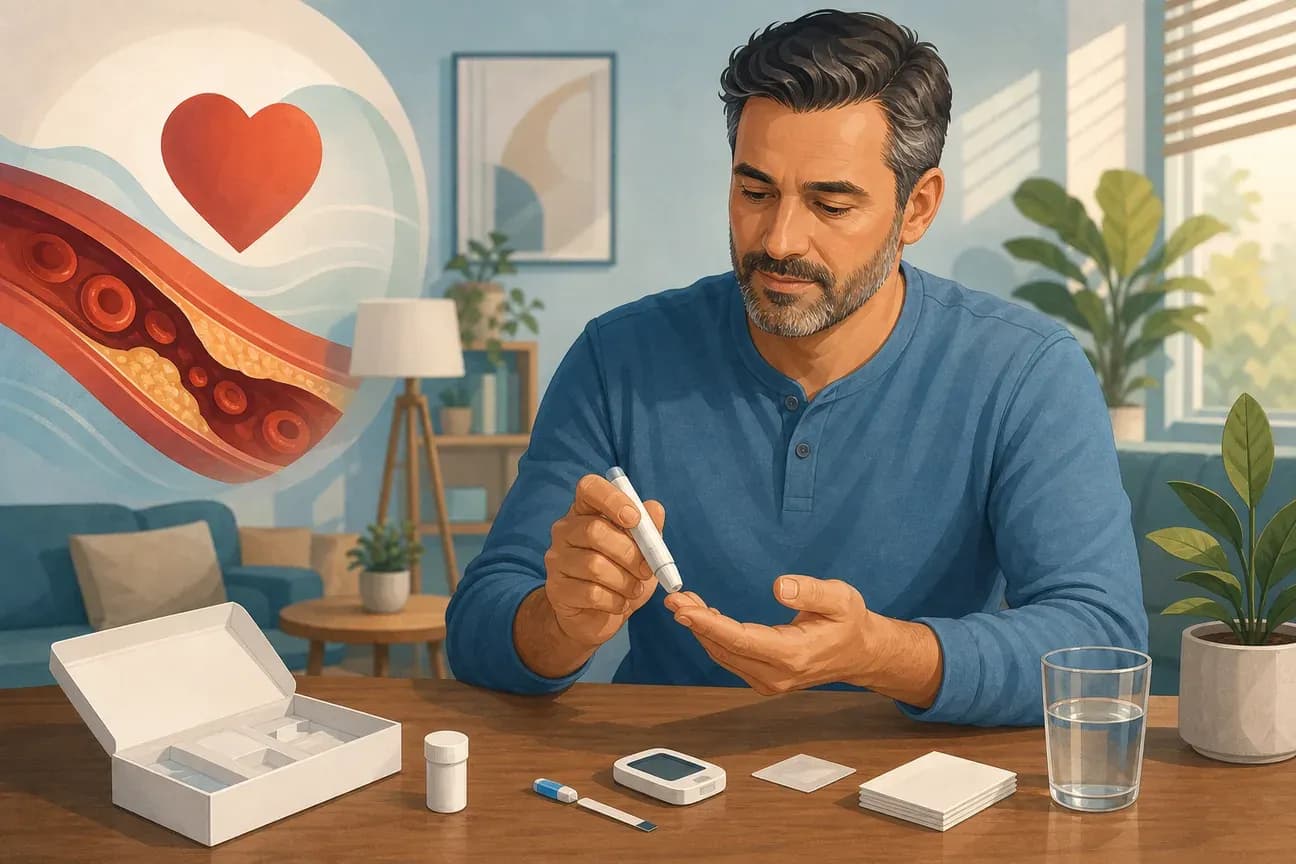
Compare home cholesterol test kit options for 2026 by biomarkers, speed, sample type, result format, cost, and key limits.
Most home cholesterol test kits measure four familiar lipids. That may be enough for a quick check, but it can leave useful context out. The options below range from a low-cost color strip to a 160-plus biomarker lab service, so you can match the test to the question you want answered.
Vitals Vault is a clinician-authorized lab testing service for people who want cholesterol data in a wider health context. It suits adults who want more than a single lipid reading, especially if they track cardiometabolic health over time.
Its listed lab testing service includes more than 160 biomarkers and costs about $49. That is a much wider panel than the four-marker format found in many home cholesterol test kits. The broader view may include related markers across metabolic, hormone, nutrient, thyroid, inflammation, and longevity systems.
That breadth changes the question. Instead of asking only, “What is my total cholesterol?” you can look for patterns that may be worth discussing with a clinician. For example, cholesterol results may be easier to interpret beside glucose-related markers, inflammation markers, or other cardiometabolic measures. A single result still does not diagnose a condition.
Vitals Vault also helps users organize old lab reports and compare results across time. That matters because one test is a snapshot. A trend can show whether a marker is moving in the same direction after a change in diet, sleep, activity, or medical care.
You can review a narrower option through the Cholesterol Follow-Up Blood Test Panel if your main goal is repeat lipid monitoring. If you want particle-level detail, an advanced panel may add information about ApoB or lipoprotein particles, which standard total cholesterol does not show.
The tradeoff is that this is a lab service, not an instant meter. You will wait for lab processing rather than read a number on a device within minutes. Its educational insights are also not a diagnosis or a substitute for care from a licensed professional.
For people who want to connect cholesterol with a larger set of health markers, Vitals Vault is the most useful starting point on this shortlist.
Next question to ask: Do you need a broad health snapshot, or do you only need a fast reading before your next appointment?
Everlywell Cholesterol & Lipids Test is a mail-in option for people who want a standard lipid panel without visiting a lab for collection. It measures total cholesterol, HDL, calculated LDL, and triglycerides from a finger-prick sample.
The four markers answer different parts of the same question. Total cholesterol gives a broad amount. LDL is the cholesterol carried in low-density lipoproteins. HDL is the cholesterol carried in high-density lipoproteins. Triglycerides are another form of fat in the blood.
The LDL result is calculated rather than directly measured. If a result seems surprising, a clinician may suggest a repeat test or a different lab method.
The sample is collected at home and mailed to a laboratory with prepaid shipping. Results are delivered digitally after processing and are described as physician-reviewed. The company also provides written explanations and educational material to help readers understand the report.
Follow the kit instructions closely, because collection errors can affect a small blood sample more than they affect a standard venous draw.
Choose this format if your priority is a familiar four-part lipid panel with digital results. Choose something broader if your goal is to compare cholesterol with other biomarkers.
The listed biomarkers are total cholesterol, HDL cholesterol, triglycerides, and glucose.
The fast turnaround is the main reason to consider this format. You place a blood sample on the appropriate test strip, use the analyzer, and receive a result without mailing a sample to a lab. That can be useful for people who want to watch direction over time, such as checking whether a change in routine appears to move a number.
Glucose adds a small amount of metabolic context, but it does not replace an A1C test. A single glucose reading can change with meals, stress, illness, sleep, and exercise. It also does not explain why a lipid result is high or low.
Several CardioChek formats use the same broad marker set and provide results in 90 seconds. Compare the named analyzer versions and their stated test menus before choosing.
A handheld meter shifts more work to you. You need to store the device correctly, use compatible strips, check expiration dates, and collect enough blood. A weak sample or a poor fingerstick can produce an error or a result that deserves confirmation.
There is also a clinical interpretation limit. A home meter can show a number, but it cannot weigh that number against blood pressure, family history, smoking status, diabetes, medicines, age, or prior cardiovascular disease. Those factors help determine what the result means for your risk.
CardioChek PA makes sense when speed and repeat checks matter more than a broad report. If your goal is diagnosis, treatment planning, or a detailed risk review, confirm important findings through a clinician and a laboratory test.
Use the device as a tracking aid, not as permission to start or stop treatment on your own.
Accutrend Plus is a multi-use analyzer that reports total cholesterol, triglycerides, glucose, and lactate from a fingerstick blood drop. It suits users who want one device for more than cholesterol and value a result within about three minutes.
The device displays results and stores them. That makes it different from a color strip, where you must compare the strip with a printed chart and record the result yourself. Stored readings can help you see direction across repeat checks, provided you use the same method each time.
Lactate is a measure linked to energy use during exertion, but its presence does not make this a complete fitness or medical assessment. Glucose also needs context. A result taken after food will not answer the same question as a fasting result.
A drop of blood is placed on a test strip, with readings available within three minutes. The strip is a single-use part of the process. Keep the analyzer and strips within the storage conditions in the instructions, since heat, cold, moisture, and expired strips can affect testing.
Multi-marker devices can look like a bargain because one meter covers several needs. But each marker may require its own strip type, and ongoing use depends on the cost and availability of compatible strips. Check those replacement details before buying the device.
Accuracy also depends on collection technique. Wash and dry your hands. Use the correct amount of blood. Do not squeeze the finger hard unless the instructions tell you to, because excess tissue fluid can dilute a sample.
The device gives you speed and storage, but it does not give you a physician’s interpretation. If your reading is unexpected, repeat it under the stated conditions and share the result with a healthcare professional.
Accutrend Plus is most suitable for a person who understands the limits of home meters and wants a reusable monitoring tool. It is less suitable for someone who wants a mailed report with written clinical context.
CardioChek Analyzer Kit is a reusable device kit for repeat testing of total cholesterol, triglycerides, and HDL. It fits people who care about keeping recent readings in one place instead of writing down every result.
The device stores 30 recent results. That can make a difference when you are comparing readings over several weeks or months. A stored history is easier to review than loose paper strips, though it still depends on testing under similar conditions.
This kit does not include every part of a standard lipid panel in the listed information. LDL is not included among the named biomarkers. That matters because total cholesterol alone can hide a higher LDL result, while HDL and triglycerides add more detail about the lipid pattern.
The device format also means you must plan for supplies. Test strips are not universal. Buy only strips made for the analyzer and check expiration dates before use. A meter without usable strips is not a monitoring system.
That cost may make more sense for someone who expects to test often. Someone who needs a one-time check may get more value from a lab service or a simpler test.
Repeated home readings are useful only when you can compare like with like. Keep notes about fasting, recent illness, unusual exercise, and changes in medication. A number that moves after a major change may reflect the change itself rather than a long-term shift in cardiovascular risk.
Do not use stored meter readings to adjust prescription treatment without medical guidance. The device can help you spot a pattern. Your clinician still needs to decide whether the pattern calls for another test or a change in care.
This kit is a device-first choice. If you want history plus a broader set of biomarkers, Vitals Vault may fit the question better than a dedicated cholesterol meter.
First Check Cholesterol Kit is a finger-prick screening kit that uses a color match rather than an electronic meter. It suits someone who wants a low-cost preliminary check and accepts a less detailed result format.
The kit is listed at $15. After collecting a blood drop, you compare the resulting imprint with a color chart. That keeps the kit simple, but it also places more responsibility on the user’s eyes and the lighting in the room.
A color match is not the same as a laboratory lipid panel. The listed format does not provide separate total cholesterol, HDL, LDL, and triglyceride readings. It gives a screening estimate that may tell you whether follow-up is sensible.
Use a visual strip on a flat surface with good light. Read it at the time stated in the instructions. Do not wait until later and assume the color will stay the same. If you cannot decide which color matches, treat that uncertainty as a reason to seek a lab test.
Price should not be the only deciding factor. A low-cost test can become less useful if it leaves you unsure what the number means. If the result is high, low, or hard to read, confirm it through a clinician or laboratory rather than making a treatment decision from the strip.
The Lipid Panel, Cardio IQ is a more detailed lab-based path for readers who want cholesterol information beyond a visual screen. An advanced lipid panel may be worth discussing when standard results do not fit your family history or other risk factors.
First Check is best viewed as a low-cost signal, not a final answer.
Home cholesterol test kits can be useful when you follow the instructions, but accuracy varies by kit and collection method. A meter may give an immediate estimate, while a mail-in sample is analyzed by a laboratory. Treat an unexpected result as a reason to repeat testing or speak with a healthcare professional.
A home cholesterol test kit may measure only total cholesterol, or it may include HDL, LDL, and triglycerides. Some devices also measure glucose or other markers. Read the test menu closely, because a total cholesterol result alone cannot show the full lipid pattern.
Fasting depends on the specific home cholesterol test kit and the question being asked. The Everlywell test instructions require eight hours of fasting. Other kits may give different directions.
Some home cholesterol test kits show results in about 90 seconds or within three minutes. Mail-in tests take longer because the sample must reach a laboratory. Speed is useful for tracking, but it does not make a quick result more clinically meaningful than a properly collected lab result.
A home cholesterol test cannot replace a medical evaluation. Cardiovascular risk also depends on factors such as blood pressure, diabetes, smoking, family history, age, and past disease. Share concerning or confusing results with a qualified healthcare professional before changing medicine or treatment.
Choose the test based on the decision you need to make. For a broad view with longitudinal lab history, start with Vitals Vault’s advanced lipid testing information; for a quick trend, a handheld meter may fit; for a low-cost signal, a color strip may be enough. Next, write down the markers you need and review any abnormal result with a clinician.
Core Essential Wellness Panel
Includes the depth of physician-backed labs plus AI-reviewed storytelling so you can act on your physiology with confidence.
