Back to Articles
How to Find a DEXA Scan Near You
Learn how to find a DEXA body composition scan near me, compare U.S. providers, prepare for the test, and read results safely.
September 22, 2026
15 min read
Written by Vitals Vault Editorial Team
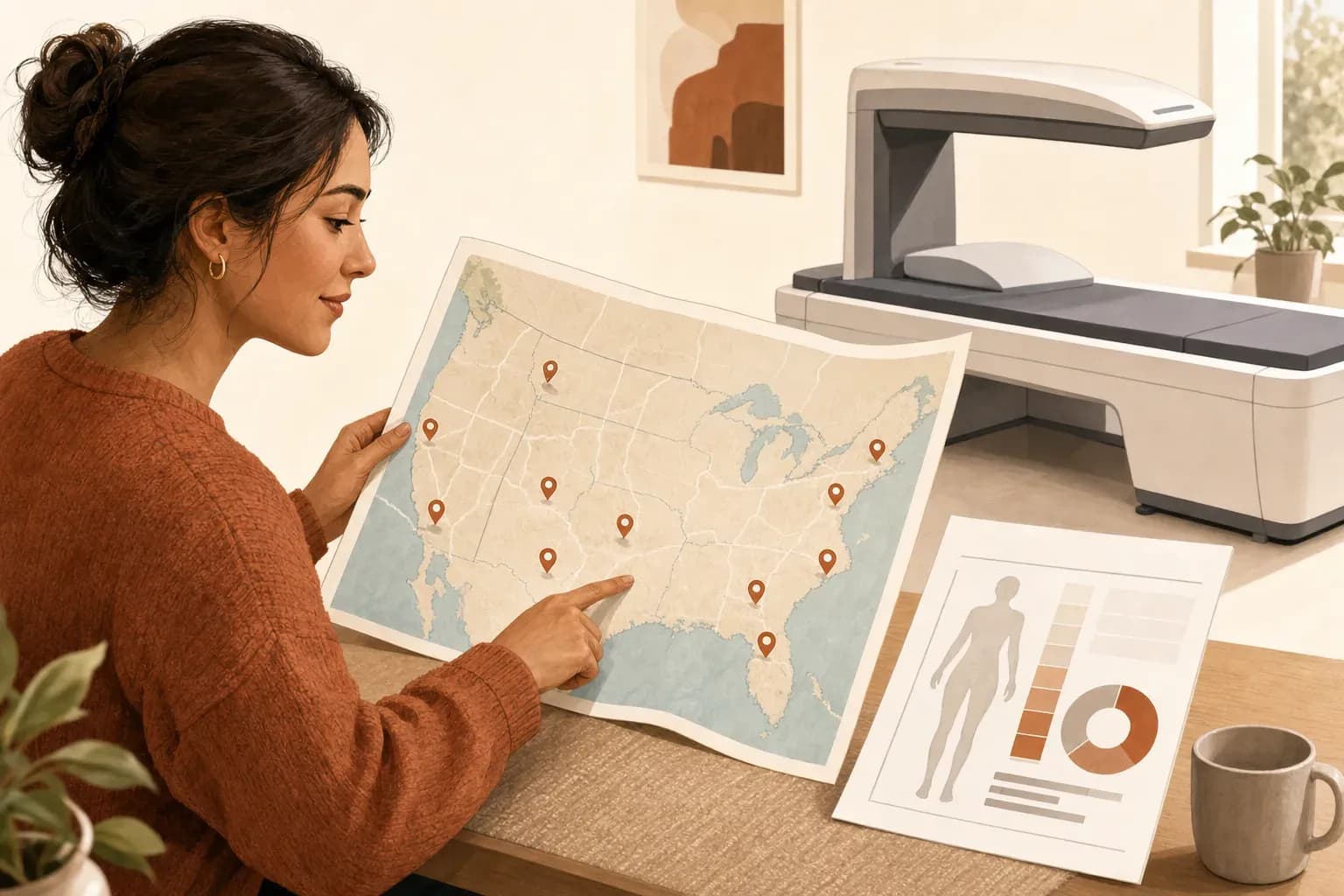
A nearby DEXA scan can show far more than a bathroom scale, but the phrase “body composition scan” doesn’t guarantee the same service everywhere. Use these five steps to find the right DEXA body composition scan near you, compare the real cost, prepare well, and without overreacting to one number.
Table of Contents
- Step 1: Decide what you want the DEXA body composition scan to measure
- Step 2: Search for nearby U.S. facilities and verify that they offer the right scan
- Step 3: Compare price, report details, and usable value before booking
- Step 4: Prepare for the scan and make the measurement as consistent as possible
- Step 5: cautiously and decide what to do next
- Frequently Asked Questions About a DEXA Body Composition Scan Near Me
- Conclusion
Step 1: Decide what you want the DEXA body composition scan to measure
A DEXA body composition scan near you may measure fat mass, lean soft tissue, visceral fat, and bone-related measures. Start with your question, because the right scan depends on what you need to learn.
DEXA, also written as DXA, uses two low-dose X-ray energies to estimate how much of the body is bone, fat, and lean soft tissue. Lean soft tissue includes muscle, water, organs, and other nonfat tissue. The scan can report whole-body results and regional results for areas such as the arms, legs, and trunk.
That makes it different from a standard bathroom scale. Your weight may stay flat while fat mass falls and lean mass rises. BMI has a similar limit. It uses height and weight, so it cannot show how much of your weight comes from muscle, fat, bone, or water.
DXA uses X-rays to measure bone density and mineral content, while the body composition version also analyzes soft tissue. The same word, DEXA, can therefore describe a clinical bone density test or a broader body composition scan.
Match the scan to your main question
Write down one main question before you search. A second question is fine, but a long wish list can make provider comparisons harder.
- Fat loss: Ask whether the report includes total body fat percentage, fat mass, and regional fat.
- Muscle gain: Ask for lean mass by body region. A total lean mass number may hide a left-right difference.
- Abdominal health: Ask whether visceral fat analysis is included. Visceral fat sits around internal organs and differs from fat just below the skin.
- Bone health: Confirm whether the visit is a medical bone density test or a wellness-focused composition scan. They may use similar equipment but answer different questions.
- Long-term tracking: Ask how the facility handles repeat scans and whether the same machine can be used later.
Researchers describe DXA as useful because it can measure regional composition with relatively few assumptions. But results still depend on the scanner, software, body position, and testing method. A report is a measurement, not a perfect picture of your biology.
If bone health is your concern, think beyond the body fat page. A low bone density result may need review with a clinician, especially if you have fracture risk, a family history of osteoporosis, or a medication that affects bone. Vitals Vault can help you organize related lab history, so a bone result does not sit alone in a folder. In some situations, a clinician may also consider collagen type I C-telopeptide (CTX) testing to evaluate bone turnover beyond a one-time scan.
You can also read about bone density and longevity strategies if your goal includes more than a one-time body fat estimate.
Key Takeaway: Pick the scan by the question you need answered, then confirm that the report contains the matching measures.
Step 2: Search for nearby U.S. facilities and verify that they offer the right scan
When you search for a DEXA body composition scan near you, check the service details before trusting the map result. A facility may advertise DEXA but only provide a clinical bone density test.
Use a search phrase that includes your city, state, or ZIP code. Then open the provider’s own service page. Look for the exact words “body composition,” “whole-body,” “fat mass,” “lean mass,” or “visceral fat.” If the page only mentions osteoporosis screening or hip and spine density, ask whether it offers the broader scan you want.
BodySpec lists a full-body scan starting at $40 and positions it for people who want data on fat, muscle, and bone health. PrimaryMD highlights report features such as percentile rankings, visceral fat analysis, and metabolic rate testing. These examples show why two DEXA searches can produce very different services.
A peer-reviewed review of body composition methods notes that no single method answers every clinical question. It also points out that weight and BMI do not show the separate contributions of fat-free mass, fat mass, bone mineral content, and body water.
Ask these questions before you book
A short message can uncover gaps that a sales page leaves out. Ask for a written answer if the scan is expensive or you plan to repeat it.
- Is this a full-body composition scan or a bone density scan of selected sites?
- Which results are included: total fat, regional fat, lean mass, visceral fat, and bone measures?
- Does a clinician review the report, or do you receive a self-guided dashboard?
- How soon will the report arrive?
- What preparation rules apply to food, water, exercise, and clothing?
- What happens if your height, weight, or body width exceeds the scanner’s limits?
- Can you use the same scanner for a follow-up?
- What are the radiation precautions, and who operates the equipment?
Ask the provider for any details that matter to you before paying.
Location matters, but it should not be the only filter. A facility ten minutes away may save time while giving you a report that does not answer your question. A farther site may make more sense if it provides regional results or a clear repeat-scan plan.
For readers in Washington, the guide to DEXA scan options in Seattle shows the kind of comparison to make around scan type, price, timing, insurance, and follow-up value.
Step 3: Compare price, report details, and usable value before booking
Price is useful, but a low advertised price does not tell you what the report includes. Compare the full visit, not just the number shown in a search result for a DEXA body composition scan near you.
BodySpec advertises a full-body scan starting at $40. Pricing for body composition scans at wellness centers varies, while hospital-based bone density scans may cost more. Those figures are examples, not a quote for your city. Confirm the current total before you book.
Ask whether the price covers the scan, the report, image review, and any follow-up discussion. Some providers may bundle these parts. Others may list a low scan fee and charge separately for interpretation or extra testing.
Compare the report, not just the appointment
A useful report should tell you what each number means and where it came from. Look for these details:
- Whole-body results: Total fat mass, lean mass, and bone-related measures give you a broad baseline.
- Regional results: Arm, leg, trunk, or side-to-side data can show patterns hidden by one total.
- Visceral fat: This may help describe abdominal fat distribution, but it is not a diagnosis by itself.
- Reference comparisons: Percentiles can show how a result compares with a reference group. They do not define your personal health target.
- Repeat-scan guidance: The provider should explain how to compare later scans without treating small changes as proof of progress.
PrimaryMD emphasizes percentile rankings, visceral fat analysis, and metabolic rate testing. BodySpec describes a dashboard that tracks body metrics and gives users a way to view change over time. These are different forms of value. One reader may care most about report depth. Another may need a lower entry price and a simple baseline.
Do not pay for a feature you will not use. If you want a simple baseline for a training plan, a detailed clinical consultation may be unnecessary. If you have a bone concern or a complicated health history, a self-guided dashboard may not answer the questions you need to discuss with a clinician.
Insurance also depends on the purpose of the test. A medically ordered bone density test may qualify for coverage when clinical criteria are met. A wellness scan for fitness tracking is usually an out-of-pocket service. Ask your insurer and the facility rather than relying on a general promise.
HSA or FSA eligibility can also depend on the expense and plan rules. Get the receipt and check your account guidance before assuming reimbursement. The person who schedules the scan should be able to tell you whether the facility submits claims, but only your plan can confirm your final responsibility.
Think about repeat value
A scan becomes more useful when the next scan can be compared fairly. That means the same type of scan matters. So does a similar preparation routine. A provider that explains repeat testing may be more useful than one with a lower first-visit fee.
Vitals Vault is not a DEXA imaging facility. We help consumers order clinician-authorized lab testing, understand biomarkers across body systems, and organize past results in one secure place. That can add context when you want to compare a body composition result with glucose, insulin, lipids, thyroid markers, or other health data.
Pro Tip: Before booking, ask for the total price in writing and request a sample report or a list of every included measure.
Step 4: Prepare for the scan and make the measurement as consistent as possible
Preparation for a DEXA body composition scan is usually simple. The main goal is consistency, especially if you plan to compare scans over time.
Do not try to dehydrate yourself or force a fast to make the result look better. Water, food, glycogen, and recent exercise can change the amount of material measured as lean soft tissue. That does not mean a normal breakfast ruins the scan. It means different conditions can make two scans harder to compare.
Use a repeatable routine
Before the appointment, follow the provider’s instructions first. If the provider gives no special rules, use a normal routine and avoid unusual changes.
- Arrive normally hydrated. Do not restrict water or drink a large amount right before the scan.
- Avoid a heavy meal immediately before the appointment.
- Avoid strenuous exercise before the scan, especially a hard lifting session, long run, or hot class.
- Wear light clothing with little or no metal. Zippers, buckles, clasps, and underwire can interfere with the image.
- Tell the technician about joint replacements, surgical hardware, or implanted devices.
- Tell the scheduler if you are pregnant, might be pregnant, or recently had imaging with contrast or a tracer.
Internal hardware does not always prevent a scan, but it can affect a region of the image. Do not stop a medication or remove a device unless your clinician tells you to do so.
Clear measurement protocols, consistent terms, and attention to validity are important when body composition methods are used for clinical or research work.
For repeat scans, aim for similar timing and similar conditions. You might schedule each scan at roughly the same time of day, wear similar clothing, and keep your exercise and hydration routine steady. You are trying to reduce avoidable noise, not manufacture the lowest body fat number.
The scan itself is usually painless. You lie still while the scanner passes over your body. The length depends on the machine and the type of scan, so ask the facility for its expected appointment time.
One more point: do not treat a small shift as a major result. A change may reflect water, food, positioning, software, or true tissue change. Your trend becomes more useful when the difference is large enough to exceed normal measurement variation.
Step 5: cautiously and decide what to do next
A DEXA body composition scan near you gives you measurements, not a diagnosis. as a set of clues that need context.
Start with the measures that match your original question. If you wanted to track muscle, look at lean mass by region. If you wanted to assess fat distribution, review total fat and regional results. If bone health was the concern, focus on the bone density section and discuss it with the appropriate clinician.
Understand the main numbers
Fat mass is the estimated weight of fat tissue. Percent body fat is fat mass divided by total body mass. These are related but not identical. A person can gain weight while lowering the percentage if lean mass rises faster than fat mass.
Lean soft tissue is not the same as pure muscle. It includes water and other nonfat tissue. A rise in lean mass after a hard training block may partly reflect short-term water or glycogen changes. Look for a sustained pattern rather than one jump.
Visceral fat refers to fat around internal organs. It can be a useful part of a broader risk discussion, but the number does not diagnose diabetes, heart disease, or any other condition. Blood pressure, glucose, insulin, lipids, liver markers, sleep, family history, and medications may all add context.
Bone density is a separate concern from body fat. Clinical bone density reports may include a T-score, which compares bone density with a healthy young adult reference. A clinician should explain what the score means for your age, sex, fracture history, and risk factors.
Check for measurement limits
Look for the scanner model, the date of the scan, the regions measured, and any note about positioning or technical limits. If one arm was outside the scan field or metal affected a region, the report should say so.
Machine differences matter. Research has found that results can vary between scanner manufacturers. For trend tracking, staying with the same facility and machine can make comparisons cleaner, but it does not remove every source of variation.
Do not compare your result with an internet target without checking the reference group. A percentile tells you where you sit compared with a particular population. It does not tell you what you must become. Population reference data also do not automatically define ideal health or athletic performance.
Turn the result into a sensible next step
If the scan supports your goal, keep your plan steady and repeat the measurement at a reasonable interval. A scan taken too often may show noise before your habits have had time to change tissue.
If the report raises a medical concern, share it with a licensed clinician. This is especially important for low bone density, a history of fractures, marked asymmetry, unexplained weight loss, or a large change that does not fit your daily life.
If body composition is part of a wider health review, Vitals Vault can help you place lab results beside the scan rather than treating the image as the whole story. We provide educational, AI-assisted insights to support questions and next steps. We do not diagnose or replace medical care.
For people considering body contouring, a scan may help separate a body fat question from a shape or skin issue. A surgical consultation is a different decision, and a U.S. surgery center is one example of a provider focused on body contouring procedures such as liposuction, tummy tucks, and BBLs. A DEXA report cannot tell you whether a procedure is appropriate.
The next action should fit the finding. Do not change medication, start a restrictive diet, or pursue a procedure based on one scan alone.
Frequently Asked Questions About a DEXA Body Composition Scan Near Me
How much does a DEXA body composition scan cost?
Pricing varies by facility, while medically ordered bone density testing can cost more. BodySpec advertises a full-body scan starting at $40. Your total depends on location, scan type, report details, and added interpretation, so ask for the final price before booking.
What is the difference between a DEXA scan and a body composition scan?
A DEXA scan can refer to a clinical bone density test or a full-body body composition scan. A bone density test focuses on bone mineral density, while a body composition scan may also report fat mass, lean soft tissue, and regional results. Confirm the exact service when searching for a nearby appointment.
Do I need to fast before a DEXA body composition scan?
You usually do not need an aggressive fast before a DEXA body composition scan. Follow the facility’s instructions, avoid a heavy meal right before the appointment, and arrive normally hydrated. For repeat scans, similar food and water conditions matter more than trying to make one result look unusually low.
Is a DEXA body composition scan safe?
A DEXA body composition scan uses a low level of ionizing radiation, but you should tell the provider if you are pregnant or might be pregnant. Ask the facility about its safety process and equipment. Recent imaging with contrast or a tracer may affect scheduling, so disclose it before the appointment.
How often should I repeat a body composition scan?
Repeat timing depends on your goal and the measure you are tracking. Body composition changes may take months, so scanning too often can show short-term noise. Bone density follow-up follows a different clinical plan. Ask your clinician or testing facility when a repeat scan would answer a useful question.
Conclusion
Choose a facility that matches your question, states what the report includes, and explains missing details such as timing, safety, and follow-up. Before you book, ask for the total price and sample report. Then keep your preparation consistent and discuss any concerning result with a clinician. If you want related blood markers organized beside your scan history, Vitals Vault can provide a clear next step.
Core Essential Wellness Panel
120 biomarkers & a thumbprint of your biological age
Includes the depth of physician-backed labs plus AI-reviewed storytelling so you can act on your physiology with confidence.
- 120 doctor-curated functional medicine tests
- Personalized Action Plan + AI-generated clinical summary
- Upload, track, and securely share past reports
- PhenoAge score to measure your biological age