Why Midlife Women's Symptoms Keep Getting Missed
Women in their 40s and 50s are being sent home with reassurances when what they actually need is answers.


Women in their 40s and 50s are being sent home with reassurances when what they actually need is answers. The women's health diagnosis gap is real, well-documented, and costly — and it shows up most clearly during perimenopause and menopause, when a cascade of symptoms gets attributed to stress, anxiety, or simply getting older. This is not a fringe concern. Researchers, clinicians, and patients have been raising the alarm for years, and the conversation is finally reaching a wider audience. If you have ever left a doctor's office feeling dismissed, or wondered whether your shoulder pain, mood swings, or brain fog are connected to something hormonal, this guide is for you. Vitals Vault's at-home lab panels and PocketMD telehealth line exist precisely for moments like this — when you need real information before your next appointment.
Why this is trending
Dr. Mary Claire Haver, one of the most-followed OB-GYNs on social media, published a wave of short-form content this month covering misdiagnosis in women, the link between PMDD and menopause, frozen shoulder as a hormonal symptom, and the structural problem of the 15-minute appointment. That critical mass of content landed because it named something millions of women already felt but could not articulate: the system was not built with their biology in mind. What is actually new here is not the problem itself — the research on sex-based differences in diagnosis goes back decades — but the growing public demand for a plain-language explanation of how these issues connect. Women are not just frustrated; they are actively searching for frameworks that help them walk into a doctor's office prepared.
What the Diagnosis Gap Actually Is
A gap built into medical research itself
For most of the 20th century, clinical trials enrolled predominantly male subjects, which means the reference ranges and symptom profiles doctors still use today were largely built on male biology. When your symptoms do not match that template, they are more likely to be minimized or misattributed — not because your doctor is careless, but because the data they trained on was incomplete.
Menopause as a missing chapter in medical education
A 2023 survey found that most OB-GYN residency programs dedicate fewer than four hours of formal training to menopause management. That means the clinician you see for hot flashes, mood changes, or joint pain may have learned most of what they know from continuing education courses taken years after training — or not at all.
The 15-minute appointment problem
Even a well-informed clinician cannot fully evaluate a complex hormonal picture in a standard 15-minute visit, especially when you arrive with several seemingly unrelated complaints. The structure of most primary care appointments rewards single-issue visits, which means women presenting with overlapping midlife symptoms often leave with only one concern addressed — and the rest filed under 'follow up later.'
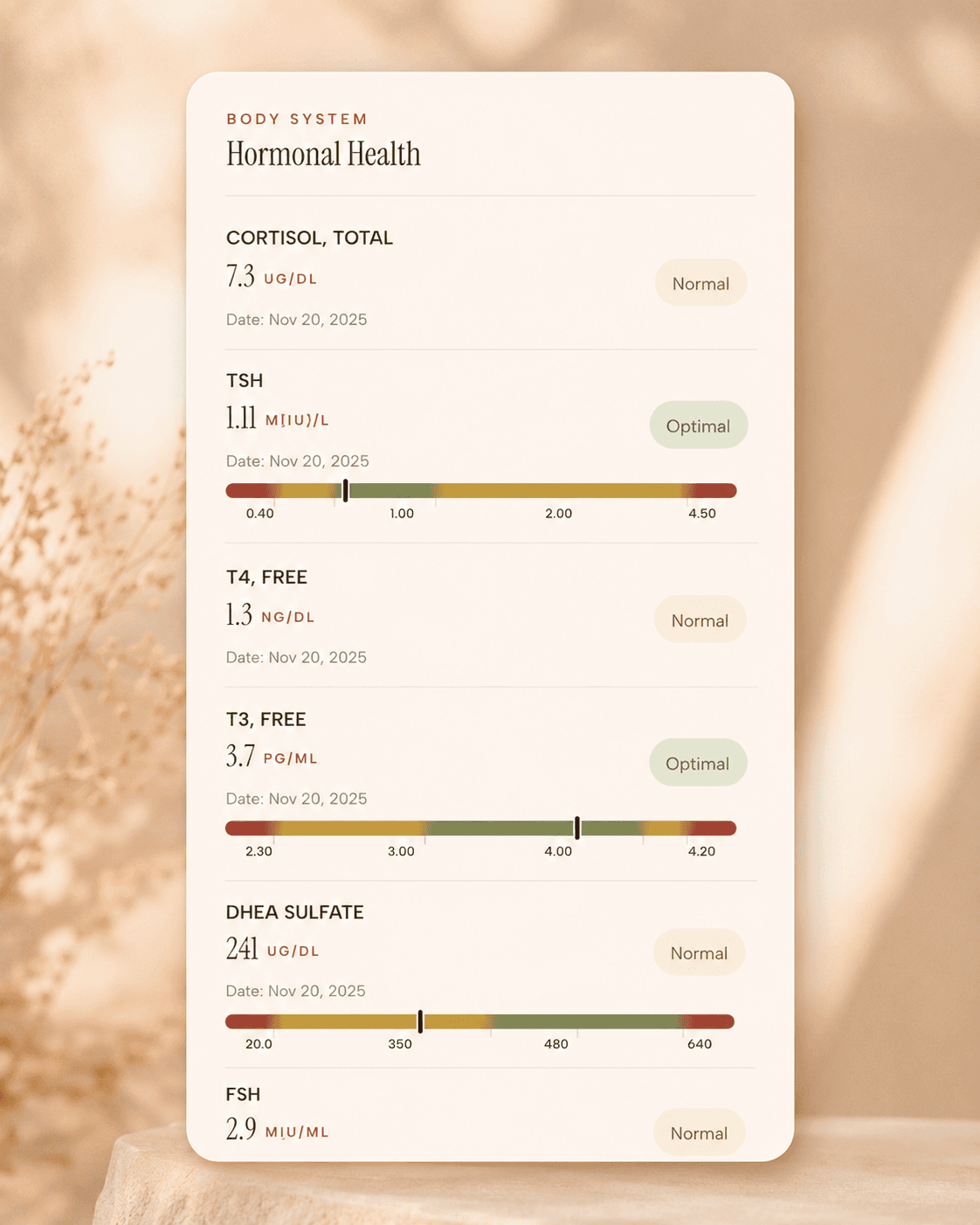
Lab testing
Check the hormones and thyroid markers most relevant to midlife symptoms
including FSH, estradiol, TSH, and cortisol
with our starting-from-$99 panel covering 100+ tests, one visit, no referral needed
About 1 week
Schedule online — results typically within a week
Clear next steps
Guidance included, with follow-up care available
HSA / FSA
Eligible for pre-tax health spending accounts
Why This Is Getting Attention Now
PMDD and menopause share a hormonal root
Women who experienced severe premenstrual dysphoric disorder [PMDD] — the intense mood disruption that arrives in the week before a period — are now understood to be at higher risk for a more difficult perimenopause transition. Both conditions involve an unusual sensitivity to the normal rise and fall of progesterone, which means your history of PMDD is clinically relevant information your doctor should know about, even if no one ever connected those dots for you.
Frozen shoulder is showing up in the conversation
Adhesive capsulitis [frozen shoulder] — a painful, progressive stiffening of the shoulder joint — affects women at roughly twice the rate of men and peaks in the same age window as perimenopause. Estrogen receptors exist in joint tissue, and declining estrogen appears to increase inflammation and reduce the lubrication that keeps joints moving freely. Most women with frozen shoulder are never told this connection exists.
Patients are arriving better prepared than ever
Social media has given women a shared vocabulary for experiences they previously thought were unique to them, and that is changing the dynamic in exam rooms. More women are arriving with specific questions, printed symptom timelines, and a clearer sense of what they want from the visit — which is exactly the kind of preparation that makes a short appointment more productive.
How the Gap Shows Up in Real Symptoms
Brain fog gets labeled anxiety or depression
The cognitive cloudiness that many women experience in perimenopause — difficulty finding words, trouble concentrating, a sense that your thinking is slower — is a recognized neurological effect of fluctuating estrogen, which acts directly on brain regions involved in memory and focus. When this symptom arrives without hot flashes, it is frequently attributed to stress or early depression, and the hormonal piece goes uninvestigated.
Joint pain and muscle aches get dismissed as aging
Estrogen has anti-inflammatory properties throughout the body, so when levels begin to drop in the years before your final period, widespread joint and muscle discomfort often follows. Because this pain is diffuse rather than localized, and because it arrives gradually, it rarely triggers the kind of workup that would reveal its hormonal origin — it just gets absorbed into the general category of 'getting older.'
Heart palpitations get misread as panic attacks
Irregular or racing heartbeats are a common but underappreciated menopause symptom, driven by the same instability in the body's temperature-regulating center [hypothalamus] that causes hot flashes. Because palpitations are also a classic sign of anxiety, women presenting with them are often started on anti-anxiety medication before anyone checks their hormone levels or rules out thyroid dysfunction.
How to Advocate for Yourself
Build a symptom timeline before your appointment
A one-page written summary of when your symptoms started, how they have changed, and what makes them better or worse is more useful in a 15-minute visit than trying to recall everything on the spot. Include your menstrual cycle changes, any history of PMDD or postpartum depression, and any new physical symptoms like joint stiffness — because your doctor may not ask about all of these unless you raise them.
Ask specifically about hormone-related causes
If your doctor attributes your symptoms to stress or aging, it is completely reasonable to ask: 'Could this be related to perimenopause or a hormonal shift?' and 'What labs would help us rule that in or out?' Knowing your estradiol, FSH, and thyroid levels gives both you and your clinician a concrete starting point rather than a guessing game.
Request a longer appointment or a follow-up focused on one issue
If you have several overlapping concerns, ask the scheduler for a longer slot or book a dedicated follow-up for the issues that did not get addressed. This is not demanding — it is how you get the care you need within a system that was not designed for complexity. Some telehealth platforms, including PocketMD, allow more flexible visit lengths specifically for this kind of multi-symptom conversation.
Risks and Realities to Know
Not every midlife symptom is hormonal
Thyroid disorders, autoimmune conditions, and cardiovascular disease all become more common in midlife and can produce symptoms that closely resemble perimenopause — fatigue, mood changes, joint pain, and irregular heartbeat among them. This is why lab work matters: it helps distinguish a hormonal cause from something else that needs its own treatment plan.
Self-diagnosis from social media has real limits
The growing online conversation about women's health is genuinely valuable for building awareness and reducing shame, but it can also lead women to arrive at appointments convinced of a diagnosis before any testing has been done. The goal of self-education is to ask better questions, not to replace the clinical evaluation that actually confirms what is going on.
Hormone therapy is not right for everyone, and that is okay
If your evaluation does point to a hormonal cause, treatment options range from lifestyle changes to prescription hormone therapy [HT], and the right choice depends on your personal health history, risk factors, and preferences. A clinician who is well-versed in menopause medicine can walk you through the current evidence — which is more nuanced and more favorable toward HT than it was 20 years ago — so you can make an informed decision rather than a fearful one.
Frequently Asked Questions
Why do doctors miss menopause symptoms so often?
A combination of factors is at work: medical training historically underemphasized menopause, symptoms like brain fog and joint pain overlap with many other conditions, and the standard 15-minute appointment rarely leaves enough time to explore a complex hormonal picture. The result is that women are frequently treated for the surface symptom — anxiety, depression, or 'normal aging' — without anyone investigating whether hormonal changes are the underlying driver.
Is there a connection between PMDD and a harder menopause?
Yes, and it is one of the more clinically important links that often goes unmentioned. Both PMDD and a difficult perimenopause transition appear to involve heightened sensitivity to fluctuating progesterone levels, so a history of severe premenstrual symptoms is a meaningful signal that your hormonal transition may need closer monitoring and support. If you had PMDD or severe postpartum depression, tell your clinician — it is relevant information.
Can frozen shoulder really be caused by menopause?
The connection is not fully proven in the way a drug trial would prove it, but the epidemiological overlap is striking: frozen shoulder peaks in women between 40 and 60, affects women at twice the rate of men, and estrogen receptors have been identified in shoulder joint tissue. Declining estrogen is a plausible contributing factor, and knowing this may change how aggressively you pursue treatment rather than waiting for it to resolve on its own.
What labs should I ask for if I think my symptoms are hormonal?
A reasonable starting panel includes estradiol, FSH, thyroid-stimulating hormone [TSH], and free T3 and T4 — because thyroid dysfunction mimics many menopause symptoms and needs to be ruled out. Depending on your symptoms, your clinician might also check cortisol, a complete blood count, or inflammatory markers. Vitals Vault's starting-from-$99 panel covers more than 100 markers and does not require a referral.
How do I make the most of a short doctor's appointment?
Write down your top two or three concerns before you go, rank them by priority, and lead with the most important one rather than saving it for the end. Bringing a one-page symptom summary — including when things started and what you have already tried — helps your doctor get oriented quickly and leaves more time for actual problem-solving. If your concerns are not fully addressed, it is appropriate to ask for a follow-up appointment dedicated to the remaining issues.