Thyroid Symptoms & the Gray Zone Between Normal and Sick
Your thyroid labs came back normal, but you are exhausted, gaining weight without explanation, freezing when everyone else is comfortable, and your brain feels like it is running through wet concrete.


Your thyroid labs came back normal, but you are exhausted, gaining weight without explanation, freezing when everyone else is comfortable, and your brain feels like it is running through wet concrete. That gap — between what the numbers say and what your body is telling you — is real, and it has a name: the thyroid gray zone. Understanding how your thyroid works, what standard tests actually measure, and what they can miss is the first step toward getting answers that match your experience. Thyroid dysfunction is one of the most common hormonal problems in adults, yet it is also one of the most frequently under-diagnosed because the standard reference ranges were built on population averages rather than individual optimal function. If you have been dismissed with a normal TSH result but still feel wrong, you are not imagining things — and you deserve a more complete conversation. Vitals Vault's at-home lab panels include thyroid markers so you can walk into that conversation with data already in hand, and PocketMD can help you interpret what you find.
Why this is trending
Peter Attia dedicated a full listener-question episode this month to thyroid health, walking through physiology, lab interpretation, and the clinical gray zone in unusual depth. The response from his audience was immediate — the episode surfaced a widespread frustration that standard thyroid testing leaves a lot of symptomatic people without answers or treatment. That frustration is not new, but the level of nuanced public discussion around it is. What is actually new is the growing body of research questioning whether the TSH reference range used in most clinics is too wide to catch early or mild dysfunction, particularly in women and older adults. Functional medicine practitioners have been raising this for years, but mainstream endocrinology is now beginning to engage with the question more seriously. The conversation has moved from fringe to legitimate debate — which means it is a good time to understand the science well enough to participate in it with your own doctor.
What the Thyroid Actually Does
Your thyroid is the body's metabolic thermostat
The thyroid gland sits at the base of your throat and produces hormones that regulate how fast or slow virtually every cell in your body runs — your heart rate, body temperature, digestion, mood, and energy production all depend on it. When output is even slightly off, the effects ripple through almost every system, which is why thyroid symptoms can feel so diffuse and hard to pin down.
The hormone chain that controls everything
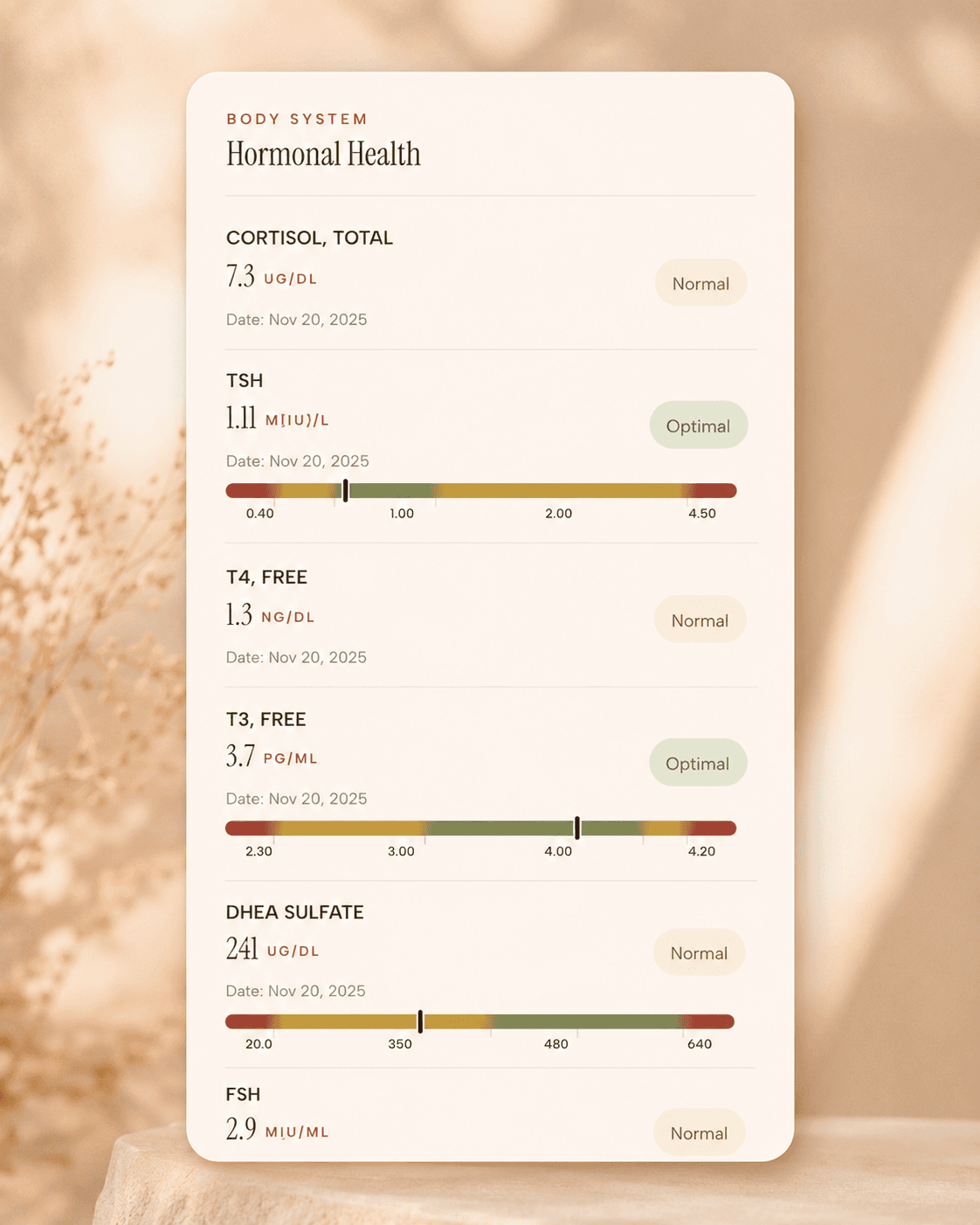
The system works as a feedback loop: a part of your brain called the pituitary gland releases thyroid-stimulating hormone (TSH), which tells your thyroid to produce thyroxine (T4). Most of that T4 is then converted in your liver, gut, and other tissues into the more active form, triiodothyronine (T3), which is what your cells actually use. A standard blood test usually only measures TSH, which means it is checking the signal being sent — not whether your body is successfully acting on it.
Why the gray zone exists at all
The reference ranges printed on your lab report were derived from large population studies, and they include people who may have had undetected mild dysfunction themselves — which can make the 'normal' band wider than it should be for any individual. Your personal optimal TSH level may sit at a different point in that range than someone else's, and symptoms can appear well before a number crosses the clinical threshold for treatment.
Lab testing
Check your TSH, free T4, free T3, and thyroid antibodies with Vitals Vault's starting-from-$99 panel covering 100+ tests in one visit
no referral needed
About 1 week
Schedule online — results typically within a week
Clear next steps
Guidance included, with follow-up care available
HSA / FSA
Eligible for pre-tax health spending accounts
Why This Is Getting So Much Attention Right Now
A high-profile deep dive sparked a wider conversation
When a physician with a large, medically engaged audience spends an entire episode on thyroid nuance — covering everything from lab interpretation to when treatment is and is not warranted — it signals that the topic has outgrown the standard five-minute clinical explanation. Listeners who have felt dismissed by a normal TSH result are now arriving at their doctor's office with better questions.
Women are disproportionately affected and often under-served
Thyroid conditions are roughly five to eight times more common in women than men, and the symptoms — fatigue, weight changes, mood shifts, brain fog — overlap heavily with perimenopause, depression, and anxiety, which means thyroid dysfunction is frequently attributed to something else first. The growing conversation around the women's health diagnosis gap has brought thyroid testing back into focus as a place where earlier, more thorough investigation could make a real difference.
Direct-to-consumer lab access changed what patients can do
A few years ago, getting a full thyroid panel — including free T3 and thyroid antibodies — required a physician referral and often a specific clinical indication. Now people can order their own panels, arrive at appointments with complete data, and have a more equal conversation about what the numbers mean. That shift in access has made the gray zone discussion practical rather than theoretical.
How Standard Testing Can Miss the Picture
TSH alone tells an incomplete story
TSH reflects what your pituitary is asking for, but it does not tell you whether your thyroid is delivering, or whether the hormone being delivered is converting properly into its active form. Someone with a TSH in the normal range can still have low free T3 if conversion is impaired — and low T3 is what actually causes symptoms like fatigue and cold intolerance.
The reference range debate is real and ongoing
Several researchers have argued that the upper limit of the normal TSH range — typically around 4.0 to 4.5 mIU/L in most labs — is too permissive, and that many people with TSH levels between 2.5 and 4.5 who have symptoms would benefit from further evaluation. This is not settled science, but it is a legitimate clinical debate, not fringe thinking, and it is worth raising with your doctor if your TSH sits in the upper half of normal and you feel unwell.
Thyroid antibodies can predict problems years in advance
Hashimoto's thyroiditis — an autoimmune condition where your immune system gradually attacks your thyroid — is the most common cause of hypothyroidism in developed countries, and it can be present for years before TSH shifts out of range. Testing for thyroid peroxidase antibodies (TPO antibodies) can identify this process early, giving you and your doctor a reason to monitor more closely rather than waiting for the numbers to deteriorate.
Symptoms matter as much as numbers in clinical decision-making
Good thyroid medicine treats the person, not just the lab value. Research consistently shows that symptom burden does not correlate perfectly with TSH levels — some people feel fine with a TSH of 4.0 and others feel terrible at 2.5. Tracking your symptoms systematically and bringing that record to your appointment gives your doctor information that a blood test simply cannot capture.
How to Advocate for Yourself Effectively
Ask for a complete panel, not just TSH
When you request thyroid testing, specifically ask for free T4, free T3, and TPO antibodies in addition to TSH — and ask for the actual numbers, not just whether they are 'normal.' Knowing where in the range your values fall, and whether antibodies are present, gives you and your doctor a much more complete picture than a single number.
Keep a symptom log before your appointment
Tracking when you feel most fatigued, when brain fog is worst, whether your body temperature runs low, and how your weight is behaving — even just for two to three weeks — turns subjective complaints into a pattern your doctor can work with. Noting what you ate, how you slept, and your stress level alongside symptoms can also help rule out other contributors.
Frame the conversation around function, not just thresholds
Rather than asking 'is my thyroid normal,' try asking 'given my symptoms and where my values sit in the range, is there a reason to monitor more closely or consider a trial of treatment?' That framing invites a clinical judgment conversation rather than a binary pass-or-fail answer, and it signals that you understand the nuance — which tends to produce a more thorough response.
Risks and Caveats Worth Knowing
Treating a normal thyroid carries real risks
Thyroid hormone replacement when it is not needed can push your system into a state of excess (hyperthyroidism), which causes its own serious problems — including heart rhythm disturbances, bone loss over time, and anxiety. The gray zone conversation is about better evaluation, not about pushing for treatment without clinical justification.
Several conditions can mimic thyroid symptoms exactly
Fatigue, weight changes, cold sensitivity, and brain fog are also caused by iron deficiency, vitamin D deficiency, sleep apnea, perimenopause, depression, and several other conditions — so a full thyroid panel is a starting point for investigation, not a final answer. If your thyroid markers come back genuinely normal, it is worth pursuing those other possibilities rather than assuming the thyroid is the culprit.
Online thyroid communities can amplify misinformation
Some corners of the internet advocate strongly for specific thyroid treatments — particularly desiccated thyroid extract over synthetic levothyroxine — based on personal testimonials rather than consistent clinical evidence. Both approaches have a place in medicine depending on the individual, but the choice should be made with a knowledgeable physician based on your specific labs and symptoms, not on forum consensus.
Frequently Asked Questions
Can my TSH be normal and I still have a thyroid problem?
Yes, and this is the core of the gray zone debate. TSH can sit within the reference range while free T3 is low, conversion from T4 to T3 is impaired, or thyroid antibodies are already elevated — all of which can cause real symptoms. A complete panel rather than TSH alone gives a much more accurate picture of what is actually happening.
What thyroid tests should I ask for beyond TSH?
The most useful additions are free T4, free T3, and TPO antibodies. Free T4 tells you how much hormone your thyroid is producing, free T3 tells you how much active hormone is available to your cells, and TPO antibodies can detect an autoimmune process years before TSH shifts out of range. Reverse T3 is sometimes measured as well, though its clinical significance is more debated.
What TSH level is considered optimal, not just normal?
This is genuinely contested. Most labs flag TSH as abnormal above 4.0 to 4.5 mIU/L, but some researchers and clinicians argue that optimal function for many people sits between 1.0 and 2.5 mIU/L. There is no single right answer because individual variation is real — what matters is how you feel alongside where your number sits, not the number in isolation.
What is Hashimoto's and how do I know if I have it?
Hashimoto's thyroiditis is an autoimmune condition where your immune system gradually damages your thyroid tissue, eventually reducing its ability to produce enough hormone. It is diagnosed by finding elevated TPO antibodies in your blood, often alongside an ultrasound showing a characteristic texture change in the gland. Many people have Hashimoto's for years with a normal TSH before hypothyroidism develops, which is why antibody testing matters even when TSH looks fine.
Should I try thyroid medication if I'm symptomatic but my labs are normal?
This is a decision that genuinely requires a physician who knows your full picture — your symptoms, your complete panel, your other health factors, and your history. A therapeutic trial of low-dose thyroid hormone is sometimes appropriate in the gray zone, but it carries risks if your thyroid is actually functioning well, and it should never be self-prescribed. If your current doctor is not willing to have this conversation, seeking a second opinion from an endocrinologist or a physician experienced in thyroid nuance is a reasonable step.