Perimenopause Brain Fog: Why Estrogen Causes Cognitive Chaos
Yes, the brain fog, word-finding struggles, and sudden memory blanks you are experiencing during perimenopause are real — and they have a clear neurological explanation rooted in how dramatically estrogen fluctuates before it finally declines.



Yes, the brain fog, word-finding struggles, and sudden memory blanks you are experiencing during perimenopause are real — and they have a clear neurological explanation rooted in how dramatically estrogen fluctuates before it finally declines. This is not early dementia, and it is not in your head in the dismissive sense. It is your brain working harder than usual to manage a hormonal environment that changes week to week, sometimes day to day. Researchers and clinicians have started calling this period the 'zone of chaos' because estrogen does not simply fall during perimenopause — it swings wildly, sometimes spiking higher than it ever did in your reproductive years before crashing. That unpredictability is what makes your brain feel unreliable. If you want to understand what your labs are actually telling you — or not telling you — Vitals Vault's 100+ test panel and PocketMD telehealth line can help you connect the dots between your numbers and your symptoms.
Why this is trending
Conversations about perimenopause brain health have been building for years, but a wave of new content from clinicians like Dr. Mary Claire Haver has pushed the topic into mainstream awareness this week. Her recent work highlights a specific concept — that the brain itself enters a kind of overdrive during perimenopause as it tries to force ovulation in the face of declining ovarian response — and that this neurological effort has real cognitive costs. Her 'menopause masterclass' on why standard lab results can mislead women during this transition has resonated widely because so many women are told their hormones look 'normal' while feeling anything but. What is genuinely new is not the existence of brain fog, which women have reported for decades, but the emerging research on specific estradiol thresholds that may matter for long-term brain and cardiovascular health. The science is still developing, and some of the threshold numbers circulating on social media are ahead of what clinical guidelines currently endorse — which is worth knowing before you walk into your next appointment.
What Is Perimenopause Brain Fog?
A real neurological event, not imagination
Perimenopause brain fog refers to the cluster of cognitive symptoms — difficulty concentrating, forgetting words mid-sentence, struggling to retain new information — that many women experience in the years before their final period. These symptoms arise because estrogen is not just a reproductive hormone; it actively supports the brain's energy metabolism, its ability to form connections between neurons, and its regulation of mood-related chemicals like serotonin and dopamine.
The 'zone of chaos' explained simply
During perimenopause, your ovaries become less predictable in how they respond to signals from the brain, so the part of your brain that controls hormone release (the hypothalamus and pituitary gland) starts sending louder and more frequent signals to compensate. This back-and-forth creates the wild estrogen swings that define perimenopause — and the brain resources devoted to that hormonal push-and-pull are resources temporarily diverted from other cognitive tasks.
Why it feels different from ordinary tiredness
Ordinary fatigue tends to improve with rest, but perimenopause brain fog often persists even after a full night of sleep, partly because sleep architecture itself is disrupted by hormonal fluctuations and night sweats. The cognitive symptoms also tend to be inconsistent — sharp one day, foggy the next — which mirrors the unpredictable pattern of estrogen levels during this transition.
Lab testing
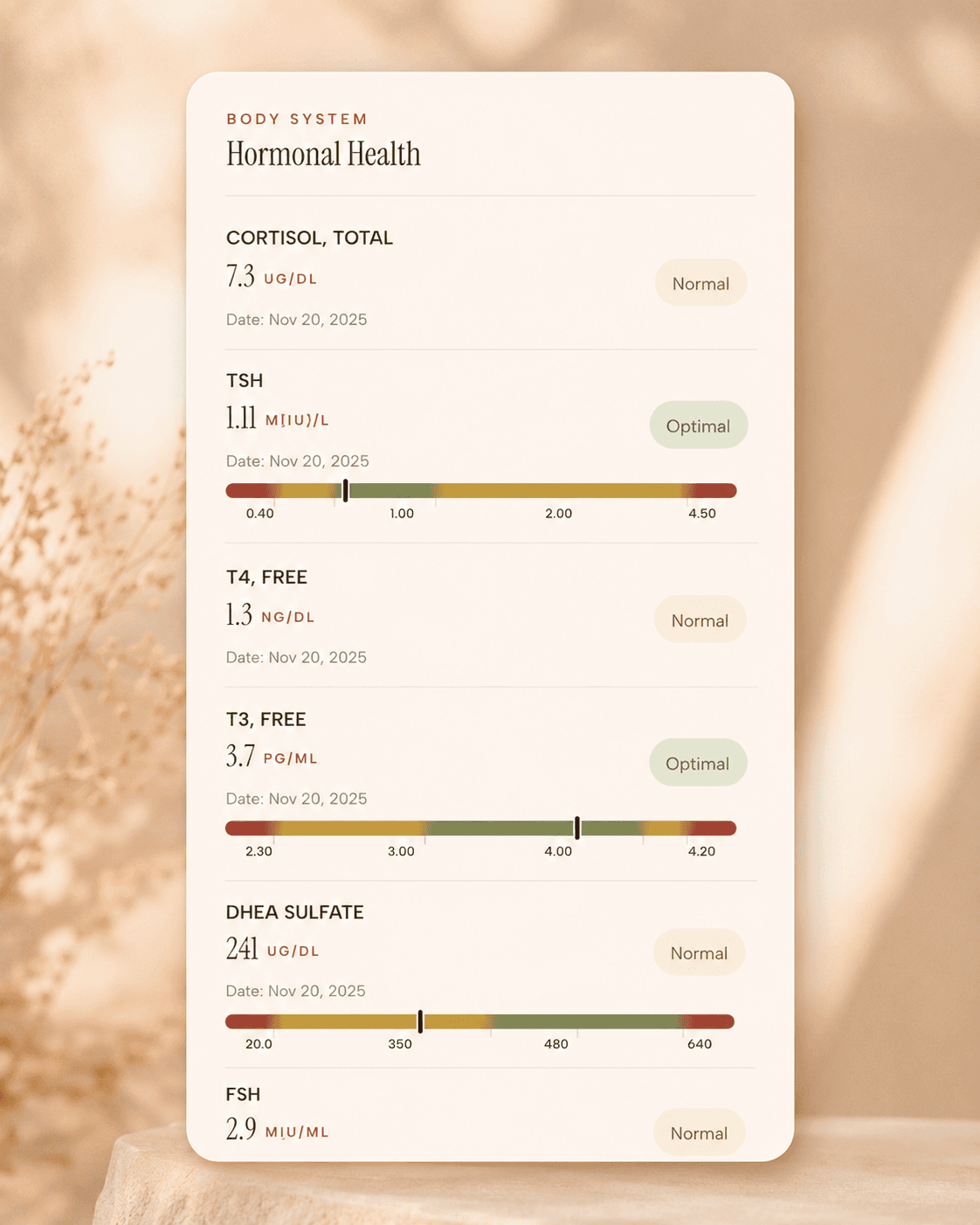
Estradiol, FSH, thyroid, and metabolic markers are all relevant to perimenopause brain symptoms
and our starting-from-$99 panel with 100+ tests covers them in one visit, no referral needed
About 1 week
Schedule online — results typically within a week
Clear next steps
Guidance included, with follow-up care available
HSA / FSA
Eligible for pre-tax health spending accounts
Why This Is Trending Now
Clinicians are naming the mechanism publicly
For a long time, perimenopause cognitive symptoms were acknowledged but rarely explained in mechanistic terms to patients. Clinicians like Dr. Mary Claire Haver are now publicly describing why the brain works harder during perimenopause — framing it as a neurological phenomenon rather than a vague complaint — and that specificity is helping women feel validated and better equipped to advocate for themselves.
New estradiol research is challenging old thresholds
Emerging research suggests that certain estradiol levels may be important not just for symptom relief but for longer-term protection of the heart and bones — and possibly the brain. This is generating real discussion because standard clinical guidelines have not yet caught up with some of these findings, which means women with 'normal' lab values may still be operating below levels that newer data suggests are protective.
The 'normal labs lying to you' conversation
A significant driver of current interest is the recognition that standard hormone panels, interpreted with broad reference ranges, can miss meaningful changes during perimenopause. FSH and estradiol levels fluctuate so much during this transition that a single snapshot can look completely unremarkable even when a woman is experiencing significant symptoms — and that gap between lab results and lived experience is frustrating millions of women into seeking better answers.
How Estrogen Actually Affects Your Brain
Estrogen fuels your brain's energy supply
Your brain accounts for roughly 20 percent of your body's total energy use, and estrogen plays a direct role in how efficiently brain cells (neurons) burn glucose for fuel. When estrogen levels drop or become erratic, some neurons temporarily switch to burning fats instead — a less efficient process that researchers believe contributes to the mental sluggishness and fatigue many women describe. This metabolic shift is one reason cognitive symptoms often appear before periods become irregular.
Estrogen shapes how neurons talk to each other
Estrogen promotes the growth and maintenance of the connections between neurons (synapses), particularly in the hippocampus — the brain region most responsible for forming new memories. Fluctuating estrogen does not destroy these connections, but it does make them less stable, which is why memory encoding (the process of turning an experience into a stored memory) becomes less reliable during perimenopause. The good news is that this appears to be largely reversible as hormonal stability returns.
The hypothalamus pays a cognitive price
The part of your brain that orchestrates the hormonal signaling cascade (the hypothalamus) is also involved in regulating body temperature, sleep, mood, and stress responses. When it is working overtime to try to trigger ovulation in the face of declining ovarian reserve, those other functions can be affected — which is why hot flashes, sleep disruption, and anxiety so often accompany brain fog rather than appearing in isolation. They share a common upstream cause.
What the Research Actually Shows
Cognitive symptoms are well-documented and temporary for most
Multiple large studies, including data from the Study of Women's Health Across the Nation (SWAN), have confirmed that verbal memory and processing speed do decline measurably during the perimenopause transition. Importantly, the same research shows that for most women these changes stabilize or improve after menopause, suggesting the fluctuation itself — not the absence of estrogen — is the primary driver of symptoms.
Estradiol thresholds for brain protection are promising but preliminary
Some researchers have proposed that maintaining estradiol above certain levels during the perimenopause window may reduce long-term risk of cognitive decline and Alzheimer's disease, a concept sometimes called the 'critical window hypothesis.' The evidence here is genuinely interesting but not yet strong enough to justify specific numerical targets in clinical practice — and some of the threshold numbers circulating on social media are extrapolated from observational data rather than randomized trials.
Timing of hormone therapy appears to matter significantly
The critical window hypothesis suggests that starting hormone therapy closer to the onset of perimenopause — rather than years after the final period — may offer more neurological benefit. Studies that found neutral or negative effects of hormone therapy on cognition often enrolled women who were already a decade or more past menopause, which is a meaningfully different hormonal environment. This distinction is important context for any conversation with your clinician about hormone therapy.
Sleep disruption amplifies cognitive symptoms independently
Research consistently shows that even one or two nights of fragmented sleep impairs the same memory and attention functions that estrogen decline affects — meaning that hot-flash-driven sleep disruption is not just an inconvenience but a direct cognitive stressor layered on top of the hormonal changes. Addressing sleep quality is one of the most evidence-supported levers for improving brain fog during perimenopause, regardless of what other interventions you choose.
What to Watch Out For
Not every cognitive symptom is perimenopause
Thyroid dysfunction, iron deficiency anemia, vitamin B12 deficiency, and anxiety disorders can all produce brain fog that closely resembles perimenopause-related cognitive changes — and they are worth ruling out with a blood panel before attributing everything to hormones. If your symptoms are severe, progressing rapidly, or accompanied by significant personality changes, that warrants a more thorough evaluation rather than a wait-and-see approach.
Social media estradiol targets are not clinical guidelines
The specific estradiol numbers you may have seen discussed online as 'protective thresholds' are drawn from preliminary research and individual clinical opinion, not from established guidelines by major medical bodies. This does not mean the research is wrong or unimportant — it means the evidence is still developing, and decisions about hormone therapy should be made with a clinician who knows your full health history, not based on a target number from a short video.
Hormone therapy is not right for everyone
For women with a personal or strong family history of certain hormone-sensitive cancers, blood clots, or cardiovascular disease, the risk-benefit calculation for hormone therapy is genuinely more complex. The goal of understanding the brain mechanisms behind perimenopause is not to push everyone toward a single solution — it is to help you have a more informed conversation with your doctor about what your options actually are.
Frequently Asked Questions
Is perimenopause brain fog permanent?
For most women, the most disruptive cognitive symptoms are tied to the transition period itself — when estrogen is fluctuating most erratically — rather than to low estrogen per se. Research from long-term studies suggests that verbal memory and processing speed tend to stabilize after the final menstrual period for the majority of women. If symptoms are severe or worsening rather than fluctuating, it is worth getting a full workup to rule out other contributing factors like thyroid issues or sleep disorders.
Why do my hormone labs look normal when I feel terrible?
Estrogen and FSH levels during perimenopause can swing dramatically within a single menstrual cycle, which means a blood draw on any given day may catch you at a relatively stable moment that looks unremarkable on paper. Standard reference ranges are also quite broad and were not designed to capture the meaningful fluctuations of perimenopause. Tracking symptoms alongside lab results over time — rather than relying on a single snapshot — gives a much more useful picture of what is actually happening.
Can exercise help with perimenopause brain fog?
Yes, and the evidence here is fairly strong. Aerobic exercise increases blood flow to the brain, supports the growth of new neurons in the hippocampus, and improves sleep quality — all of which directly address the mechanisms behind perimenopause-related cognitive symptoms. Resistance training also appears to have independent benefits for cognitive function in midlife women, separate from its effects on bone density and metabolism.
What is the critical window hypothesis for hormone therapy and the brain?
The critical window hypothesis proposes that starting hormone therapy during or shortly after perimenopause — when the brain's estrogen receptors are still responsive — may offer more neurological benefit than starting it years after menopause. Studies that found no cognitive benefit or even harm from hormone therapy often enrolled women who were already 10 or more years past their final period, which may represent a different biological situation. This is an active area of research, and the evidence is promising but not yet definitive enough to set specific timing guidelines.
Should I test my estradiol levels during perimenopause?
Testing estradiol during perimenopause can be informative, but a single result needs to be interpreted carefully given how much levels fluctuate. More useful is testing alongside FSH, thyroid function, and metabolic markers to build a broader picture of what is driving your symptoms. Vitals Vault's 100+ test panel covers these markers in one visit, and a PocketMD clinician can help you interpret what the numbers mean in the context of how you actually feel.