Hair Loss Women Over 40: Hormones & Blood Tests
If your hair is thinning after 40 and your doctor told you it's probably just stress, they may be missing the real story.



If your hair is thinning after 40 and your doctor told you it's probably just stress, they may be missing the real story. The most common cause of hair loss in women during perimenopause and menopause is hormonal — and it shows up in blood work that is rarely ordered unless you ask for it specifically. The good news is that once you know which hormones and nutrients to look at, you have a clear path forward instead of a shrug and a referral to a dermatologist. Vitals Vault's at-home lab panels include many of the markers discussed here, and if you want to talk through your results with a clinician, PocketMD is available by phone. But first, let's make sense of what is actually happening to your hair.
Why this is trending
Conversations about female hair loss have been building in the perimenopause community for a couple of years, but they reached a new level of specificity recently when clinicians started naming the exact blood tests women should request — not just saying 'get your hormones checked.' Dr. Mary Claire Haver, an OB-GYN who focuses on menopause medicine, published several short videos this week walking through why women's hair loss is so frequently misdiagnosed and which lab values are most likely to reveal the real cause. The content resonated because it gave women something concrete to bring to their next appointment. What is actually new here is not the biology — we have known for decades that hormones affect hair follicles — but the growing recognition that standard annual bloodwork almost never includes the markers most relevant to hair loss. Women are increasingly arriving at appointments informed and asking better questions, which is pushing the conversation forward.
What Is Hormonal Hair Loss in Women?
A pattern that looks different from men's baldness
Hormonal hair loss in women most often shows up as a widening part, overall thinning across the top of the scalp, or a ponytail that feels noticeably thinner than it used to. Unlike the receding hairline pattern common in men, women tend to lose density diffusely, which makes it easy to dismiss as normal aging or overlook in a standard exam.
The follicle is alive but shrinking
The medical term for the most common pattern is female-pattern hair loss [androgenetic alopecia], and it happens because hair follicles gradually miniaturize — they produce thinner, shorter strands until eventually they stop producing visible hair at all. The follicle is not dead, which is why catching this early and addressing the hormonal drivers can actually make a difference.
Hormones are the trigger, not just a contributing factor
Estrogen helps keep hair in its growth phase longer, so when estrogen drops during perimenopause, hair cycles speed up and more strands enter the shedding phase at once. At the same time, the relative rise in androgens — male-type hormones that all women carry — can shrink follicles on the scalp, which is why the hormonal shift of midlife hits hair from two directions simultaneously.
Lab testing
Check the markers that matter most for hair loss
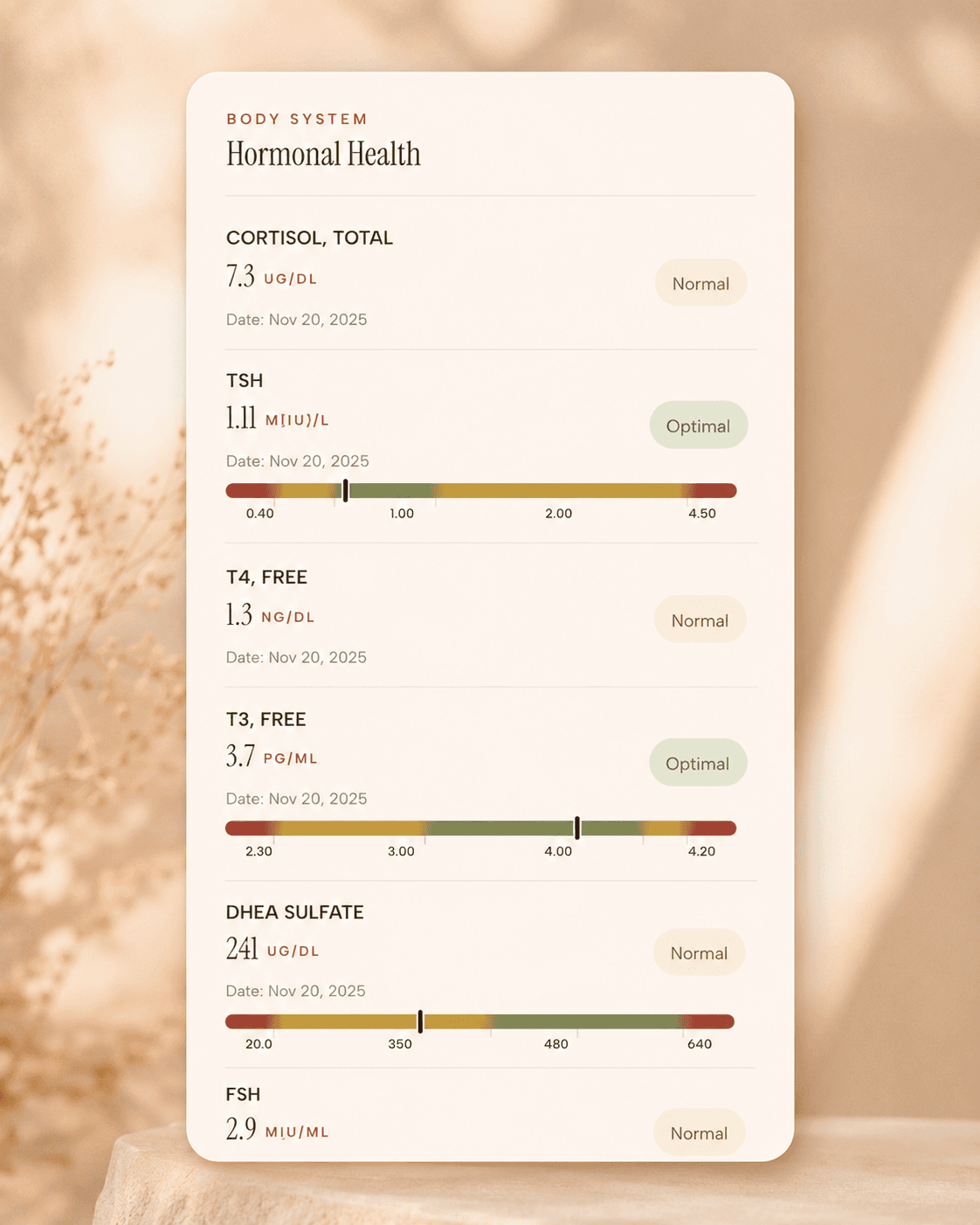
including ferritin, thyroid function, free testosterone, DHEA-S, and estradiol
with Vitals Vault's starting from $99 panel with 100+ tests, one visit
About 1 week
Schedule online — results typically within a week
Clear next steps
Guidance included, with follow-up care available
HSA / FSA
Eligible for pre-tax health spending accounts
Why This Is Getting Attention Now
Women are being told it's stress when it's hormones
One of the most consistent frustrations in the perimenopause community is that hair loss gets attributed to stress, poor diet, or 'just getting older' when the actual driver is a measurable hormonal shift. This misdiagnosis matters because stress-focused advice — sleep more, relax, take biotin — does nothing for a follicle that is being miniaturized by androgens or starved of iron.
The specific blood tests are rarely ordered by default
A standard annual physical might check your thyroid-stimulating hormone [TSH] and a basic metabolic panel, but it almost never includes free testosterone, DHEA-S, ferritin, or estradiol — the markers most likely to explain hair thinning in a woman over 40. Women are now learning to ask for these by name, and that shift in self-advocacy is driving a lot of the current conversation.
Menopause medicine is finally catching up
For years, hair loss in midlife women was treated as a cosmetic concern rather than a symptom worth investigating. The growing field of menopause medicine is changing that framing, treating hair thinning as a legitimate clinical signal that deserves the same workup as fatigue or brain fog. That cultural shift in medicine is what makes this moment feel different from previous waves of interest in the topic.
How Your Hormones Actually Affect Your Hair
Estrogen keeps hair growing longer before it sheds
Your hair grows in cycles, and estrogen extends the growth phase [anagen] so that each strand stays on your head longer before it falls out. When estrogen drops in perimenopause, that growth phase shortens, and you may notice more hair on your brush or in the shower drain — not because new loss is happening, but because the normal shedding cycle is accelerating.
Androgens shrink the follicle itself
Testosterone converts in the scalp to a more potent form called dihydrotestosterone [DHT], and DHT is the molecule that actually binds to follicle receptors and causes them to miniaturize over time. Women with higher free testosterone or higher sensitivity to DHT are more vulnerable to this, which is why checking free testosterone and DHEA-S — a precursor hormone made by your adrenal glands — is part of a proper workup.
Thyroid and iron are the two most overlooked pieces
An underactive thyroid [hypothyroidism] slows the entire hair cycle and is one of the most common reversible causes of diffuse hair thinning in women — yet a full thyroid panel including free T3 and free T4 is often skipped in favor of TSH alone. Low ferritin, the stored form of iron, is equally important: your body will sacrifice hair follicle function to protect essential organs when iron stores are low, and ferritin can be depleted even when your standard hemoglobin looks normal.
The Blood Tests Worth Asking For
Ferritin: the single most underordered marker
Research consistently shows that women with hair loss have lower ferritin levels than those without, and some studies suggest that ferritin below 70 ng/mL may impair hair growth even when you are not technically anemic. The frustrating part is that many labs flag ferritin as 'normal' at levels as low as 12 ng/mL, so ask your clinician what your actual number is rather than accepting a binary normal/abnormal answer.
Full thyroid panel, not just TSH
TSH tells you whether your pituitary is signaling the thyroid to work harder, but it does not tell you how much active thyroid hormone is actually reaching your cells. Free T3 and free T4 give you that picture, and thyroid antibodies [anti-TPO] can reveal autoimmune thyroid disease [Hashimoto's] that may be suppressing function before TSH even moves out of range.
Free testosterone and DHEA-S for the androgen picture
Total testosterone is less useful here because most of it is bound to proteins and unavailable to your tissues — free testosterone is what actually acts on your follicles. DHEA-S reflects adrenal androgen production and tends to rise relative to estrogen in perimenopause, which can tip the hormonal balance toward follicle miniaturization even in women who would not consider themselves 'high androgen.'
Estradiol and sex hormone-binding globulin together
Estradiol is the main form of estrogen that protects hair follicles, and checking it gives you a direct read on how much protection your follicles are currently getting. Sex hormone-binding globulin [SHBG] matters because it determines how much of your testosterone is free versus bound — low SHBG means more free testosterone is available to act on your scalp, even if your total testosterone looks unremarkable.
What to Watch Out For
Not all hair loss is hormonal — and timing matters
Sudden, patchy hair loss or loss in unusual patterns can signal autoimmune conditions like alopecia areata, scalp infections, or medication side effects, and those need a different workup entirely. If your hair loss came on rapidly over weeks rather than gradually over months or years, that is worth flagging to a dermatologist rather than assuming it is perimenopause.
Supplements marketed for hair loss are mostly ahead of the evidence
Biotin is the most heavily marketed supplement for hair, but research only supports it for people with a true biotin deficiency — which is rare. High-dose biotin can also interfere with thyroid and cardiac lab tests, so if you are taking it, tell your clinician before bloodwork. Saw palmetto and other DHT-blocking supplements have some preliminary evidence but are not a substitute for addressing an underlying hormonal imbalance.
Lab results need clinical context, not just a reference range
A ferritin of 15 ng/mL might sit inside your lab's reference range but still be functionally low for hair health. Similarly, a free testosterone that looks 'normal' for your age group might still be high enough relative to your estrogen to drive follicle miniaturization. This is why having a clinician who understands the interplay of these markers — not just whether each number falls in a box — makes a real difference in getting useful answers.
Frequently Asked Questions
What blood tests should I ask my doctor to run for hair loss?
The most useful starting panel includes ferritin, a full thyroid panel with free T3, free T4, and anti-TPO antibodies, free testosterone, DHEA-S, estradiol, and sex hormone-binding globulin. Standard annual bloodwork almost never includes all of these, so you will likely need to ask for them specifically. Vitals Vault's panels cover most of these markers in a single visit.
Can low estrogen really cause hair loss?
Yes — estrogen extends the phase of the hair cycle where strands are actively growing, so when estrogen drops during perimenopause, more hairs shift into the shedding phase at the same time. This often shows up as increased shedding or a noticeably thinner ponytail rather than a receding hairline. Addressing the estrogen decline, whether through hormone therapy or other means, can slow or partially reverse this process for many women.
What ferritin level is considered too low for hair health?
Most hair loss researchers suggest that ferritin below 70 ng/mL may impair hair growth, even though many labs mark anything above 12 ng/mL as normal. This gap between the lab reference range and the functional threshold for hair health is one of the most common reasons women are told their iron is fine when it is actually contributing to their thinning. Always ask for your actual ferritin number rather than just a normal or abnormal result.
Is hair loss from hormones permanent?
Not necessarily — because the follicle miniaturizes rather than dies outright, catching the hormonal imbalance early and addressing it can allow follicles to recover and produce thicker strands again. How much recovery is possible depends on how long the imbalance has been present and how miniaturized the follicles have become. Early intervention consistently produces better outcomes than waiting until the thinning is severe.
Why do doctors miss hormonal hair loss so often in women?
Part of the problem is that hair loss in women has historically been treated as a cosmetic issue rather than a clinical symptom, so the workup is often superficial or skipped entirely. Standard annual bloodwork does not include the specific markers most relevant to hair loss, and without a clinician who is familiar with menopause medicine, the dots between hormonal shifts and follicle changes often go unconnected. The growing awareness in the perimenopause community is helping women advocate for more thorough testing.